Category Archives: Consumer Issues

WAPO, Your Bezos Is Showing

It didn’t take long for the Washington Post to launch a hysterical attack on the choice of the voters in New York City who, apparently tired of the way things have been run, chose convincingly between the options presented to them by the democratic process there. Zohran Mamdani drops the mask  https://www.washingtonpost.com/opinions/2025/11/08/zohran-mamdani-class-warfare-new-york-mayor/  I suppose this is not surprising after Jeff Bezos stopped the paper from endorsing Kamala Harris in the 2024 presidential race. Still, this is the Washington Post, once venerated as one of the leading independent (remember Watergate?) news sources in the country and, indeed, the world.

No more. It’s now apparent that its owner has completely coopted the so-called Editorial Board and revealed his and its acquiescence in the fascist model of government promoted by Donald Trump. Bezos has a lot of money, so he probably doesn’t care much what happens to the paper as it is abandoned by many of its leading thinkers and many also of its subscribers. It is interesting how individuals who amass vast fortunes become indifferent to the needs and wants of the people whose patronage created those fortunes.

Mr. Bezos has aligned himself, and his newspaper, with Donald Trump, a man who has no respect for the Constitution he swore to uphold, no respect for anything that does not serve his personal interests. The Post’s Editorial Board (EB) has now gone full Trump by attacking the choice made by the voters of New York City. The EB apparently no longer believes in democracy. Maybe it’s time for the Post to change its name to reflect what it now represents. The paper’s motto still says, “Democracy Dies in Darkness.” But the lights are out at the Post now, and it is dark indeed.

Consider what the EB has said about the choice of New York City’s voters.

They opened by calling him “Generalissimo,” a reference typically applied (though not exclusively) to fascists and dictators. Donald Trump loves to call opponents names and the Post’s EB has apparently gone full in on Trump’s approach. The Post’s EB must be terrified. I watched the same acceptance speech that it did. I saw a young man relishing his hard-earned victory (you don’t win in New York politics the easy way but remember the wisdom of Sinatra: if you can make it there, you can make it anywhere).

I am not going to waste a good Monday with chapter-and-verse discussion of the Post’s new-found discovery that less government is the solution to New York’s (and presumably everyone’s) problems. Note, however, that whoever watched the acceptance speech at the Post failed to note how often Mamdani smiled, how often he spoke of using the power of government to help the general population of the city. Now, suddenly, the Post’s EB has become the voice of the “small government is the best government” crowd while whining that Mamdani mentioned Donald Trump eight times but didn’t utter “growth” even once. The people at the Heritage Foundation must be ecstatic. And it is a fundamental mistake to believe that Donald Trump is an adherent of “small government.” Trump’s “philosophy” is that of the prototypical dictator: “the government is me.” Size is irrelevant.

It is a fundamental truth that humans often hear what they want to hear. That principle applied to the Post’s EB as it listened to Mamdani’s speech. What seems most clear in all this is that the Post editors are terrified that the people of New York City have chosen someone whom the editors don’t trust because they don’t know him. They apparently have not been paying enough attention and now that the people of New York City have spoken, the EB is panicked.

The ”observers” at the Post apparently missed the part of Mamdani’s acceptance speech in which he spoke eloquently about his election being a victory for those “so often forgotten by the politics of our city.” He spoke the importance of keeping hope alive, a vital tenet at a time when hungry people are being cut off from their daily bread by a hostile president who is now threatening the city and Mamdani personally. Trump threatens to punish NYC over Mamdani. Will he arrest new mayor and block funds? https://www.usatoday.com/story/news/politics/2025/11/08/trump-threat-nyc-mayor-mamdani/87133111007/?utm_source=usatoday-newsalert-strada&utm_medium=email&utm_campaign=newsalert&utm_term=hero&utm_content=usat-mclean-nletter01

Trump’s blather aside, perhaps hope comes first and growth follows.

The only real alternative was former governor Andrew Cuomo. I happen to appreciate some aspects of Cuomo’s service as New York’s governor. I wrote about it here: https://shiningseausa.com/2020/05/01/governor-andrew-cuomo-presents/ but also here: https://shiningseausa.com/2023/06/04/appalling-failure-great-city/ It is also true that I was deeply disappointed to learn of the accusations against him from multiple women whose complaints I fully credit. It’s too bad, but it is what it is. Cuomo created his own trouble and paid the price. If the same principles were applied to Donald Trump, he would be sitting in a prison cell right now.

Mr. Cuomo lost the Democratic primary to Mr. Mamdani, ran against him as an independent, and lost again. The people of New York City made their choice in a free and fair election, something that should be respected. Instead, the Post’s EB chose to suck up to Jeff Bezos and, make no mistake, to Donald Trump whose last-minute endorsement of Cuomo failed badly. What the Post’s EB hopes to achieve from this hatchet job on the voters of New York (Mamdani was their clear choice), I can’t imagine.

Finally, compare the approach taken by the New York Times in an opinion piece more appropriately entitled: 6 Ways Mayor Mamdani Can Improve New York https://www.nytimes.com/2025/11/04/opinion/mayor-mamdani-new-york-election.html

Anyone who has lived in New York City (I did for three glorious years [including the decidedly inglorious pandemic year 2020]) and who was paying attention understands the enormous challenges the city presents to anyone trying to engineer major changes. But change is possible if bold thinking is supported. It won’t be easy, but little worth the effort is easy. Instead of whining about Mamdani’s “class consciousness,” the Washington Post would do well to remove its collective head from Donald Trump’s hindquarters and join the parade that the Democratic victories on November 2 suggested were now within reach.

Trump’s Attack on Higher Education-Go on Offense

I have made a habit through my adult life of, when possible, avoiding talking about my education. When asked where I went to college, I have usually just said, “in the east.” I did this because disclosing that I went to Yale would often lead to uncomfortable statements about things about which the inquirer usually knew little. I was certainly not ashamed of having attended Yale, but I also didn’t want to be seen as bragging about having an Ivy League education and conversations about it were often awkward.

The same was true of my law school experience at Harvard. Truth be told, my attendance at both Yale and Harvard were the product of teachers who cared enough to intervene on my behalf, to encourage me to reach high, to achieve way beyond what I imagined was possible for me. The result was an enriched life beyond anything I ever dreamed of. I became a life-long learner, driven perhaps beyond what was healthy at times, but determined not to fail. Yale, in particular, taught me that working hard, and harder still, was the key to success.

My Yale experience, in the early 1960s, was extraordinary in many ways. I will not detail them here. My purpose is different. The Yale of today is, I think, quite different and more imposing than the school I attended. I am certain that Harvard College has also evolved well beyond what was already back then a world-class education and research institution.

The current Trump administration’s attack on these and other major research and institutions of higher learning reflects a view of the world that is alien to everything these schools represent. I have just read that the President of the University of Virginia has resigned to avoid damaging conflict with the federal government under Trump. While the details of President Ryan’s situation at UVA are perhaps unique (he says he was doing to step down next year anyway), the fact remains that the Trump assault on higher education will have profoundly damaging consequences throughout our society.

Since I know Yale the best, I will focus on it. Yale has produced a website entitled Yale’s Impact on America. https://www.yale.edu/yales-impact-america

Did you know, for example, that “Yale’s large-scale clinical trials – 38,000 patients are currently enrolled in over 2,000 clinical trials – are yielding key discoveries that translate into life-saving therapies.” The health issues involve patients with heart issues, Alzheimer’s, and diabetes among other life-threatening maladies.

Did you know that chemotherapy was developed at Yale and is used to help about one million people each year? And the first insulin pump was developed at Yale as well, now helping 350,000 patients a year. The first U.S. artificial heart pump was also produced at Yale and helps six million people suffering from heart failure. And “Yale research led to the discovery of esketamine as a therapy for major depression, which the FDA approved in 2019 as the first new medication in decades for people suffering from treatment-resistant depression.”

I subscribe to Yale Today, a daily publication of the University. It is a rare day that some remarkable achievement in science, medicine or other discipline is not detailed there. On June 27:

Yale School of the Environment researchers have pioneered a novel method for measuring how urbanization is affecting biodiversity in cities, a tool that will help scientists and officials better manage human-wildlife interactions around the world.

On June 23:

Cutting-edge lab technique hints at new era for neuroscience

In a new study, Yale researchers unveil a more efficient method of simultaneously capturing the electrical activity of large numbers of neurons — an advance that opens doors to understanding and treating neurological diseases.

Yale is not alone in this. Harvard makes similar discoveries through original research constantly, as do the other major research universities. Trump and his goons don’t know and don’t care about the potential loss of these benefits as they attempt to reshape the country into a low-education, all-white society.

Yale needs to wake up to the reality that defensive posturing is not going to solve the real problem Trump poses. Yale, like Harvard, has massive resources, including obviously the law school’s cadre of brilliant lawyers. It needs to make clear to the administration that if it does not back off completely, Yale will lead/join a coalition of universities across the country to litigate the administration to death, including, I suggest, asserting personal liability against the perpetrators of these obviously unlawful actions.

Trump and his drone followers (male and female) have shown that they believe they can act as they wish without consequence to themselves. It is no loss to them personally if they disregard the First and Fifth Amendments and other laws by demanding submission to their will and then lose in court. They’ll just come back with something else as bad or worse. The universities should test that, I think. Make the bastards work hard. Put them on defense.

It’s not good enough to talk or call Senators. Even if victorious today politically, Trump will be back tomorrow with another outrage. Having been attacked as Harvard has and as have all the others with tax increases on their endowments, the universities need to recognize this is not a one-off situation. Trump is coming for them. Prepare for the end game and go on offense. Trump and gang are not doing normal politics, and the defense must not be based on the premise that they are.

Democrats and others who believe in preserving democracy must wake up and fight the fight that’s in front of them, not some policy-based game of old-fashioned politics. Those days are over probably forever. Just look at the contents of the bill the House just passed by one vote. One of the two political parties is off the range. and we must fight the fight that is staring at us with dead eyes before it’s too late.

Take the offense and use the considerable communications resources of the universities to inform the public of what they stand to lose if Trump’s no-nothings succeed in suppressing the vital work that the universities perform in addition to teaching some of our best and brightest future leaders. Time is short.

A New York State of Mind

Hopefully you’re familiar with that title of an anthem song about New York City that was written and made famous by Billy Joel. We achieved this euphoric condition last week with four glorious days there.

We took Amtrak as usual on Wednesday, arriving in plenty of time to get squared away in the Luxury Collection Hotel (formerly the Conrad), one of our favorites well-located on West 54th Street. The weather was perfect. We dined at PJ Clarke’s across the street from Lincoln Center, and walked there to see New York City Ballet perform Apollo, Ballo della Regina, Tschaikovsky Pas de Deux, and, finally, Chaconne. The dancing was, as always, perfectly performed. We weren’t thrilled by Apollo, but the ballerinas were exceptional. Another night to remember.

The next night we traveled out Broadway to Smoke, the post-pandemic remodeled version, where Cyrus Chestnut was performing. We’ve seen Cyrus many times, perhaps too many, but his playing still resonates, and his trio is always “on.” One odd but serendipitous thing was that we chose our seats from the online seat map that showed we would be seated immediately behind Cyrus and could thus follow his hands on the keyboard. But it turned out that the map was inaccurate, and we were going to be jammed in the back corner in an uncomfortably tight space.

As it happened a couple seated a few tables forward of the bandstand overheard our exchange with the maître d’. They told her that the couple who were to join them had come down with COVID and would not be present, so would we like to join them? [Finally, COVID fortuitously did something good for us.] We moved to their table and discovered two delightful New Yorkers who loved jazz as much as we do and have seen pretty much everyone we have. The man was a retired professor; his wife was a neuro-psychologist. They were most interesting and engaging companions for the evening.

The Cyrus Chestnut trio performed as expected and were applauded by a packed house of jazz enthusiasts.

The third night we traveled to the Winter Garden Theater that sits in the center of Times Square. Winter Garden dates to 1911 (remodeled in 1922) and while it is well-worn, the seats were surprisingly roomy. We were there to see Good Night, and Good Luck, starring George Clooney. We snagged our tickets early and avoided paying the current extremely high prices. In the event, it would have been worth almost any amount. Clooney’s acting was what you would expect, such that you tended to forget he was not Edward R. Murrow reincarnated.

The show tracked the movie very closely … except for the ending. I will not spoil it by revealing the ending here. Suffice to say, I have seen many plays over my long years and never was I stunned and moved by an ending like this one. Hopefully, you will see this play and experience it for yourself.

Incidentally, because of the way the play is staged, with normal action and dialogue on stage combined with screens of Joe McCarthy and others, it doesn’t much matter where you sit. You can see and hear just fine. Just be ready for the ending. I am still reeling.

The final night of our New York experience arrived with a challenging weather forecast but the details said it would clear by the time to line up (seats at Birdland are first come-first seated; there is always a line outside well before the doors open). We were meeting a New York friend (and my wife’s fellow hula dancer from the local dance group) who also loves the music and joins us for these shows when she is not traveling the world.

As our Lyft crept down West 44th Street in the usual stop-and-stop traffic, and we were 100 feet from the club, the clouds suddenly dropped their water (all of it) in an overwhelming deluge, zero to a hundred in one second. When we finally reached the club, the rain had intensified; our driver offered to pull over and let us stay in his car until the rain let up (tell me again about those rude New Yorkers). Seeing our friend being drenched in the rear of the line, we declined the offer, departed the car, and were promptly soaked. My wife approached the club people managing the line, and we were immediately admitted to the club. This led to everyone being admitted well before the official “doors” time (see prior parentheses).

The trio this night was led by Emmet Cohen at the piano, with Phillip Norris on bass, and Joe Farnsworth on drums. We had seen a different group under Cohen’s leadership on the first post-pandemic night of jazz at Birdland, so we didn’t know what to expect. We had thought Cohen was great that night, but part of the vibe was excitement that “jazz was back!”

There was no reason for concern. The band was “on” from the first note. And Joe Farnsworth put on a class in drum technique accentuated by his constant change of facial expressions as he and Cohen communicated in that mysterious way that jazz musicians have. Over my life of 150 years, I have had the pleasure of seeing many great jazz drummers, including the magical Eric Harland and Billy Kilson. Farnsworth left no room between him and the best. I told him so after the performance and he seemed genuinely delighted at the praise. I also spoke briefly with Norris who was open and welcoming to my approach.

One thing about Cohen and his ensemble – they seemed always to be having fun, and that vibe translated through the music to the audience. It was an extraordinary performance that left us exhilarated and spent when it was over. They played for almost an hour and a half, long by jazz group standards, and left nothing on the table. Halfway through, my wife leaned over and whispered to me, “this is an amazing show.” Indeed, it was.

Thus, ended our New York State of Mind for this trip, memorable in every way. We still talk about the play, something I will never forget. There is no place on earth like New York City. We miss it every day. I suspect that once you achieve that New York State of Mind, it never leaves you. I hope not.

Kennedy Center

Last night my wife and I ventured out in the cold to the Kennedy Center to see the Paul Taylor Dance Company, one of our favorites that we saw several times during our sojourn in New York City between late 2017 and late 2020. They never disappoint. I believe their performances tend more toward balletic movement than, for example, those of Alvin Ailey but I have no expertise in this – I just know what I like.

We were a bit concerned about what me would find in the wake of Donald Trump’s mind-boggling and culture-destroying decision to assume management of the Center. Everything seemed normal until we entered the great hall that leads to the performance auditoriums. Arrayed in the center of the hall, at both ends, were four airport-style magnetometers with “guards” in uniforms to check bags, including placing cell phones and keys in trays for separate examination.

It was a bit unnerving and I, having a big mouth (lies, all lies) asked one of the guards whether this was the product of Trump’s “leadership.” She responded testily that it was to “protect the performers,” a statement that made no sense until we realized that the China-based Shen Yun was performing in the Opera House adjacent to our show in the Eisenhower Theater. Much of the large crowd milling around was apparently there to see Shen Yun who we then assumed was responsible for the security.

Once through that minor but irritating inconvenience we joined what seemed a sell-out crowd for the Paul Taylor performance. The program explained it this way:

The Paul Taylor Dance Company makes a triumphant return to the Kennedy Center as the company commemorates 70 years of extraordinary dance. Paul Taylor emerged as a cutting-edge choreographer in the 1950s. Over six decades, he crafted 147 company works that provoke social issues and spotlight theatrical modern dance. Taylor’s astonishing legacy continues today under the leadership of Michael Novak, a company member appointed to the role of Artistic Director by Taylor before his passing in 2018.

The company ushers in a new era with the world premiere of How Love Sounds by Hope Boykin (Artistic Advisor for Dance Education at the Kennedy Center). Nine dancers perform boundary-pushing movement, all set to Boykin’s favorite songs that “sound like love.” You’ll hear the joyful timbre of Stevie Wonder, the shimmering pulse of Donna Summer, the heartbroken twang of Patsy Cline, and even the stirring music of Antonín Dvořák. Commissioned by the Kennedy Center, the work was developed as part of the Social Impact Office Hours residency program.

The Paul Taylor Dance Company will also perform two classics by Paul Taylor. In Arden Court, dancers move playfully in a romantic scene inspired by Shakespeare, performing to symphonic excerpts by baroque composer William Boyce. Celebrating its 50th anniversary in 2025, Esplanade transforms the idea of pedestrian movement into a riveting performance, set to music by Johann Sebastian Bach.

As we expected, the performances were stunning, defying our understanding of human stamina in the presence of extraordinary, coordinated movements. We could not help but wonder what kind of humans these were that could keep up that pace for so long without a slip or falter at any point.

I am posting this mainly for two reasons, first to express our gratitude that, notwithstanding the surprise of facing the security gauntlet inside, the rest of the experience was what we have always had at the Kennedy Center. So far, at least, Trump has not managed to ruin it.

The other reason is to thank the Paul Taylor Dance Company for not canceling. We would have understood if they had, but our lives are all the richer for having spent some time in their presence. Their gifts are beyond what words can convey. The work they put in to do what they do is superhuman and a true joy to watch.

Book Announcement


I am delighted to announce the publication of Not to Yield, a two-volume compilation of essays adapted from my blog at http://shiningseausa.com and, to a lesser extent, my retired blog at AutumnInNewYork.net.

This is most important: I do not expect you to buy the book because you know me.

If you are interested, please do buy it, but I will never ask. You owe me no explanation of your decision. Similarly, if you are offended by the contents, I’m sorry for that but the book, in addition to being a political and legal history, is replete with my opinions about many subjects. They are my opinions, and that’s that. I have explained the basis for them in, I hope, every case. If you agree, wonderful. If not, you are entitled to. This is the United States, after all. At least for now. One thing seems certain: if Trump loses the election, he will not accept the loss and just retire quietly to Mar-a-Lago. Many of the essays in this book will remain instructive for some time to come.

How to buy Not to Yield”
 
The books are now available at Barnes & Noble:

For Volume One: https://www.barnesandnoble.com/w/not-to-yield-paul-m-ruden/1146438480?ean=9798823034661

For Volume Two: https://www.barnesandnoble.com/w/not-to-yield-paul-m-ruden/1146448160?ean=9798823034685

You may qualify for a Member Discount and Free Shipping.

If you prefer to buy from the publisher, here is the AuthorHouse website:

For Volume One: https://www.authorhouse.com/en/bookstore/bookdetails/863010-not-to-yield
For Volume Two: https://www.authorhouse.com/en/bookstore/bookdetails/863011-not-to-yield

There may be shipping and handling charges.

In the relatively near future, they will be available through Amazon, among others. If you want to know when that occurs, state so in a comment  and I will advise at the appropriate time.

The e-book version of the volumes will also be available in the near future on the AuthorHouse website, as well as Amazon and Barnes & Noble, for a lower price and useable on any e-platform. If e-books are your thing, you may wish to wait. In all events, if you buy it/them, I hope the reading will be stimulating and thought-provoking. Remember that experience (history) keeps a dear school …. [Ben Franklin]

If you think you might want to read some of the essays but not all (each volume is long), you may want to consider buying the book, reading what you like, and donating the books to a local library, perhaps for a tax deduction.

To assist in deciding whether you want to buy one or both volumes, I have set out below a list of the main chapters, each of which usually has multiple essays within it.

From the Back Cover:

“This raw, provocative book of essays adapted from the blog ShiningSeaUSA pulls back the curtain on the Trump presidency, providing a panoramic view of his turbulent time in office, the legal implications of his actions, and the inactions of those surrounding him, enabling him, or standing by. The book includes memoir about life in New York City, legal analyses of major political developments since Donald Trump emerged, deep dives into what went wrong in the Mueller investigation, Trump’s mishandling of the COVID pandemic, and the threat to American democracy from Trump, the Republican Party he has captured, and the “conservative” Supreme Court. Not to Yield exposes the corruption and incompetence that dominated Trump’s presidency, his denial of his 2020 election loss, the January 6 attack on the Capitol and Trump’s attempt to return to power, all observed through a legal lens that spotlights blatant disregard for the law of the land and our democratic system.”

Chapters Volume One: Chapters Volume Two:


1 NEW YORK CITY MEMORIES 16 TRUMP’S PRESIDENCY 2017


2 PEOPLE 17 TRUMP’S PRESIDENCY 2018
3 CLIMATE, ENVIRONMENT, SCIENCE, & SOCIETY 18 TRUMP’S PRESIDENCY 2019


4 CONGRESS 19 TRUMP’S PRESIDENCY 2020
5 DEMOCRACY 20 PANDEMIC 2020
6 LAW & COURTS 21 ELECTION 2020
7 TERRORISM 22 TRUMP IN 2021
8 MEDIA 23 TRUMP IN 2022
9 REPUBLICAN POLICY 24 TRUMP IN 2023


10 GUNS IN AMERICA 25 ELECTION 2024


11 POLICING IN AMERICA
12 RACISM & MYSOGNY
13 ELECTION 2016
14 MUELLER REPORT
15 TRUMP’S PRESIDENCY 2016

Inflation – Who is Responsible?

Republicans say it’s President Biden. With their usual remote relationship with “truth,” they blame the current President for gas and grocery prices. They are not much interested in complex explanations of post-pandemic supply chains, the continuing power of the Middle Eastern oil producers, or anything beside the facile narrative that “it’s Biden.” Now, of course, they have to shift targets to Kamala Harris, which is proving difficult.

For those who still have functioning minds, it’s interesting to look at some facts.

GAS PRICES

Reuters reported in February 2024 that Exxon Mobil posted a better-than-expected $36 billion profit for 2023. That same month the Statista Research Department reported that Chevron Corporation’s net income in 2023 was $21.37 billion.

Here are the top 15 in 2023 as reported by the Natural Resources Defense Council (NRDC):

Exxon Mobil               $36 billion

Chevron                       $21.37

Shell                              $19.36

Total Energies              $21.38

Conoco Phillips            $10.96

Valero Energy                 $9.15

BP                                    $15.24

Phillips 66                        $7.02

EOG Resources              $7.59

Cheniere                         $9.90

Pioneer                            $4.89

Occidental                        $3.77

Diamondback                  $3.34

Marathon                          $1.45

Hess                                   $1.38

TOTAL                       $172,813,000,000

That’s just shy of $173 BILLION in profits in one year.

Source: Natural Resources Defense Council  https://tinyurl.com/h7ku2x9z

Hard as it may be to believe, those numbers represent a decline from 2022. Per the New York Times, “The companies’ earnings were down from the bonanza year of 2022, when a surge in prices pushed up profits, but were otherwise the strongest in recent history.” Oil Giants Pump Their Way to Bumper Profits https://tinyurl.com/38zs2eb2

If you’re also wondering how prices are set at the pump and what explains the variation, often substantial, between gas stations only a block apart, I can’t help you. Most of the online sources I have reviewed argue that the pump price is simply a result of supply and demand. That claim may be true, but it makes no sense to me in casual observation of prices and price changes where I have lived and traveled. Moreover, I have seen almost instant price changes occur at the pump at nearby stations following announcements of OPEC price fixing changes for oil produced in the Middle East. This seems inconsistent with the supply-demand concept since the per-barrel prices set by OPEC do not relate to gas delivered to the pumps the very next day.

DRUG PRICES

Ranking of 20 largest pharmaceutical companies in the world by annual profit and profit per second (31,536,000 seconds in a 365-day year):

    1. Pfizer $31.37 billion ($995)
    2. Johnson & Johnson $17.94 billion ($569)
    3. Merck $14.52 billion ($460)
    4. Roche $13.00 billion ($412)
    5. AbbVie $11.84 billion ($375)
    6. BioNTech $10.34 billion ($328)
    7. Sanofi $8.80 billion ($279)
    8. Novo Nordisk $8.80 billion ($270)
    9. Moderna $8.36 billion ($265)
    10. Novartis $7 billion ($222)
    11. Amgen $6.55 billion ($208)
    12. Bristol-Myers Squibb $6.33 billion ($201)
    13. Eli Lilly $6.25 billion ($198)
    14. Abbott $5.80 billion ($184)
    15. GSK $5.30 billion ($168)
    16. AstraZeneca $4.70 billion ($149)
    17. Gilead Sciences $4.59 billion ($146)
    18. Bayer $4.40 billion ($140)
    19. Regeneron $4.34 billion ($138)
    20. Merck KgaA $3.50 billion ($111)

            TOTAL   $183.73 billion ($5826)

That’s just shy of $184 BILLION in profits in one year [2022, latest I could find] Source: The Biggest Pharmaceutical Companies in the World Ranked by Profit per Second https://tinyurl.com/42cjhjn6

If you’re wondering where all that money went, you get a good idea from reporting by the Senate’s Health, Education, Labor, and Pensions (HELP) Committee:

https://tinyurl.com/4enwp4dt

One explanation of all this may be read at CorporateWatch.org: VACCINE CAPITALISM: FIVE WAYS BIG PHARMA MAKES SO MUCH MONEY  https://tinyurl.com/3f4fhhpa

I understand the argument that the Pharmas do a lot of research/development that does not lead to marketable outcomes, BUT that money is already accounted for in the final profit figures. Stated differently, research/development costs are in the expense side of the calculus that NETS the profits in the chart. Wouldn’t it be interesting to know in detail what a normal day looks like for managements at, say, Merck that warrants compensation of $60.5 million in one year?

GROCERIES

 According to Forbes, groceries are 30 percent more costly now than four years agoWhy Your Groceries Are Still So Expensive https://tinyurl.com/4245t4kb

While noting that “industry leveraged pandemic-related supply chain crises to raise prices and reap enormous profits, all while selling less food,” Forbes, of course, blames this on an “’ongoing policy failure by the Biden Administration.” I will return to that claim in a bit.

Forbes’ analysis of food price inflation states the following:

The U.S. grocery industry is a $1.03 trillion behemoth. According to data shared … by NIQ, across all grocery categories in all channels of trade, prices are up nearly 30% since 2019, while unit volumes are flat. What does this mean? Average shoppers are spending more money and coming home with less food. And Ozempic has nothing to do with it.

Despite the illusion of variety, most grocery categories are dominated by a handful of consumer packaged goods (CPG) companies that own troves of familiar brand names.

Soft drinks provide a textbook example of CPG domination. The top 3 companies, Coca-Cola, Pepsico and Keurig Dr. Pepper, control around 90% of the soda market. Overall, soda sales are up 56%, unit volumes are down 2% and prices are up 59%. In Q1 2023 for example, Coca-Cola prices were up 9%, and Pepsico prices were up 16%, while unit volumes were down 2%. Pepsico more recently posted a 21% rise in operating profit to $970 million, with a 6% volume decline after double-digit price increases for 7 consecutive quarters – nearly 2 whole years. As an executive bluntly stated, “I still think we’re capable of taking whatever pricing we need.”

Kraft Heinz dominates the packaged cheese category at 65% market share. Category unit volumes are up just 6%, while prices are up 21%. That is exactly the intention. “We are not going to be chasing volume,” according to the Kraft Heinz CEO, “We’re going to be looking to drive profitable volume.”

In 2022-2023 Kraft Heinz profits skyrocketed from $225 million to $887 million, an increase of 448%. Gross profit margins reached 34%, up 400BP over Q3 2022.

Similarly, chocolate candy sales are up 34%, unit volumes are down 8% and prices are up 46%. The top 3 companies, including Hershey’s, Mondelez and Mars, possess over 80% market share. Hershey’s CEO said in 2022, “Pricing will be an important lever for us this year and is expected to drive most of our growth.” Hershey’s saw a 62% increase in profits in 2021. Hershey’s 30 brands control at least 46% of the candy category.
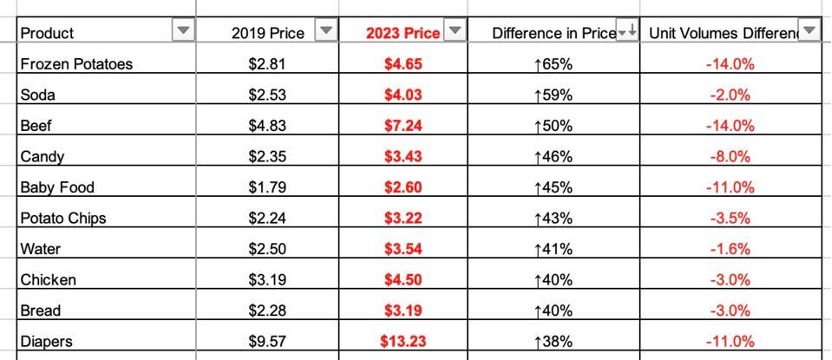
Top 10 price increase and volume trends across all grocery channels, 2019-2023. Data Courtesy of … [+] ERROL SCHWEIZER

Boxed cereal dollar sales are up 17%, unit volumes are down 12% and prices are up 33%. The top 3 brands, General Mills, Kellogg’s, and Post Holdings possess over 70% market share. “It’s been surprising how resilient the consumer really is,” stated Kellogg’s Chief Executive Steve Cahillane in 2022, without a hint of irony.

Beef demand is highly elastic. As prices go up, volumes go down. According to NIQ, beef unit volumes are down 14%. Prices have gone through the roof, up over 50% in just 4 years. The average beef price per pound is now over $7. So it wasn’t Impossible Burger or cultivated lab meat that killed demand. And no wonder. The top 4 meat processors hold around 50% market share. Tyson Foods doubled its profits from 2021-2022, dryly stating in an earnings call, “Our pricing actions, which partially offset the higher input costs, led to higher sales during the quarter.”

Diaper unit volumes are down 11.7% while prices are up 38%, to over $13 a pack. Proctor & Gamble (P&G) and Kimberly Clark control 70% of the domestic diaper industry. P&G prices have stayed high while lower input costs drove 33% of their profits. The brand predicted an $800 million windfall, and an executive recently mentioned, “We continue to believe that the majority of that growth will be price driven with a negative volume component.”

Multiple other product lines show the same pattern of reduced sales volumes accompanied by much larger percentage price increases: milk, yogurt, fresh potatoes, potato chips. The yogurt industry concentration (four firms with aggregate 70 percent of market) resembles the airline industry where four firms have about 70 percent of sales. And, according to Forbes reporting of NielsenIQ data, increases in prices of base ingredients are lower than the increases for processed commodities made from those ingredients.

Price inflation takes other forms than straight-up increases – package sizes are often reduced while price is held constant (called “shrinkflation”). Data also exists showing that corporate profits (income after accounting for expenses) accounted for more than half of inflation.

While media and large companies often assign blame for inflation on consumer demand and workers demanding higher pay, Forbes shows that “corporate profits as a share of the national income are at historic highs, while workers’ share is lower than before the pandemic.” And, “Wall Street profit rates are the highest since World War II and stock buybacks are at record highs.” A good argument exists on the known facts that the largest concentrated industries are taking advantage of the pandemic and its aftermath to extract monopoly profits from consumers.

Instances of suppliers withholding product from uncooperative retailers refusing price pass-throughs are strong evidence of the effects of market concentration. Only firms with market power can successfully withhold product from the market without loss of business.

Finally, for present purposes, energy cost inflation, driven by multiple largely uncontrollable factors, are running persistently higher than general inflation. https://www.vox.com/technology/366885/utility-power-bill-price-clean-energy

Returning to the question whether price inflation is chargeable to the government, the Forbes article suggests Congress could act, along with the USDA and FTC, all targets of Republican angst over government overreach and the “deep state.” There are statutory tools available, for sure, but using them effectively in the face of massive Republican resistance is not a hopeful path to a solution and would in any case consume many years of litigation. Recall the hysterical Republican response to the budgeted increase in IRS staffing which, properly understood, would have resulted in hiring more staff over several years and largely made up for historical reductions in staff that have impaired collection work and return processing. And it certainly would not have led, as Republicans claimed, to armed IRS agents shooting people over tax obligations.

The Congress as currently constituted is not going to cooperate in any legislative efforts to further regulate large American businesses. And the Supreme Court has eviscerated one of the main supportive legal principles (“Chevron deference”) that enabled federal agencies to act aggressively under general legislative authorities to regulate highly-concentrated industries that are responsible for most of the inflation.


If The Scots Can Do This, Why Can’t We?

A November report in the BBC News indicates that a solar-powered boat has been developed and launched in the Philippines. http://tinyurl.com/52vyjys4

Aside: [I Googled this story and found no indication of coverage by any major U.S. news outlet online or otherwise.]

This is a solar-powered version of the “banca” boat, a traditional vessel typically made of wood and powered by a diesel engine, notorious polluters.

Stromness-based Aquatera, an Orkney company, said this was the first of its kind to be powered by renewables. The banca forms the backbone of coastal communities in the Philippines, providing lifeline sources of food, water, and livelihoods through tourism and fishing.

The new version can carry six passengers and two crew and travel up to five hours with a maximum speed of 11 knots. It has a cold-storage facility for the delivery of perishable goods and temperature-sensitive commodities, such as vaccines, to remote communities.

Ian Hutchison, director of Oceantera, said:

Through this initiative, we plan to work with local businesses, communities, and partners to help establish fossil-fuel-free transportation networks across the Philippines and wider South East [sic] Asia.

The project was included in the Renewable Energy-Powered Marine Transport for Island Communities project, funded by the United States Agency for International Development.

One small step for man ….

On the Precipice

As we approach with bated breath the change of years on the calendar, the flow of events continues. The calendar is an artificial device invented by humans for counting time but time ticks forward regardless. So, here we are, about to celebrate another “year” lived and with hope, we hope, for a better future for everyone.

Given all that, it’s a good idea to review some things about the recent past that have a large bearing on the near future. For this, I turn to Heather Cox Richardson, brilliant Boston College historian to whose daily newsletter [Letters From an American] I have recently subscribed. I’m pretty sure she’s ok with my repeating her thoughts/information because each issue of the newsletter as a “Share” button at the end with options for email, Twitter, Facebook, and others. And we’re on the same team.

Here are some of HCR’s observations about the Biden administration’s performance:

  • The U.S. economy is stronger than that of any other country in the Group of Seven (G7)—a political and economic forum consisting of Canada, France, Germany, Italy, Japan, the United Kingdom, and the United States, along with the European Union—with higher growth and faster drops in inflation than any other G7 country over the past three years.
  • … growth accelerated to an astonishing 4.9% annualized rate in the third quarter of the year while inflation cooled from 6.4% to 3.1% and the economy added more than 2.5 million jobs.
  • The S&P 500, which is a stock market index of 500 of the largest companies listed on U.S. stock exchanges, ended this year up 24%. The Nasdaq composite index, which focuses on technology stocks, gained more than 40%.
  • … new businesses are starting up at a near-record pace.
  • … holiday sales this year were up 3.1%.
  • Unemployment has remained below 4% for 22 months in a row for the first time since the late 1960s.
  • … unionized workers in the automobile industry, UPS, Hollywood, railroads, and service industries [won] higher wages and other benefits.
  • Real wages have risen faster than inflation, especially for those at the bottom of the economy, whose wages have risen by 4.5% after inflation between 2020 and 2023.
  • the nation has had a record drop in homicides and other categories of violent crime. The only crime that has risen in 2023 is vehicle theft.

One must wonder why this kind of news does not get more attention from at least the so-called Mainstream Media. I get a vast array of news articles from a vast array of sources every day and you would think from the headlines/content of most of them, that the United States is on the brink of economic collapse. I have wondered in other posts why the Democratic Party’s message of progress/achievement/hope is not keeping up with the relentless drumbeat of lies/deceptions/deflections from Donald Trump and his acolytes. I will wonder.

The “new” science of Behavioral Economics [see Kahneman, Thinking Fast and Slow] teaches us about cognitive biases and the influence of salience on how we generalize our understandings of “reality.” To some significant degree, the repetition of the lies and distortions of Trump’s dark vision of America have led many people to believe we are on the precipice of collapse brought on by immigration, socialism, communism, abortion, and transgenderism, etc etc. The facts say otherwise.

That is not to say, obviously, that there are no problems. One of them, that gets too little attention, is our continued dependence on other countries, most notably but not solely China for many vital products, including critical microchips. See https://www.ted.com/talks/rob_toews_ai_s_single_point_of_failure/transcript?user_email_address=f286772a6726b8e7d0d1da2e91e7f0c9 There are many others but the scale of the United States, its history and its attachment to capitalism inevitably cause problems. For an honest explanation of some by a brilliant scholar who believes in capitalism, see Charles Lindblom’s The Market System (2001), as valid today as when written.

So, as we approach the “New Year,” there is much to celebrate and much about which to be concerned. Maybe this is nothing new, but it feels more ominous for reasons I have discussed in other recent posts. For now, just for today, I will desist from worrying and, with Heather Cox Richardson, accept that we have much to appreciate in our current political leadership, that we still have hope because the good guys outnumber the bad guys, and trust that the good guys will, as they have in past, do what must be done as Americans who still believe in our aspiration set out in the Preamble to the Constitution:

We the People of the United States, in Order to form a more perfect Union, establish Justice, insure domestic Tranquility, provide for the common defence, promote the general Welfare, and secure the Blessings of Liberty to ourselves and our Posterity, do ordain and establish this Constitution for the United States of America.

HAPPY NEW YEAR!!

Republican Grinches – Get Over Yourselves

You really must wonder how extreme Republican Trump worshippers can keep so many conflicted ideas in their minds at the same time.

The White House just had the Dorrance Dance Company perform there, doing a tap version of The Nutcracker. The First Lady Jill Biden posted a video of some of it on Instagram and, predictably, Fox News and the New York Post (the closest thing to a supermarket tabloid), went nuts. https://tinyurl.com/326drmsx For Trump acolytes who purport to oppose cancel culture, it’s interesting that they want to terminate Dorrance Dance because its website promotes racial justice. Fox and NYP prefer a police state like the one Donald Trump is promising to instigate if elected in 2024.

In keeping with Republican orthodoxy, Fox and NYP would prefer to continue spending billions and more to incarcerate “bad guys” rather than looking for constructive ways to reduce crime and improve social/economic equity in American society. It’s “just lock them all up” all the time for these people, all the while complaining about the cost of everything.

We saw the Dorrance Nutcracker performance at the Kennedy Center a few weeks ago. While I’m not generally that interested in tap dance as an art form (but loved the movie White Nights) and have only limited interest in the Nutcracker even as a classical ballet, the Dorrance show was amazing. The energy and creativity of the dancers were remarkable. They are plainly qualified to perform at the White House.

The show there was not about political or related issues. It was about art, and anyone with even a minimal artistic appreciation would see the glory in the Dorrance Company’s art. But not the Grinchy Fox News and New York Post. I’d wager they’d sing a very different tune if Dorrance’s website promoted “law and order” and “deport them all.” Will no one rid me of these troublesome negators of everything American?

When Will We Learn?

Two cases in point.

Case One:

The Yale School of Public Health reports that

Some “non-menthol” cigarettes that are being marketed as a “fresh” alternative in states where traditional menthol cigarettes are banned use synthetic chemicals to mimic menthol’s distinct cooling sensations, researchers at Yale and Duke University have found.

The synthetic additives could undermine existing policies and a U.S. Food and Drug Administration ban on menthol cigarettes expected later this year that is intended to discourage new smokers and address the harmful health effects of tobacco use.

https://tinyurl.com/35r7t7wz

….

Hundreds of municipalities across the United States and some states – Massachusetts and California – have already restricted the sale of flavored tobacco products, including menthol cigarettes.

In a study published Oct. 9 in the Journal of the American Medical Association, researchers from the Yale School of Public Health, the Center for Green Chemistry & Green Engineering at Yale, and Duke School of Medicine identified a synthetic flavoring agent known as WS-3 in the newly introduced “non-menthol” cigarettes that delivers similar, or stronger, cooling sensations as menthol but without the minty aroma or taste.

….

Flavored tobacco products such as menthol cigarettes tend to reduce tobacco’s harsh effects making them particularly popular among young people and those just starting to smoke. Historically, menthol cigarettes have also been aggressively marketed towards African Americans, with up to 90% of African Americans who smoke using menthol cigarettes.

It seems likely that this “gap” in the regulatory regime for death-dealing cigarettes results from the regulations being based on specific chemicals rather than on the effects of flavor-enhancing chemicals regardless of type. The lesson to be learned from this, yet again, is that industries looking to make money regardless of impacts on public health will always look for an escape route and finding such routes is always easier when the “thing to avoid” is named rather than relying on the effects of the danger factor or the way it influences behavior.

The historical conduct of the tobacco industry, among others, should be a lesson for governments at all levels that you have to think very deeply about what you’re trying to prevent and how such prevention may be avoided. This doesn’t seem that hard.

Case Two:

The Virginia Highway Use Fee (the “HUF”).

I only recently learned about this assessment even though we bought a highly fuel-efficient hybrid vehicle in late 2020. The fee is not a lot of money, but the purpose of the fee is offensive and counter to other goals, or what should be other goals, as we try to offset some of the worst environmental effects of our dependency on automobiles.

The fee is $25 a year. The Virginia law provides a way of saving, maybe, $5 of the fee but is very complicated and, in my judgment, not worth the effort that involves obtaining another “reader” for your windshield, taking and reporting readings, etc. No thanks. Not to save $5.

More troubling is the motivation for this fee.

According to the Virginia Department of Motor Vehicles,

     You pay the HUF if you register a:

    • Fuel-efficient vehicle, which is a vehicle that has a combined fuel economy of 25 miles per gallon (MPG) or greater
    • Vehicle made in a year in which the average combined MPG rating for all vehicles produced in that year is 25 MPG or greater
    • Low Speed Vehicles, pay an annual $25 HUF

The highway use fee (HUF) helps make up for the fuel taxes that drivers with fuel-efficient and electric vehicles spend less on, because they’re not using as much fuel.

Among the vehicles exempted from the HUF are:

  • Vehicles with a combined MPG rating less than 25 MPG
  • Autocycles
  • Motorcycles
  • Mopeds

The HUF was started in 2020 but in July 2022,

the state launched an alternative program to let drivers pay the fee at a per-mile rate — a cost savings for those who drive less than the average amount, which officials peg at 11,600 miles annually. For drivers of battery-powered cars, that fee works out to a penny per mile. [https://tinyurl.com/yh4kt6tx]

In plain English, Virginia wants to penalize you for using a fuel-efficient vehicle (like a hybrid or fully electric, that, by the way, costs more than a regular gas-using vehicle) by forcing you to pay taxes based on gasoline consumption you don’t use, BUT you can potentially reduce the penalty slightly by signing up for the complex pay-per-mile program.

Or you can have what’s behind Curtain No. 1.

Seriously, this crazy scheme is a product of multiple conflicting forces, including Congress’s failure to increase gas taxes since 1993, the attraction of fuel-efficient vehicles and the inability of states to see the clear alternative of just taxing vehicles sufficiently to provide the revenue they need for road maintenance without depending on gasoline consumption. The current system must be beloved in the hallowed halls of the oil companies as it disincentivizes the purchase of fuel-efficient vehicles.

The more one looks at these systems of regulation, the more our government looks like something created by the Keystone Kops. If you don’t know what they are, see https://en.wikipedia.org/wiki/Keystone_Cops