Category Archives: Consumer Issues

When Will We Learn?

Two cases in point.

Case One:

The Yale School of Public Health reports that

Some “non-menthol” cigarettes that are being marketed as a “fresh” alternative in states where traditional menthol cigarettes are banned use synthetic chemicals to mimic menthol’s distinct cooling sensations, researchers at Yale and Duke University have found.

The synthetic additives could undermine existing policies and a U.S. Food and Drug Administration ban on menthol cigarettes expected later this year that is intended to discourage new smokers and address the harmful health effects of tobacco use.

https://tinyurl.com/35r7t7wz

….

Hundreds of municipalities across the United States and some states – Massachusetts and California – have already restricted the sale of flavored tobacco products, including menthol cigarettes.

In a study published Oct. 9 in the Journal of the American Medical Association, researchers from the Yale School of Public Health, the Center for Green Chemistry & Green Engineering at Yale, and Duke School of Medicine identified a synthetic flavoring agent known as WS-3 in the newly introduced “non-menthol” cigarettes that delivers similar, or stronger, cooling sensations as menthol but without the minty aroma or taste.

….

Flavored tobacco products such as menthol cigarettes tend to reduce tobacco’s harsh effects making them particularly popular among young people and those just starting to smoke. Historically, menthol cigarettes have also been aggressively marketed towards African Americans, with up to 90% of African Americans who smoke using menthol cigarettes.

It seems likely that this “gap” in the regulatory regime for death-dealing cigarettes results from the regulations being based on specific chemicals rather than on the effects of flavor-enhancing chemicals regardless of type. The lesson to be learned from this, yet again, is that industries looking to make money regardless of impacts on public health will always look for an escape route and finding such routes is always easier when the “thing to avoid” is named rather than relying on the effects of the danger factor or the way it influences behavior.

The historical conduct of the tobacco industry, among others, should be a lesson for governments at all levels that you have to think very deeply about what you’re trying to prevent and how such prevention may be avoided. This doesn’t seem that hard.

Case Two:

The Virginia Highway Use Fee (the “HUF”).

I only recently learned about this assessment even though we bought a highly fuel-efficient hybrid vehicle in late 2020. The fee is not a lot of money, but the purpose of the fee is offensive and counter to other goals, or what should be other goals, as we try to offset some of the worst environmental effects of our dependency on automobiles.

The fee is $25 a year. The Virginia law provides a way of saving, maybe, $5 of the fee but is very complicated and, in my judgment, not worth the effort that involves obtaining another “reader” for your windshield, taking and reporting readings, etc. No thanks. Not to save $5.

More troubling is the motivation for this fee.

According to the Virginia Department of Motor Vehicles,

     You pay the HUF if you register a:

    • Fuel-efficient vehicle, which is a vehicle that has a combined fuel economy of 25 miles per gallon (MPG) or greater
    • Vehicle made in a year in which the average combined MPG rating for all vehicles produced in that year is 25 MPG or greater
    • Low Speed Vehicles, pay an annual $25 HUF

The highway use fee (HUF) helps make up for the fuel taxes that drivers with fuel-efficient and electric vehicles spend less on, because they’re not using as much fuel.

Among the vehicles exempted from the HUF are:

  • Vehicles with a combined MPG rating less than 25 MPG
  • Autocycles
  • Motorcycles
  • Mopeds

The HUF was started in 2020 but in July 2022,

the state launched an alternative program to let drivers pay the fee at a per-mile rate — a cost savings for those who drive less than the average amount, which officials peg at 11,600 miles annually. For drivers of battery-powered cars, that fee works out to a penny per mile. [https://tinyurl.com/yh4kt6tx]

In plain English, Virginia wants to penalize you for using a fuel-efficient vehicle (like a hybrid or fully electric, that, by the way, costs more than a regular gas-using vehicle) by forcing you to pay taxes based on gasoline consumption you don’t use, BUT you can potentially reduce the penalty slightly by signing up for the complex pay-per-mile program.

Or you can have what’s behind Curtain No. 1.

Seriously, this crazy scheme is a product of multiple conflicting forces, including Congress’s failure to increase gas taxes since 1993, the attraction of fuel-efficient vehicles and the inability of states to see the clear alternative of just taxing vehicles sufficiently to provide the revenue they need for road maintenance without depending on gasoline consumption. The current system must be beloved in the hallowed halls of the oil companies as it disincentivizes the purchase of fuel-efficient vehicles.

The more one looks at these systems of regulation, the more our government looks like something created by the Keystone Kops. If you don’t know what they are, see https://en.wikipedia.org/wiki/Keystone_Cops


 

Jake–Gifts Beyond Measure

Monday evening, for probably the sixth time, we saw the virtuoso ukulele player, Jake Shimabukuro, perform at the Birchmere Music Hall in Alexandria.

Physically, Jake is rather diminutive, proving yet again that giants come in all sizes. His intimate connection with his music and his obvious joy when he performs keep him looking much younger than the 46 years in which he has graced the planet with his talent. You can read his biography here. https://jakeshimabukuro.com/biography/

The main Birchmere performance hall seats 500 guests at tables for six people each. It is a massive space, but in the hands of someone like Jake, it becomes remarkably intimate. We have seen Jake and other performers at the Birchmere many times. This time he was doing his magic on a Monday night and while the doors opened at 5 pm, the show wasn’t scheduled until 7:30. We figured to have plenty of time to arrive around 6:15 and finish dinner before the show started. The parking lot rings one half of the large building that houses the venue. We were shocked to find it was almost completely full when we arrived. The crowd knew Jake and had come early for the best seats. There were probably a few empty spots at show time but not many.

Jake wastes no time in displaying his prodigious musical gifts. It can be overwhelming for first-timers. You just can’t anticipate such sounds from a ukulele, even one electrically amplified. When Jake bounded onto the stage, the audience went nuts. He was obviously excited to be back at the Birchmere, and they were equally excited to see him again.

I don’t have words adequate to convey the power and quality of Jake’s playing. This evening he was accompanied by a young electric bass player, Jackson Waldhoff who has some impressive chops of his own:

[Waldhoff]  grew up in Kyoto, Japan, and moved to Hawaii when he was 15 years old. Jackson did not speak English at the time, and started to play music as a way to break language barriers. Later he fell in love with bass guitar, and decides to follow his passion for music. Since then Jackson has performed and recorded with wonderful artists such as Jake Shimabukuro, Mick Fleetwood, Alan Parsons, Sonny Landreth, Keb Mo, Sam Bush, Taku Hirano, Fiji, Mark Yamanaka, Conner Johnson, and many others. [https://www.jacksonwaldhoff.com/]

After a few pieces, Jake welcomed Conner Johnson to the stage. Johnson was an “America’s Got Talent” contestant whose voice and guitar riffs attracted Jake’s attention. He clearly loved to sing. Johnson performed and sang several great pieces, among them the amazing Hallelujah by Leonard Cohen.

We thought Johnson would stay for the remainder of the show, but he departed after four or so pieces. We anticipated the show would wrap up soon thereafter, but Jake has so much fun performing that he continued with bassist Waldhoff into the night. He managed to work in two of my absolute favorite pieces, While My Guitar Gently Weeps [https://tinyurl.com/mr2scjjr] and Sakura, Sakura [ https://tinyurl.com/ye2aat4r?v=FuqdeFqtxCg]

Then, when we were sure the show was about to end, Jake broke into the great anthem by Queen, Bohemian Rhapsody [https://www.youtube.com/watch?v=IYhcN8p4yhg] followed by, yes, We Will Rock You. On the ukulele. The audience was transfixed, singing the words (hundreds of people knew the words) as everyone joined in the excitement.

The YouTube videos of Jake playing do not do justice to his astonishing talent. But they give you a small hint of what it’s like to witness his performance live. If you ever have the chance to see him, do yourself a favor. You will, quite simply, be amazed and uplifted.

Two closing notes.

Jake played for about 1 hour and 45 minutes, which is extraordinary in itself. He closed the show by thanking everyone involved in producing it and the people in the venue, the waiters, the cook-staff in the kitchen, and delivered a message to the young people in the audience to stay drug-free. After all that, he appeared in the outer hall to speak with every person there who wanted to meet him. He stood for hugs, for photos, signing CDs, books, shirts, ukeleles. Always smiling. Always friendly. Never rushing anyone. The line was long – my wife waited in it for over a half hour and there were still many people behind her when she finally had her minute with Jake. She had him sign her CD and, typically, another one for the kumu hula (hula master) for her hula troupe with which she has been dancing hula for more than 15 years. Jake was probably there another half hour or more speaking to the last guests who wanted to meet him.

The other note is that Jake’s website mentions one of his

dearest friends and favorite singers — Pōmaika`i Keawe. In addition to her incredible musical talent, Jake is always so inspired to see how much time she dedicates to local non-profit organizations, lifting up the community through outreach opportunities. Pōmaika`i had always wanted to record “Ho`okahi Akua,” as a tribute to her late grandmother, the legendary Aunty Genoa Keawe. It was Aunty Genoa who arranged the music with the help of her friend Malia Craver who provided the Hawaiian translation. They had originally recorded the song during the pandemic and both were in tears by the end of it. Fate would have it that the song had to be re-recorded and the recent track captured the more hopeful and joyful feelings they now share.

As it happens, Pōmaika`i Keawe is the daughter of Eric and Marlene Keawe who are wonderful friends of ours in Hawaii. The entire Keawe family are exceptionally talented musicians on multiple instruments, carrying on a multi-generational love of Hawaiian music and culture. Pōmaika’i’s voice is spectacular. We were thrilled to see the entire family perform at a local show some years ago on a visit to Oahu and had dinner with them on our last visit. We saw Jake at the Hawaii Blue Note together. Eric on his guitar accompanied my wife’s surprise performance of a special hula dance as a treat for the audience at a travel industry business conference where she spoke a few years ago. She and he were a smashing success. It’s Hawaii. It’s what they do.

Now, go see Jake.

Only a Matter of Time Before Firearms Disaster On a Plane

“Those who cannot remember the past are condemned to repeat it.”

You’ll be thrilled to know that the Transportation Security Administration has released its first-half 2023 firearm interception numbers. https://tinyurl.com/vtnnazfd You will not be surprised, I suspect, to learn that the 3,251 total interceptions, an average of 18 firearms per day (of which more than 92 percent were loaded) was a 6.5 percent increase from the first half of 2022 (3,053 interceptions; 86 percent loaded). TSA is expecting a year-end increase over last year’s record of 6,542.

Granted that 3,251 is a miniscule percentage of the total domestic passenger enplanements during the first half of 2023 (396,154,000), the fact remains that the discharge of a pistol in a pressurized confines of a cruising airplane could have catastrophic consequences for everyone on board and possibly many more on the ground. So far, we’ve been fortunate that the security systems at airports, and the people who staff them, have detected so many weapons before they were taken on board an aircraft. Whether the 3,251 represents all such weapons, however, we can only hope, but we can’t be sure.

In fact, there is a recent report of an on-duty flight attendant who was arrested at Philadelphia International Airport trying to take a loaded pistol onto a plane. https://tinyurl.com/3fxscr3k The weapon in this case was a loaded .38 Ruger semiautomatic handgun. It was in her purse. With five rounds in the magazine.

The article does not specify which of the many Ruger semiautomatic handguns she carried, but assuming it was among the less expensive, it weighed just under 10 oz with a barrel length of less than 3 inches. The online ads describe it as “highly concealable.” Great. Holds 6 rounds in the magazine and one in the chamber. (In this instance no round was in the chamber, a minor inconvenience if quick shooting were at hand).

Further,

The arrest comes just two weeks after an airport concession worker was stopped trying to take a loaded handgun into the secure airside area of the airport. The worker claimed he forgot the gun was in his bag.

“I forgot I had the gun in my … purse, briefcase, pocket” is the standard excuse offered when TSA detects these items which, in the context of an aircraft in flight, could easily become a “weapon of mass destruction.”

The article says the flight attendant faces firearms charges under Pennsylvania law and “a potential federal financial penalty” related to trying to take a gun through a TSA checkpoint.

And there lies the issue: a “potential financial penalty.” And in many states, no charges would lie under local gun laws because they basically don’t have any.

When passengers bring firearms to the TSA security checkpoint, TSOs contact local law enforcement to check the contents of the carry-on bag, safely unload and take possession of the firearm and process the passenger in accordance with local laws on firearms. TSA will impose a civil penalty up to $14,950, eliminate TSA PreCheck eligibility for five years and may require enhanced screening.

Some passengers will be arrested or cited, depending on local laws on firearms.

Not good enough. Some, but not all?  Why not all?

Then, there’s this:

Aircrew can often skip most security screening at US airports as part of the ‘Known Crewmember’ initiative ….

The Association of Flight Attendants (AFA) issued an urgent circular earlier this year warning crew members not to break KCM rules and to be particularly mindful of not accidentally trying [??] to take a firearm through the security checkpoint.

In some cases, the union warned that flight attendants had managed to leave the United States on international trips with a firearm in their luggage only for it to then be discovered as they went to return to the US resulting in hefty fines and even imprisonment.

According to another report, the flight attendant caught in PHL lives in Arizona. https://tinyurl.com/ms36hpmkOne wonders how the pistol came to be with her in PHL if it wasn’t flown there from Arizona. That article notes: “It’s possible that the flight attendant may lose her job here, but generally the consequences for being caught with a gun at a security checkpoint are quite minimal (at least compared to what they’d be in other countries).

A recent report in CNN https://tinyurl.com/3y6tmx4e notes that a June 20023 IATA report shows that “there was one unruly incident reported for every 568 flights in 2022, up from one per 835 flights in 2021.”

Thus, we have reports of deranged passengers fighting with other passengers and crews on in-flight aircraft coming in weekly combined with a multitude of pistols, the vast majority being loaded, being stopped almost literally at the boarding door (and apparently some getting through) – the perfect recipe for an in-flight catastrophe.

We know from statistical principles that even though the chances of an event may be very small, such low-probability events do happen. What will we say when an in-flight disaster brought on by a loaded pistol in-flight brings down an aircraft?

Here’s what: “Oh my, we will undertake a thorough examination of our security protocols because, you know, your safety is our top priority, and we take it very seriously.” That, by the way, is probably the most-repeated and least meaningful cliché in the English language. It is standard public relations formula for after-the-fact, but readily foreseeable, disaster events.

Two days ago, the local news outlet, Patch, reported that a VA Man Blames Wife For Loaded Gun In Carry-On Bag At Reagan National; the man

told officials that she packed his carry-on bag and did not know that he already had his loaded gun inside,” TSA said.

What the article does not discuss is why the gun was already in the man’s carry-on bag. Had he succeeded in taking it on another flight previously and just left in the bag for his next flight when his unsuspecting wife dutifully packed his bag for him?

In a classic example of understatement, TSA’s security director for National Airport was quoted,

It is disappointing to continue to see travelers carrying their loaded guns to our security checkpoints.

Disappointing, yes, indeed. But, more accurately,

There is no reasonable excuse for not knowing you are carrying an unsecured, loaded firearm in your bag. It presents a danger to everyone around you.

Here are the reported firearms captures at National Airport alone:

The current one is the sixth capture in the last three weeks.

What does this tell you? Answer: the current approach is not working and the risk to passengers on planes and people on the ground is growing.

The solution, I suggest, while imperfect, is to have an absolute policy of strictest law enforcement against every person caught with firearms in their carry-on luggage. Every one of them should be prosecuted under federal law and visited with the maximum penalty. Then, maybe, just maybe, gun owners would begin to take the rules seriously.

We can, of course, expect Second Amendment challenges to such an approach. The “originalist” argument will be that that when the Constitution was adopted there was no general prohibition against carrying firearms on planes, therefore, we cannot enforce one now. I don’t have to explain how ludicrous that argument is, so I won’t bother.

Can We Please Stop Blaming Everything on the Pandemic?

A short while ago, Vox.com published an article decrying how people are acting in public now: People forgot how to act in public https://tinyurl.com/mur5rx3x Reports describe concert attendees throwing phones & other items at performers (I cheered when I read about Cardi B launching her microphone at the person who threw a drink at her), Broadway audiences engaging in grotesque displays, and people using cell phones disruptively during movies. The conclusion, after consulting some “experts,” was that this behavior related to the forced closures and isolation everyone experienced during the pandemic.

I found the article confusing.  On the one hand, it claimed people during the pandemic had simply “forgotten” how to act. Now that they can return to these collective experiences, “[w]hen someone makes a scene in public at a group event, we’re disturbed in large part because these gatherings are extremely important to our intellectual and emotional selves …. The “collective effervescence” of live events is something humans crave, whether they know it or not.”

The quoted term apparently refers to the fact that while we’re buying a ticket for the performance, we’re also “buying that electric feeling of a crowd of humans appreciating the same thing …. these events are moments of highly pleasurable social connections.” The idea seems to be that in addition to our personal experience of the performance, we are also stimulated by the enjoyment of others around us, even though we don’t know any of them, and we resent the disruption of that collective and connective response by people who seem more interested in what’s on their phones.

I readily admit that I prefer the other people attending a show to actively enjoy it, but only up to the point just before their “enjoyment” lapses into hysterical enthusiasm that detracts from the show. We experienced this during the musical MJ in New York a while back. Some members of the audience, seated near us, apparently came to believe that the actor playing Michael Jackson was Michael Jackson inexplicably risen from the grave and there for their personal entertainment, in return for which they were obliged to scream and shriek at every cool move the actor made to imitate the real MJ. The noise was overwhelming and detracted from our experience of the show. The “collective effervescence” spilled over into something else.

Tne academic cited in the Vox article thought that “the lockdown’s impact on social gatherings has affected our social skills, such as conversation and general awareness … and I’m sure it has impacted social skills.”

The pendulum swing from gathering in real life to being relegated to social media to now, in 2023, coming back to real-life events may explain why some people are being disruptive and not fully comprehending the impact they’re having on their fellow audience members. They’re using the modes of social connection they got accustomed to — posting a video from a movie theater, scrolling through social media during a Broadway play, or treating a concert like a performance they’re watching from home — in a setting that’s inappropriate. In some cases, it’s an upsettingly tangible example of the self-interested behavior we’ve come to call main character syndrome,” wherein a person seems to believe that everything that happens around them only contributes to their own story.

That is a bridge too far for me.

I suspect the explanation lies in a broader social phenomenon associated with generational attributes that lead some groups (broad generalization here) to only be seriously interested in things that are about themselves. They therefore can easily block out the interests of those around them. This explains the hysterical laughter and ultra-loud conversations in restaurants that ignore the impact on people at adjoining tables. These people simply don’t care that their “good times” are affecting other people’s “good times,” because everything important and relevant is just about them and them alone.

Make all the excuses you want, but I reject the idea that people in the space of one year lost entirely their awareness of the people around them to such an extent that upon returning to a movie theater, for example, they think it’s fine to text and even talk. We’ve attended three movies in the past month and in every case the end of the previews includes a prominent, loud warning to “don’t text, don’t talk, don’t ruin the movie.” That same warning was played at movies well before the pandemic closed everything. People who violate that warning simply don’t care much about anyone else. They didn’t care before or during the pandemic either. They saw the pandemic as an unjust inconvenience in the world that should still be revolving around them exclusively.

As for the “fans” throwing things at performers, I have tried to understand what might cause such odd behavior. Several possibilities came to mind:

  1. The throwers are obscenely wealthy, which explains their up-front seats, and don’t place real value on their phone – they have more than one or can easily afford another.
  2. The perps are resentful of the notoriety of the performers and want to show them they’re not so special compared to the anonymous ticket-holder in the audience, so “take that, Taylor Swift; you’re not so special.”
  3. The perps have been suppressing their violent hostility toward everyone in authority and now they can release their angst against a live target who is “up” on the stage while they are stuck “down” here with the other screaming masses.

There is no way to sort this out. The truth probably is “all of the above and more” for many people in the audience. But it’s not the pandemic.

So, please, let’s stop with the overreaching explanations for why people behave like inconsiderate boors. It’s most likely because they are inconsiderate boors. The pandemic may have made us more aware of their presences because collective activities still seem “new,” but these particular people are the same as they always were. Once a boor, always a boor, someone once said. You can see them taking videos at the ballet immediately after being told to turn off their phones and put them away because videoing the performance is “strictly prohibited.” Better not sit near me ….


Why Are Doctors Not Allowed to Practice Everywhere?

For reasons I don’t recall, I subscribe to the JAMA Network, which is a monthly medical journal published by the American Medical Association with a large variety of articles about the biomedical sciences. I’m reasonably sure my interest was driven by the pandemic. In any case, much of the contents are beyond my ability to understand. But every so often, I find something compelling either about some disease or, in the present case, about the manner and method by which medicine is practiced in our peculiar collection of regions we call “states.”

The present issue is how we have collectively prevented doctors from counseling patients across state lines into states where they are not “admitted to practice.”

As a retired lawyer, I certainly understand the reason we limit, with a notable exception, unadmitted lawyers from the practice of law in states in which they have not passed the state bar exam. That reason is that the laws of each state often vary significantly, particularly regarding the details of procedure but also in many substantive areas such as estate law. It would be problematic to permit lawyers with no knowledge of those laws and procedures to regularly give advice to clients in those states.

There is, as stated, a notable exception, which is that out-of-state lawyers may appear in trials and some other court proceedings if they associate with “local counsel,” an attorney who is admitted to practice in that jurisdiction. The “foreign” attorney may do all the work, but “local counsel” must sign off on it as assurance to the court that the foreign attorney is complying with local law and procedure.

Turning then to the issue of “foreign” doctors “practicing medicine” by, in modern times, counseling patients using technologies like Zoom for “televisits,” I have wondered for some time why the states restrict this activity. Laws and procedures differ from state to state, but is the science on which medical practice is based different from state to state? I am not aware that it is.

Yet, as reported in Jama Network, https://tinyurl.com/5dab4tcm, Providing Responsible Health Care for Out-of-State Patients:

while exceptions may have been made here and there during the pandemic, the states have returned to their prior position of barring “foreign” doctors from remotely advising patients:

…physicians have increasingly been told by lawyers and compliance officers that calling patients located in another state is a legal gray area and introduces a risk of sanctions. States have accelerated this concern. The New Jersey Attorney General’s Office recently warned out-of-state physicians that, without a New Jersey medical license, “any practice by way of telemedicine, will constitute the unlicensed practice of your profession, and may subject you to administrative and criminal action” (email communication, March 31, 2023). These restrictions are impeding other communications as well. When Virginia ended its temporary pandemic regulations around physician licensure, Johns Hopkins had to inform more than 1000 patients they were no longer eligible to utilize telehealth appointments with its providers.

Physicians given this advice are understandably frustrated because these restraints disrupt and reduce the quality of the care they provide. This is especially true for specialty physicians who serve a broad geographic area and physicians whose practice is near a state border. For example, many states lack any pediatric subspecialists and the majority of the population must travel more than 100 miles.

Notwithstanding the negative consequences for patients who may have a long-standing successful relationship with a doctor in another state where the patient, for example, once lived, state laws say such relationships must end. The law of Texas is typical:

Any “person who is physically located in another jurisdiction but who, through the use of any medium, including an electronic medium, performs an act that is part of a patient care service initiated in this state…that would affect the diagnosis or treatment of the patient, is considered to be engaged in the practice of medicine.

I didn’t know this, but the JAMA article notes that many telemedicine visits are now accomplished by persistent and/or desperate patients who “sit in cars or coffee shops on smartphones, searching for good WiFi and sharing tips about the best parking lots that are just across the state border.

 These constraints severely inconvenience patients, especially those with serious illness, physical disabilities, or lower income and limited resources; threaten patient privacy; encourage discontinuity of care; and might force private health care conversations to take place in ineffective and public settings.

Have we lost our collective minds?

Not only is this bad for patients, but it places doctors in a precarious legal situation in which the “best” solution for them is simply to “fire the patient.” Every doctor these days carries medical malpractice insurance. Is continuing to advise an out-of-state patient malpractice under those policies? Or is the opposite true, that failing to continue giving needed advice is malpractice? What about the not-unusual situation where the patient cannot reach a local doctor and seeks out his former doctor in the prior state of residence? Should that doctor respond? Not respond? It’s a Hobson’s choice.

The authors of the JAMA article propose several common-sense solutions that, for example, allow for “any follow-up care after a relationship has been appropriately established through in-person or virtual means.” A “bigger” solution would be federal preemption of the field that would override state laws. Examples include expansion of the principles in the Sports Medicine Licensure Clarity Act in which reasonable exceptions for licensure are created to cover clinicians who travel with a sports team to another state and provide care, even if they are not licensed in the state in which the sporting event occurs.

Interestingly, the authors note that:

the delivery of medical care could be defined as being rendered where the physician is located, although that could potentially upend our existing system and impact state licensure authority. Although congressional action would mean the federal government supersedes, or preempts, existing state regulations, the advantage of either federal legislative approach is uniformity and clarity, rather than requiring physicians to navigate through 50 different approaches to the issue.

Indeed, such action would likely face a gauntlet of opposition from local doctors wanting to preserve their “monopoly” on access to local patients, present and future. Therein lies, I believe, the root of this problem. If someone can convince me that medical practice should vary from state to state in the manner of local law, I will confess error. Until then, I will assign “blame” for the present shameful situation on doctor protecting their turf.

If it was medically acceptable to do interstate televisits during the pandemic, then it must be true that there is no medical problem in the post-pandemic period to allow interstate doctor-patient communications as they choose.

This situation cries out for a federal solution. I understand that some states limit medical services such as assistance in death (known as Death with Dignity) which is forbidden in Virginia but allowed in many other states. A federal solution would leave responsibility for knowing such local restrictions to the doctors in question. Beyond that, let them practice their magnificent craft unimpeded by artificial state boundaries and licensure rules designed to protect doctors’ incomes rather than promote the welfare of all patients.

Another Major News Entity That Needs Editors

The Internet has brought us many new and useful tools, but one of the glaring downsides is that it has undermined journalism in multiple ways. One response of the media has apparently been to either eliminate editing or significantly diminish its role in vetting articles before they are posted. Examples continue to multiple.

The latest glaring example comes from ABCNews.com that published a story about two US Navy sailors accused to spying for China. https://abcnews.go.com/US/2-us-navy-sailors-arrested-allegedly-spying-china/story?id=101990144  While the content of the story is important and interesting, there is no obvious reason why it had to be rushed to “print” without competent checking of the writing.

Examples:

  • Jinchao “Patrick” Wei, a 22-year-old petty officer 2nd class, was arrested Wednesday and charged with espionage — more specifically, conspiracy to and committing the communication of defense information to aid a foreign government.

Conspiracy to committing?  Conspiracy to the communication?

  • Petty Officer Wenheng Zhao, of Monterey Park, California, was also arrested Wednesday, by FBI and NCIS agents, and is charged with conspiracy and receipt of a bribe by a public official, officials said, according to Zhao’s indictment.

“According to Zhao’s indictment” does not belong at the end of the sentence. It should be placed at the beginning.

  • Zhao, 26, worked at the Naval Base Ventura County in Port Hueneme and had an active U.S. security clearance who had access to classified information, officials said.

As written, that sentence says that it was the “security clearance,” as a “who” rather than a “what,” that “had access to classified information.” I am reasonably certain that the sentence was intended to say that Zhao had the security clearance that gave him access to classified information.

  • His indictment states he had access to material classified as secret, as did Wei, who was born in China and became a U.S. citizen in 2022 as he was allegedly also sending information to his handler.

I’m not sure what to say about that sentence. The concluding phrase, “as he was allegedly also sending information to his handler,” is lost in space. With slight changes, it probably belongs after “secret.” The sentence would be improved by creating two sentences from it, one about the indictment and one about Wei’s background. Sigh.

  • “The alleged conduct also represents a violation of the solemn obligation of members of our military to defend our country to safeguard our secrets and to protect their fellow service members.”

What happened to the punctuation? Properly written, that sentence would read this way: “”The alleged conduct also represents a violation of the solemn obligation of members of our military to defend our country, to safeguard our secrets, and to protect their fellow service members.”

  • It was not immediately clear if either Wei or Zhao had retained attorneys who could comment on their behalf.”

I admit I am nitpicking a bit here, but wouldn’t that sentence read better this way: “It was not clear whether Wei or Zhao had retained attorneys who could comment on their behalf.” OR, even better, “It was not clear whether Wei or Zhao had retained an attorney who could comment on his behalf.”

  • Wei is alleged to have passed along imagery of the USS Essex, provided the locations of various Navy ships and provided dozens of technical and manual for systems aboard his ship and other Navy ships.

Open your blue books and answer this question: How many manual or manuals was Wei claimed to have shared?

  • “The case against Mr. Zhao is part of a larger national strategy to combat criminal efforts from nation state actors to steal our nation sensitive military information,” Estrada said.

Obviously, “nation” should have been “nation’s,” the singular possessive form. I suppose it’s possible that Estrada misspoke and said only “nation” but, if so, the authors should have inserted “[sic]” after the word to indicate their awareness of the mistake.

There are other problems with the piece but eight is enough to make the point. A final note: the article lists five contributors to the piece. Remarkably, none of the five apparently saw or raised any of the issues I have identified. If they did, they were ignored, which may be worse

Lest I be accused of picking on ABC, I hasten to assure you that problems like these are evident throughout Internet-published journalism.

Examples: click-bait titles are rampant.

Blue Jays Acquire Angels’ Star Shohei Ohtani In Blockbuster Trade Proposal That Would Instantly Shake Up The MLB

Maybe I’m being unfair, but I believe that headline in https://www.totalprosports.com/mlb/shohei-ohtani-angels-blue-jays-trade-rumor/ was written to lead the reader to believe that the Los Angeles Angels had agreed to trade Shohei Ohtani to the Blue Jays, which is about as likely as my being recruited as a pitcher for the Los Angeles Dodgers. In fact, the article makes clear that the acquisition of Ohtani was merely a proposal from the Blue Jays.

Another example of failed/missing proofreading:

The bomb squad “determined that the small grenade was insert,” according to a sheriff’s office update. [Miami Herald, July 11]

I have many more examples but, frankly, they are buried in my emails. In preparing to write this post, I realized that I have more than 9,150 emails in my Inbox. Many are routine items (“Your Amazon order has shipped”) and there are hundreds, possibly thousands, related to Donald Trump and his many crimes against the Constitution, the law, and humanity. One of these days I “plan” to find time to review them all and either act on them or delete them. One fine day.

Meanwhile, c’mon ABC and the rest. Do better.

Stopping by Gardens on a Summer Day

If he were alive, Robert Frost would forgive me, I think, for paraphrasing his famous poem, one of my all-time favorites, in the interest of sharing beauty.

This past Sunday, in an effort to beat the heat (failed), we set out early (for us) to visit Brookside Gardens in Montgomery County, Maryland. Brookside is comprised of 50-acres within Wheaton Regional Park. By the time of our arrival late morning, temperatures were approaching 90 with comparable humidity. We therefore shortened our stay and walked only a few areas close to the Visitors Center, including the conservatories. It’s free!

The overwhelming impression one gets in a place like this has two elements: the astounding array of brilliant, surreal colors of the flowers, and the equally astounding diversity of the flower forms that evolution (and artificial selection) has produced.

Words can’t add much to those, so I will spare you, and simply show you some of what we saw. BTW, in the pond shot, the color comes from algae that covered almost all of the ponds this day. Finally, who  among us does not love a chipmunk?

I hope seeing such stunning beauty brightens your day.

A Visit to the Apple Store

If you keep your iPhone long enough, it will eventually need a new battery. We bought our iPhone 11s in very late 2019, so they are in their fourth year. The nearest Apple Store to us in in the Fashion Centre at Pentagon City.

Note: For the uninitiated, Pentagon City is neither a pentagon nor a city. It is a neighborhood in Arlington, VA. The Fashion Centre (note the “tre” at the end, very fashionable) is actually, well, a mall. A big one. One hundred sixty-four stores, to be precise. Most of them, by my rough count, cater primarily or exclusively to women, which seems fair.

In any case, we recently learned that both our phones needed new batteries. Since this happened two days ago, I do not remember how we discovered this troublesome fact. But I do recall that it was projected to cost $89 to replace the battery in each phone at the Apple Genius Bar. Such is the genius of the Apple business model.

So, we made an appointment for, Saturday, today, to have my phone’s battery replaced. When you do this, you are advised to back up the phone to iCloud lest all your data be erased. It took me so long to accomplish the backup (the phone is set to automatically back up but who trusts that?) that when I went to make a second appointment for my wife’s phone, the next appointment was in September (lie: but it was many hours later). We decided to wing it.

So, this morning arrived sunny and, unusually, with non-life-threatening air quality and off we went to the Fashion Centre at Pentagon Mall for my 10:30 am appointment.

To my surprise, and somewhat to my dismay, the mall was practically deserted. Many stores weren’t open yet and few visitors were present. Even the Apply Store, usually a beehive of activity, was quiet, with way more attending Apple staff than customers. We were early, usually a good omen.

A pleasant young man greeted us. I pushed my Apple Wallet app into his face, showing the QR code for my appointment. He pushed a larger square electronic pad device my way and asked, “you’re Paul?” “Yes,” I replied. He said his name was also Paul. Very pleasant. Punching many buttons on my phone and on his square electronic pad thing, he confirmed everything. We then broached the question of getting my wife’s phone attended to as well (I sheepishly explained why we couldn’t get her a separate appointment). More buttons pushed and, voila! he takes both phones. Mine will be ready at 11:45, hers at noon. I am shocked that a battery replacement could take this long, but they have you by the iPhone so what are you going to do? We head out into the mall, carrying our now-empty phone cases.

When my wife peels off into Nordstrom’s (“just to look around”), I realize for the first time that without our phones, we have no means of finding each other if we are separated. Since one of my wife’s many skills is shape-shifting whereby she can completely disappear in a store, even one organized into straight rows, I realize we must remain together at all costs.

You know where this is going. Victoria’s Secret, it happens, is having a sale. VicSec is a store I have no interest in visiting so I pace outside for what seems like a half-hour while my wife saves money. I pretend I am mall security in disguise. Time passes, slowly, very slowly. The store has three entrances along mall corridor. I can’t see my wife in any of them. She has shape-shifted into women’s undergarments.

Eventually, she emerges proudly holding up here pink bag (everything is pink now – Barbie, you know) with her goodies. It’s all fine. Through the magic of shopping mathematics, we have less money than before, but we have saved money.

So it goes. We wander the mall, stopping in stores because they’re there, killing time. I learn that Macy’s does not sell John Varvatos cologne, but the nice young lady persuades me to let her blast my forearm with Montblanc something. It’s not bad. How much? She tells me it comes with some other Montblanc product and includes a gift bag. I don’t want a gift bag. How much without the “package?” Same price. How much? $115. For how many bottles? One.

Er, I‘ll need to think about that. She’s, obviously conditioned to rejection, is fine with that. [Note: three hours later, my forearm still reeks of Montblanc]

Finally, after about a mile of walking, we re-enter the Apple Store, greeted again by Paul who reminds us we’re early. We know. I tell him we came back early to sit and look sad in hopes that it would speed up the return of our phones. He laughs. I tell him that I know he’s too young to remember a time when people like me left home with no phone and had to carry exact change to use a “public phone” in case an emergency arose. I tell him we used to be away all day without every using a phone or even thinking about one. He laughs, nods, laughs. I imagine at day’s end Paul going home to report to his mother and/or roommate, “you won’t believe what I had to put up with today.”

I tell Paul that I have not been away from my phone this long since 1983 and that I am going to need therapy. He laughs harder. We wait.

While we’re waiting, I engage a pleasant young woman in an Apple staff shirt about a question I have about iCloud: why I was told to back up my phone to the Cloud when I had once been told by AppleCare that, contrary to my belief, my computer was not backed up to iCloud, that iCloud was merely a device for synching your Apple devices and that backing up should be done with a separate device (Apple will see you one) using Time Machine. I tell her I have such a device that is backing up my iMac to Time Machine.

She explains about how I can have both an iCloud Drive and a separate set of document files that are in the Cloud but are not in the Cloud. And because the phone has less capacity than the iMac, well, you can see why …. I tell her I took metaphysics in college and this sound a lot like that. She laughs. She and Paul laugh a lot. They are very adept at concealing what must be their abiding sense of superiority over my generation. We part amiably as Paul interrupts to report that our phones are coming out.

My wife notes that her phone’s battery life is minimal and that her plastic screen protector is gone. Paul explains that, yes, we don’t provide fully charged batteries and, yes, your protector didn’t fit properly anyway. He also reports that the Apple Store does not have any iPhone 11 screen protectors. That will be $89 per phone plus tax, sign here (on the square thing’s screen with your finger and, no, don’t even think about reading the 15,000-word agreement) and thanks for being part of the digital world. And, yes, the new phones start at $999 …. Y’all come back now, ya’ heyah.

For sure, we will be back.

No Way to Run a Railroad

Disclosure: Despite what follows, there is no way I would travel to New York City from Washington, DC except by railroad. Yet, Amtrak remains an extraordinarily unreliable organization.

We booked our Memorial Day travel on the Acela train from Washington, DC Union Station to New York’s “new” Moynihan Penn Station terminal on January 22, 2023, a full four months before the trip. Having had enough of listening to people yelling into their cell phones, oblivious to the disclosure of their personal and business information, we were determined to get into the Quiet Car and to sit next to each other in regular seats, not at a table with two strangers.

Thus, we (my wife actually) booked Acela 2170 departing Washington on May 26, 2023, at 3:00 PM and arriving in New York City at 5:49 PM, enough time to make it to a dinner engagement and then to a jazz show at Dizzy’s Club. The confirmation returned by Amtrak took us out of the Quiet Car. After several changes online, consuming some hours, we received a fourth confirmation showing we were in the Quiet Car and, we thought, not seated at a shared table. We had the same seats assigned in both directions. The return train (Amtrak 2155) was scheduled to depart New York City at 11:00 am on Monday, May 29 as we had seen in the schedules on the Amtrak app.

Perfect.

For reasons that defy understanding, Amtrak sent us a new confirmation on January 27, changing our seats on the return trip to DC to 8A and 8C. The message sending the PDF of the ticket simply said:

Thank you for choosing Amtrak.
Your travel documents are attached. Please print and bring them with valid identification to show the conductor aboard the train.

Concerned about the implications of this unexplained change, I tried to locate a seat map to be sure we were not seated at a table on the return trip. I could not find a seat map on Amtrak.com which was not recognizing our reservation number, so I engaged the Amtrak “chat” feature to be sure we had the seats we wanted. There ensued a 779-word “chat” with “Desiree.” I will spare you the details of this agony of miscommunication. Suffice to say that Desiree assured us that our new return seats were not at a table and were still in the Quiet Car. Exhausted, I accepted her assurance.

On February 16, my wife, but not me, received an UPDATED confirmation from Amtrak indicating a “modified” reservation, but in fact the details were the same as we had previously received. Puzzlement.

On April 5, we received another Amtrak unexplained email (labeled Change Summary), showing an issue time of 7:09 am PT, changing our return train to a different train number, later departure (11:20 instead of 11:00) and …  and … changing our seat assignments to two different cars!!!!

Car 2 Quiet Car – Seat 4D

Car 3 – Seat 10A

No explanation provided.

We called Amtrak yet again and succeeded in getting reassigned to adjacent seats in the Quiet Car:

Car 2 Quiet Car – Seats 4F, 4D

The confirmation, labeled Sales Receipt with PDF ticket attached, issued on April 5 and, curiously, also at 7:09 am PT.

Also, on April 5 at 7:09 am PT, Amtrak issued yet another email moving us out of the Quiet Car on the return trip:

Car 3 – Seats 10A, 10C

Followed by another email also at 7:09 am:

Car 2 Quiet Car – Seats 4F, 4D

I am not making this up.

In the chaos, I failed to record the change of train number and departure time. My bad. But not just me. How can Amtrak explain this turn of events? Wait.

As reported in my previous post, we had a truly remarkable weekend in New York City. We departed our hotel in plenty of time to make what we thought was our 11:00 am train to DC.

When we arrived at the Red Cap station in the Moynihan terminal, we noticed our train number (the original number on which we had been confirmed) was not listed on the departure board. I inquired.

We were informed that we had the wrong train number and that we were not in the Quiet Car and not seated together!!!!! Neither of us had any record of this change. Fortunately, the Red Cap was very polite and helpful and in a few seconds, using the Amtrak app in my cell phone, was able to change our car assignment to the Quiet Car in adjacent seats.

So, all’s well that ends well, right?

True enough, I suppose, but how can the above sequence of events be explained or justified? Amtrak’s technology and “self-awareness” of what it is doing seem to be mythologically screwed up. This is not the first time our trains and seats have been changed without being told. It happened on a previous New York trip and, when discovered at the last minute, could not be changed. We ended up traveling in different cars, each seated adjacent to a stranger and not in the Quiet Car.

Amtrak is the only feasible alternative to flying to New York, especially on a holiday weekend when the roads are packed with cars and huge delays are commonplace. Surely this is not the best Amtrak can do. In a real sense Amtrak is a monopoly – at least in the sense that it is the only way to travel to NYC by train. Obviously, there are options – driving, the dreaded airlines (one to two hours taxi/Uber/Lyft ride into the city) but for many of us there is no real choice. Knowing its position in the hearts of many travelers, we would hope Amtrak would be better at its job. It’s not. A mystery.


New York City is Back!

You may recall that when the pandemic struck in 2020 with its epicenter at New York City, people, especially the well-to-do, fled the city in droves. Like many other predictions about the long-term effects of the pandemic, many observers declared the city permanently “dead.”

Turns out, like many a political poll, those doomsayers were wrong. To paraphrase the misquote attributed to Mark Twain, the reports of New York City’s demise were exaggerated. Recent data indicates large in-migration to the great city. While it’s not scientific, we can testify that the Big Apple is indeed back in business.

We took Amtrak from Washington for Memorial Day weekend and what a weekend it was! We arrived late Friday afternoon and were confronted with the usual late afternoon bedlam around the no-longer-new Moynihan Penn station. We rushed in a bone-jarring taxi ride up 8th Avenue to our hotel to change, met a dear friend for dinner at PJ Clarke’s, then walked with her to Dizzy’s Club to see the 9:30 performance of the Bill Charlap Trio. Because we were among the first to arrive, they seated us in the second tier of tables directly in front of the piano (the first row of tables is reserved for couples).

We have seen Charlap several times, and considered him the quintessential New York piano jazzman, playing tunes like Autumn in New York with somewhat mellow tones redolent of a moody late-night experience in the one of the world’s greatest cities. His music typically creates a sense of leaning into the vibe of the city, a kind of calm within a storm.

This night, however, Charlap was in a different zone, on full tilt from the first note and usually ending each song with a dramatic crashing of the keys, reminiscent of the great Cyrus Chestnut. It was a spectacular virtuoso performance from start to finish, accompanied by two of New York’s most in-demand sidemen: Peter Washington on bass and Kenny Washington on drums. We’ve seen both many times with different leaders, and they never disappoint. We were blown away by the power and musical drama of a world-class jazz trio, one of the greatest nights of jazz we’ve ever seen.

An additional treat we didn’t expect – Charlap rose from the bench several times to talk about the history of the music and the composers, something rare among jazz artists who mostly just want to play.

The final surprise occurred in the men’s room as I was leaving. Charlap and I ended up there together. I could not avoid engaging him, so I told him how spectacular we thought the performance had been. Characteristically, I think, he seemed genuinely moved and, after asking my name, thanked me profusely. No sign of artistic hubris, just happy that he had succeeded in making us happy.

We stumbled back to our hotel and collapsed, wasted, over-stimulated and completely thrilled by what we had seen.

Saturday arrived with some of the most spectacular Spring weather New York City has ever experienced. We met another friend at the Tavern-on-the-Green where the walkers, bikers, scooters, pedi-cabs, and runners were thronging on the main road around Central Park. People were everywhere soaking up the sun and blessedly mild temperature and humidity.

After brunch, we subwayed to Astoria and visited the Museum of the Moving Image, a surprisingly interesting place where my wife practiced her puppetry skills with one of the Muppet characters. The place is like many specialty museums – overwhelming in its scope and depth. Three learning experiences stood out to me: (1) most of the dialogue in movies is added after the filming of the (typically) multiple takes of each scene; (2) in televised baseball games, the camera shots (and dialogue of the broadcasters) are coordinated by a person who constantly directs which camera is live on the TV screen, often changing every few seconds, and the announcers have to keep up extemporaneously; and (3) the technology behind the Muppets is extraordinarily sophisticated and complex, remarkable to see in action.

We highly recommend this museum to everyone interested in how things work and the illusions that television and movies create.

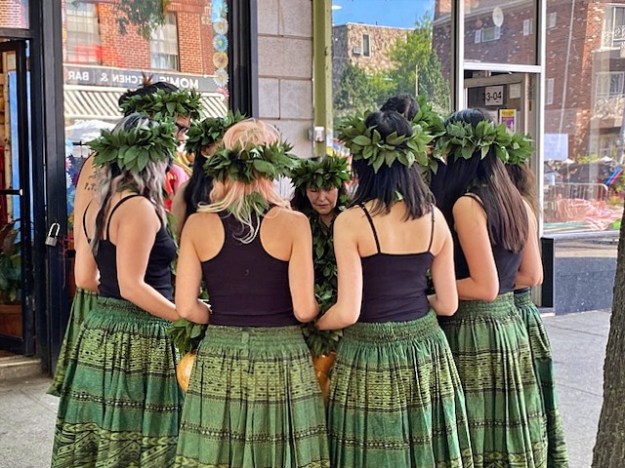
We taxied to 31st Avenue for the Asia & Pacific Islander Festival, a smallish gathering on a closed-off street where my wife’s New York hula troupe was performing. She had a joyous reunion with some old friends not seen since 2019, before the pandemic shut everything down. The aloha was strong in this group.

We raced back to Manhattan on the subway, changed clothes, had dinner at The Smith and walked across the street to the always spectacular Lincoln Center. We had great orchestra seats to what became one of the most exciting ballet evenings we have ever experienced.

New York City Ballet never disappoints and often just takes your breath away with the precision, stamina and virtuosic moves that are their trademark. This night was no exception.

Fancy Free was first up and surprised me with its energy and interest. The concept is that a trio of sailors are in town at a bar looking for companionship (it was in fact Fleet Week in NYC, so this made sense). A competition ensues when they meet just two women and, after a brief encounter with a third, end up with no one. The ladies are simply not having it. The contest for the females’ allegiance is sometimes intense, but in the end the young men are drawn back to their comradeship. Fancy Free is not my favorite style of ballet, but the dancers were amazing, and the choreography kept my attention throughout.

The music is by Leonard Bernstein with choreography by Jerome Robbins, whose work is, of course, brilliant. The musical and dancing style connection with West Side Story soon became very clear. Familiar but not distracting.

We knew this was the teaser for what followed: Agon, which means “struggle” or “conflict” in Greek. Music by Igor Stravinsky, choreography by, who else, George Balanchine. We did not know what to expect but had seen a video about the famous pas de deux narrated by Maria Kowroski [https://www.youtube.com/watch?v=CiPOZ0NS_2E] that helped us understand what was going on. Agon was described in the Playbill this way:

The dance critic Alistair McCauley says that many who saw the first performance of Agon were struck by how the music and movement created an impression of “shapes, phrases, rhythms and sounds that hadn’t been encountered before, but embodied New York modernism itself.”

https://tinyurl.com/3hm6ysmb The ballet is more than 60 years old but seems completely modern in style and costumes. Remarkable in every way, and, as usual, NYCB was at the top of its game. We both were entranced by the spectacle.

The evening was completed with Brandenburg, music by Johann Sebastian Bach and choreography by Jerome Robbins. Performed to excerpts from four of the Brandenburg Concertos with a large ensemble, the dancing was joyous. We were delighted to see Mira Nadon, who was promoted to the rank of soloist dancer in January 2022, and to principal just a year later. She is the first Asian-American female principal dancer at NYCB and a delight to watch. Brandenburg is long, maybe too much for us, although we were exhausted after our busy Friday and Saturday. There is, however, no denying the exceptional quality of the dancing throughout.

The next morning, we subwayed to Brooklyn to have brunch with another couple, also dear friends, and enjoyed, as always, a lively discussion of many things New York and beyond. We then walked together to the riverfront where the view of the Statue of Liberty was stunning in the late morning sun.

Sunday afternoon was, for me, yet another wonderful surprise. We had front row tickets at the Shubert Theatre for the matinee performance of Some Like It Hot, the updated adaptation of the Tony Curtis-Jack Lemon 1959 movie. Two down-on-their-luck musicians witness a mob hit and must flee for their lives. They disguise as women and join a newly formed, also struggling, all-female band.

I had given little thought to this show and expected an overly loud rock-music-based show. Wrong in every aspect. This was one of the funniest shows we have ever seen, and we’ve seen most of the great Broadway musicals. The music, dancing, acting were spectacular in every way. We both thought sitting so close might be problematic, but it was fascinating to see the dancers so close, performing incredibly high-energy moves in a somewhat constrained space and never missing a beat. Each dancer attending to his or her own space and actions with the result reminiscent of whirling dervishes. I noticed particularly the racial expressions and eye contact the dancers had with the audience – subtle but essential to the overall effect of the action. Perfect synchrony and stunning to see up close.

Each of the primary actor/singers was exceptional but note must be made of the role of Sugar played this day by the understudy, Kayla Pecchioni, who was remarkable in every way. Returning to my earlier mention of an updated adaptation, for this show, one of the two musicians is a Black man, played to perfection by J. Harrison Ghee. His facial expressions alone were worth the price of admission, but the man can also sing, dance and act. The updated show touches issues of race and gender, both handled with great humor in, for example, the song, You Can’t Have Me (If You Don’t Have Him), that gave the show a modern relevance.

While obviously presenting a very different vibe than masterpieces like Miss Saigon that have moved me to tears, Some Like It Hot is one of the most entertaining shows I have ever seen. It was, we both thought, flawless. If you get the chance to see it, don’t miss the opportunity. You will not be disappointed.

Our weekend escapade ended that evening with dinner at a wonderful New York style red-sauce Italian restaurant called Il Corso at 54 West 55th Street. The waiters were extremely attentive and helpful, and the food was phenomenal, especially the soup of the day, a puree of chickpeas and potatoes with some special spices. Remarkable and highly recommended.

Overall, then, our weekend in New York City was a smash hit in every way. Spectacular weather and phenomenal entertainment by the best-of-the-best. Unforgettable. Can’t wait to return.