Category Archives: Politics

Words Fail Me

Well, not quite. Don’t get your hopes up just yet.

I refer to the overpowering anger I experienced (and still feel hours later) upon reading the Washington Post’s recounting of the decision by the National Archives to blur out portions of photographs from the 2017 Women’s March for an exhibit celebrating the centennial of women’s suffrage. https://wapo.st/2TzSTSo [Note: if you can’t access the story because you lack a subscription, you should get one. Not that expensive and we need to support the surviving independent journalism of the free press lest we lose it]

The gist of this latest outrageous deferral to the childish bigoted misogynist mind of Donald Trump is a decision by the National Archives, supported by the archivist of the United States, to digitally obscure words that, had they been left in, could constitute engagement in “current political controversy.” The word “Trump” was removed from signs held by marchers that said, “God Hates Trump” and “Trump & GOP — Hands Off Women.” Note that “GOP” was left on the latter sign in the photo exhibit. Only Trump’s name was removed.

If that weren’t bad enough, and it is, the Archives also removed references to parts of women’s anatomy from some signs [avert your eyes, children, we don’t want you to know about women’s’ anatomy; education is bad for you]: ‘vagina’ (yes, VAGINA!!! RUN FOR YOUR LIVES! THE HORROR, THE HORROR!) was blurred out on signs that said, “If my vagina could shoot bullets, it’d be less REGULATED.”

Clearly those women marchers (and supportive men like me who were there too) were intent on bringing down the nation’s morals, undermining democracy and, THE HORROR, exposing viewers of the exhibit to unwanted attention to parts of women’s’ bodies.

By now, I’m sure you’ve also figured out that the word “pussy” was obliterated from signs that read, ““This Pussy Grabs Back.” Those signs, of course, refer to the statement of that paragon of moral virtue, Donald Trump, that “when you’re a star, they [women] let you do it. You can do anything…. Grab ’em by the pussy. You can do anything.”

So, it is clear beyond a reasonable doubt that these decisions were driven by a desire to avoid showing how women felt about the president during the Women’s March. The signs were part of historical photographs of the March. And the Archives decided that they were too much for the public to see because WHY? Because Trump wouldn’t like it. This is the same Trump that, along with his wife, dismissed the statements as just “boy talk” and “locker room talk.”  Apparently, the Archives is more concerned about the statements than the person who made them.

Given other attitudes Trump has expressed and that some people claim that the Civil War was about a “northern invasion” and that slavery had nothing to do with it, we can now expect the Archives will surely want to avoid “current political controversy”  by removing the bodies of Confederate soldiers from historical exhibits of Civil War battles. And, of course, no more photos of slaves. Should the Archives do an exhibit about the Holocaust, we can expect it to remove all evidence of bodies because there are still fools, and Nazis, who claim that the Holocaust never happened. Can’t risk offending them, can we?

And those pictures of American astronauts on the moon? Forget it. Just show the moon lander and the flag but no astronauts because there are people who claim the moon landing by astronauts was faked. Can’t offend them either.

Rather than avoiding “current political controversy,” the Archives has landed squarely in the middle of it by doing what the leadership of Soviet Russia did when they caused photos of the Politburo to be cleansed of “displaced” leaders. The Archives has also copied the techniques of Nazi Germany in “fixing” historical records. Once you start down the path of this type of “cleansing,” there is no end to it.

In an utterly lame and tone-deaf attempt to defend its decision to alter the historical record, the Archives sad, “Our mission is to safeguard and provide access to the nation’s most important federal records, and our exhibits are one way in which we connect the American people to those records. Modifying the image was an attempt on our part to keep the focus on the records.”

The problem with that is, of course, that the Archives did not provide access to the “records.” It provided access to records it wanted you to see without upsetting the president. In other words, we want you to see the records but only the records we think you, and our Dear Leader, can handle without getting upset. Because we all know what happens when Trump gets upset. We must avoid upset even if it means suppressing the truth.

Understandably, the Post reported, “Archive officials did not respond to a request to provide examples of previous instances in which the Archives altered a document or photograph so as not to engage in political controversy.”

It did say, “The decision to blur references to women’s genitals was made because the museum hosts many groups of students and young people and the words could be perceived as inappropriate.”  I suppose no students or “young people” read the newspapers or watch TV or music videos either, so, of course, the Archives is just trying to align with everyone else in denying information so we can keep students and “young people” uninformed about female anatomy. How thoughtful of the Archives to manage the national morality this way.

The Post quotes Rice University historian Douglas Brinkley saying, “If they don’t want to use a specific image, then don’t use it. But to confuse the public is reprehensible. The head of the Archives has to very quickly fix this damage. A lot of history is messy, and there’s zero reason why the Archives can’t be upfront about a photo from a women’s march.”

Wendy Kline, a history professor at Purdue University, is quoted as saying, “Doctoring a commemorative photograph buys right into the notion that it’s okay to silence women’s voice and actions,” Kline said in an email. “It is literally erasing something that was accurately captured on camera. That’s an attempt to erase a powerful message.”

The article also mentions that Getty Images, the owner of the images, licensed them for use by the Archives but that it was unclear at press time whether Getty had approved the alterations. But Getty is not the Archives. Whether or not it approves of the alteration is total irrelevant in judging the decision to alter the photos for public consumption. Getty can do whatever it wants with its property on its own website but is not the arbiter of what is appropriate for the National Archives.

This, I suggest, is what happens when the government bends its knee to the Executive Branch, distorting history without even disclosing what it has done until called out for it. The Trump Administration has made itself unique in American history by the level of graft and corruption among presidential appointees, not to mention the president himself. This corruption has infected the work of the executive agencies to an unprecedented degree. In this unbelievable and outrageous example of the Archives being afraid to offend the president, and thus willing to distort historical records presented for public display, we see just how far the effects of the president’s corruption have extended.

The Archives must immediately either reverse the digital distortion of these photographs. If it’s so worried about upsetting children and “young people,” it can take other measures to warn about the content and let the parents and “young people” decide what they want to see. Making such decision is not the proper business of the government, at least not one serving a democracy rather than a dictator.


Money, Money, Money ….

You hopefully recognize the lines from the movie version of the musical Cabaret in which Liza Minelli and Joel Grey sing

Money makes the world go around
The world go around
The world go around
Money makes the world go around
It makes the world go ’round

A mark, a yen, a buck, or a pound
A buck or a pound
A buck or a pound
Is all that makes the world go around
That clinking clanking sound
Can make the world go ’round

And so on, humorously, but with underlying cynicism about what motivates people to act, or not act. The full lyrics can be found here. https://genius.com/John-kander-money-song-lyrics  and a YouTube video of the movie masterpiece, here: https://bit.ly/2rVMplk

We’ve been seeing a lot of recent press reports fawning over the large contributions haul that Donald Trump has accrued, with the suggestion, but, as usual, with no real proof, that his money-raising success is attributable to public backlash against his impeachment by the House of Representatives. Indeed, these claims are made despite multiple polls showing the majority of Americans think it’s time for Trump’s removal for high crimes and misdemeanors. A lot of the publicity about the money seems intended to demoralize Democrats.

But all this gushing over Trump’s financial haul (even assuming, improbably, he/they are not lying about the sums he’s getting, a partial truth still being a lie), the full picture is quite different.

Let’s consider what is actually happening on the Democratic side of the fundraising ledger. Politico reports, “Democrats are riding a massive surge of presidential campaign cash into 2020.” https://politi.co/39GUuvq

The current Democratic presidential contenders and the Democratic National Committee combined raised over $480 million in the last year — more than President Donald Trump’s reelection machine brought in during that time. [emphasis added]

This occurred despite the huge advantage that an incumbent president normally has, the division of Democratic efforts among an unusually large number of hopefuls and the traditional Republican advantage among the big-money donors, whose support Republicans are completely happy to accept even when it comes with major expectations of favors later to be granted. Money, Money Money ….

To be sure, there are issues for Democrats in the fundraising area, but also offsetting considerations, as noted by Politico,

Though the [Democratic] party is about to spend much of the money raised on a tough primary while Trump builds up resources to take on the eventual nominee, the millions of contributions to Democrats in $10 or $20 increments signal massive enthusiasm from the party grassroots heading into the election year.

Some of that enthusiasm may derive from the growing awareness that Trump is also stealing a lot of money from the taxpayers to cover the cost of his incessant golf trips to his properties and the cost of his political “rallies” at which he spends his time attacking his “enemies” (the press, Democrats, the Constitution, teenagers like  Greta Thunberg and the survivors of the school shootings, and on and on).

Is there anything on the horizon that should dim the enthusiasm that Democrats currently show? Maybe. It has been speculated almost since Trump took office that, if he felt his power position genuinely threatened, he would stop at nothing to save himself, including starting a war somewhere. It may be that the recent decision to kill the top Iranian military commander with a drone strike was just that moment everyone has dreaded. Only time will tell how this plays out politically. Some young people will no doubt be satisfied to sacrifice their careers and perhaps their lives to live out Trump’s fantasies about global power and “America First,” but many others, and their parents and other family members, will likely blanch at the prospect of forced military service to support a war that Trump promised would not happen on his watch.

Trump can’t go more than a few hours without tweeting about the impeachment that he claims is unwarranted. He protests way too much for an innocent man, especially one who knows he has the Republican Party in his back pocket, no matter what he does. Tweeting and starting a war won’t save him. If anything, these actions should inspire Democrats to contribute more.

The main hope is that once the in-fighting is over, the Democratic Party will unite around whoever is the nominee and the real donations will flow in. Trump will spend without limit, even if he has to drain his businesses (more bankruptcies won’t concern him at all) to do it. And, of course, he probably hasn’t begun to think of creative ways to make taxpayers cover more of his campaign costs.

Democrats better get sharp with their messaging. Trump has provided a literal gold mine of material to use against him. I understand that his so-called “base” will likely not be moved by any evidence of wrong-doing or incompetence on Trump’s part, but there are plenty of movable voters who should not be written off just because they voted for Trump in 2016. Much has happened since the last election and almost none of it is favorable to Trump. The question is whether the Democratic Party and its leadership will be as smart and tough as the Trump machine that knows no bounds of decency or honesty. That is not to argue that Democrats should emulate Trump and the Republican Party’s conduct but that it should be very focused on using that conduct against Trump’s re-election campaign. Rope-a-dope and all the rest. Just do it.

And meanwhile, prepare to keep the money, money money … coming in. It’s time also to narrow the field and get to the end game – a nominee that can not only defeat Trump but also be a leader worthy of the United States of America, a leader who can recognize the faults in our history but with the vision to create a better country for the future. We need a leader who can understand how to be strong and peaceable at the same time, who can respect differences but unite the country behind a benevolent vision that sustains everyone, not just the people already at the top.


F**king Liberals

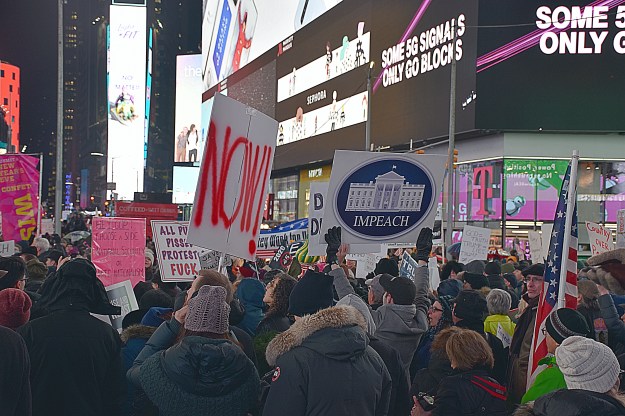
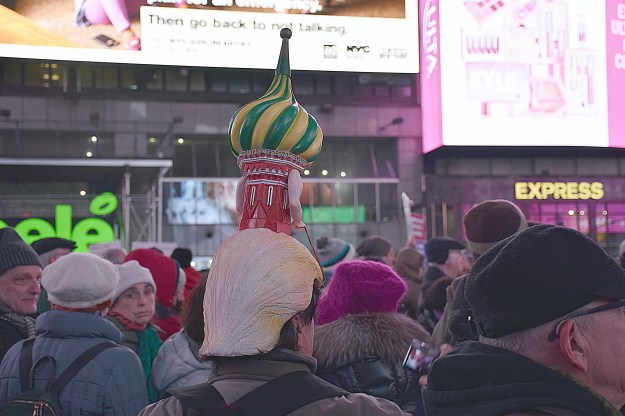
As previously reported, it was a cold and wet night in New York City for Impeachment Eve. That did not stop the thousands upon thousands of loyal Americans from joining a rally and march from Times Square (46th & Broadway) to Union Square (14th Street & Park Avenue). The large crowd was enthusiastic and angry. The repeated chants of “Ho, Ho, Donald Trump has got to GO!” and “Impeach Trump – REMOVE!” were rendered with gusto. There were some amusing signs but most were direct in their recognition that the occupant of the White House is a criminal and traitor to American values. Considering the weather, the turnout for this event was extraordinary. New York’s Finest were turned out in force to block streets where necessary to let the march pass unimpeded.

Meanwhile, back in the White House, the president of the United States was likely going berserk. Having already produced a tyrannical and hysterical rant letter of six pages to the Speaker of the House, packed as usual with dissembling and lies, what is left? He could break up some furniture that, after all, doesn’t belong to him so why would he care? Better yet, he could do some tweeting. I haven’t checked but I’m betting that’s what he did. And continues to do today.

Anyway, the march in New York City was remarkable. As far as I’m aware, there was no pushback from Trump “supporters” except one relatively young man with a large backpack who pushed past us on the sidewalk muttering aloud, “f**king liberals!” Otherwise, the crowd was of one mind. We were impressed to see the diversity of ages, including elderly folks walking with canes and many young adults who recognize the danger that Trumpism represents to their future.

I have set out below a small sample of photos from the event, mostly rendered in “night vision.” We were not alone, of course, as the internet is alive with photos from around the country as groups large and small went outside to show their contempt for this president and his enablers.

We all understand that the Republicans in the Senate are not going to convict Trump. Their position is that they don’t care what crimes he may have committed. He is their man and they are going to stick with him to the end. They apparently live under the illusion that they will be in control of the federal government forever and therefore there will be no day of reckoning. That is, of course, the ultimate question: will the majority of Americans accept the destruction of their democracy or will they rise up and assure that truth, justice and the American way prevail in 2020? If Impeachment Eve is any guide, the answer is YES.

Impeachment Eve

NOTE: Feel free to share this post with anyone you wish.

Tomorrow evening (Tuesday), rallies will be held around the country in anticipation of the House vote on the Articles of Impeachment against Donald Trump. The weather forecast for New York City (wet and cold) notwithstanding, we will be participating in the Times Square event. At last count 589 events were scheduled around the country. If you’re reading this, you can almost certainly find an event close enough to attend.

When asked what kind of government the new Constitution would produce, Ben Franklin famously said, “A republic, if you can keep it.” That is the essence of the question before us now.

While news reports indicate that the House Democrats have the votes to adopt the impeachment articles, it is important to show strength of conviction now and actively support the impeachment effort. If it’s cold where you live, add some layers, buy pocket warmers, do whatever it takes to join the thousands, nay, the tens of thousands who will be demonstrating in support of the House action to impeach Donald Trump for high crimes and misdemeanors.

If you harbor doubts about whether the impeachment is warranted, I urge you to search for the editorials of the New York Times or the many other major papers that have come out in favor of impeachment. Here is a sample of the some of those papers:

Los Angeles Times

Boston Globe

New York Daily News

Chicago Sun-Times

USAToday

Washington Post

Philadelphia Enquirer

San Francisco Chronicle

Orlando Sentinel

Salt Lake Tribune

Tampa Bay Times

The Republican arguments against impeachment have changed so many times it is impossible to comprehend in cogently logical terms the principles or concepts on which their defense is based. In the end, it comes down to “So what? Who cares?” They simply refuse to acknowledge what the White House-manufactured “transcript” says Trump demanded. They argue that he was really only interested in curing corruption in Ukraine even though corruption was not mentioned in the call with Ukraine President Zelensky.

I will not go into the details of all that at length. If you aren’t persuaded by now that Donald Trump is a corrupt violator of the U.S. Constitution, including his oath of office, and American law, nothing I can say here will persuade you.

But I will say this, that I believe is true beyond a doubt: the fate of the democracy we know as the United States of America, imperfect though it may be, is in grave danger. It is no exaggeration to compare the Republican subservience to Donald Trump and the resulting disinformation campaigns to the events that subverted Germany in the 1930s. Many serious thinkers, historians and legal experts, have warned of these dangers.

I understand that the Republican-dominated Senate is not going to convict Trump. The Senate Majority Leader has already publicly stated that the Senate Republicans will coordinate with the accused and do whatever the president wants. Senator Lindsey Graham, who formerly condemned Trump as a “nut job,” has stated that he is not even going to read the evidence before voting against impeachment. It is nonetheless vital that the evidence of Trump’s perfidy be presented for action.

Suffice to say, then, that the burden is upon us as individuals to be a little uncomfortable and to take action to challenge the narrative on which the Republican Party has chosen to stand. If we fail to do enough, we may regret it forever.


Hero of the Week

No, it’s not any of the Democratic politicians who brought articles of impeachment against the criminal traitor Donald Trump (because they omitted the 10 cases of blatant obstruction of justice from the Mueller Report – more about that in another post).

No, my Hero of the Week is Houston Police Chief Art Acevedo who ripped into Mitch McConnell, Ted Cruz and John Cornyn for their corrupt alliance with the National Rifle Association that the Sheriff said was ultimately responsible for the death of the officer he was there to bury [https://bit.ly/2RAg7XA]:

I don’t want to see their little smug faces about how much they care about law enforcement when I’m burying a sergeant because they don’t want to piss off the NRA.

Referring to the three senators, Sheriff Acevedo also said:

Make up your minds. Whose side are you on? Gun manufacturers, the gun lobby — or the children that are getting gunned down in this country every single day?

The Violence Against Women Act is stalled in the Senate in part because

the NRA doesn’t like the fact that we want to take firearms out of the hands of boyfriends that abuse their girlfriends …. You’re either here for women and children and our daughters and our sisters and our aunts, or you’re here for the NRA.

This is a law enforcement officer who speaks his mind. He is angry because he witnesses the real-life consequences of the Republicans’ refusal to advance legislation that might affect the position of the NRA that any restriction on access to guns is unacceptable. Cornyn is cited in the referenced article as, typically, blaming the bill’s failure to advance on the Democrats who won’t “negotiate” because they are focused on the small matter of a criminal traitor sitting in the White House with the support of, naturally, the Texas senatorial delegation and, of course, #MoscowMitch. I saw a TV clip yesterday of Cruz claiming that it was true that Ukraine interfered in the U.S. election in 2016, another example of gaslighting the nation with false narratives promoted by Russia for which zero evidence has been found to exist. Cruz cited a public statement made by an official in Ukraine to support his case, but it is blatantly obvious to any thinking person that expressing an opinion about something is not “interference” in an electoral process. Cruz is just another Trump toady.

In any case, kudos to Sheriff Acevedo for speaking the truth under the difficult circumstance of burying a fellow officer who died in the line of duty answering a domestic disturbance call involving an abusive boyfriend. The blood on NRA’s hands continues to mount. One day they will drown in it and good riddance.

Impeachment – Why and What?

I recently heard that a friend of mine was confused about the impeachment process now underway in the House of Representatives. I will try here to clarify, in simple English and without legalisms, what is going on and why.

The president is currently subject to an “impeachment inquiry” started by a resolution of the House of Representatives. The “inquiry” is a fancy term for an investigation. That investigation is about the question whether the president in his dealings with Ukraine committed “treason, bribery or other high crimes or misdemeanors,” that are the criteria for impeachment in the U.S. Constitution. If impeached (by the House adopting articles of impeachment) and convicted (by the Senate finding that the asserted crimes in the articles are true), he may be removed from office. Since he is still president during this process, he cannot be indicted (according to the Department of Justice). Once removed, however, he can be indicted, tried, convicted and sent to prison for crimes committed while in office.

The investigation is being conducted through two main processes.

The first process is the gathering of evidence through testimony-under-oath by various witnesses who have been subpoenaed (ordered to appear) or have volunteered to testify. Initially, those depositions (taking testimony under oath recorded verbatim) were conducted in private sessions open to members of the three investigating committees from both parties. Despite the opportunity to be present and ask questions, Republicans have complained bitterly about what they hysterically and falsely called “secret” sessions, even to the point of storming into one of the sessions in a group, violating the security requirements that apply to the site of the depositions.

The second process is the public hearing phase, now being broadcast on many TV stations, in which the same witnesses are called to be examined in public, again by both Democrats and Republicans. Now the Republicans, including the president himself, are bitterly claiming that the hearings should not be public. In the end of their rhetoric, what the Republicans want is to shut down the impeachment process entirely. That is not going to happen.

Why, then, is this impeachment inquiry happening? The essence of it is that Donald Trump tried to use Congressionally approved funding to help Ukraine defend  against further military incursions by Russia and also the prospect of a meeting with Trump for the newly elected Ukraine president (Zelensky) to leverage Ukraine’s new leadership to announce investigations into the then-leading challenger to Trump’s re-election, Joe Biden. The immediate target of the investigation would be Biden’s son, Hunter, who was, for a period, being paid $50,000 a month to sit on the board of Burisma, a Ukrainian energy company. Republicans claim that this arrangement was part of the historic and endemic corruption that has afflicted Ukrainian political leadership for a very long time, but thus far no evidence has turned up to indicate that either Joe or Hunter Biden broke any laws.

All this is complicated by a number of details that are not central to the issue of what the president did, but they certainly illuminate his motives and explain his conduct. For one, Trump used his personal attorney, Rudy Giuliani to engage with the Ukrainians and to promote false conspiracy theories about the Biden’s and to lead a smear campaign against the sitting U.S. ambassador to Ukraine, Marie Yovanovitch. Trump eventually fired her without notice or explanation.

There are many other characters in this drama, some with long titles and long histories as diplomats in the U.S.-Ukraine relationship. Republicans have attacked many of these people because they obtained some or all of their information about Trump’s campaign against Biden through other sources. Indeed, the initial report that started all of this came from an anonymous whistleblower. The Inspector General of the Intelligence Community within the Office of the Director of National Intelligence reviewed the whistleblower’s report and found it credible and disturbing. The impeachment inquiry followed.

It is important not to be distracted by the efforts of Republicans to focus the fight on side issues, such as the identity of the whistleblower or the “hearsay” nature of some of the evidence against Trump. The most damaging evidence was direct and produced by Trump himself, in the form of a memo (not a transcript) of his call with Ukraine President Zelensky in which Trump called on Zelensky to start the investigation. There is much additional testimony from Trump appointees, like Gordon Sondland, U.S. Ambassador to the European Union, who personally participated in the leveraging of Ukraine.

The impeachment may be broadened before it’s over. One example comes from the Mueller investigation. Mueller’s final report found 10 instances of obstruction of justice by Trump and/or members of his staff and administration. These may, and in my opinion definitely should, be included in the forthcoming articles of impeachment. A second major example is playing out in the courts now – Democrats in the House are seeking  access to many of the redacted materials in the Mueller Report that may show that Trump lied to Mueller and is thus guilty of the high crime of perjury.

So, the impeachment is pretty straightforward when the Republican smoke is cleared away. Trump tried to induce Zelensky to publicly announce a Ukrainian investigation of the Biden’s to damage Joe Biden’s challenge to Trump’s re-election. The evidence on this is clear. He did it. The evidence of obstruction of justice in the Mueller Report is also clear. The House of Representatives is collecting the evidence and presenting it through public hearings. Eventually, when the hearings are completed, the House will have the opportunity to vote on “articles of impeachment.” These are like a criminal indictment. They will state the specific charges of “treason, bribery or other high crimes and misdemeanors” that the House leadership believes are the basis for impeaching the president.

If the articles are approved by a majority vote in the House prior to the 2020 election, the impeachment moves to the Republican-controlled Senate for “trial” to determine if the president is guilty of the charged offenses and, if so, what the penalty should be. This process will be controlled entirely by Republicans and, absent a massive change in positioning, Republicans will refuse to convict the president regardless of the charges and regardless of the evidence.

The question of judging Trump’s conduct in office will then move to final determination in the election of 2020.

Impeachment – Who Should Testify?

In keeping with their desperate and ill-conceived defense of the indefensible president, Republicans have submitted a list of proposed witnesses they claim should be called to testify in next week’s public hearings on the impeachment of Donald Trump. Not surprisingly, the list includes the heretofore anonymous whistleblower who first revealed the president’s treachery in trying to leverage Ukraine’s president to publicize an investigation of Joe Biden by withholding Congressionally-approved aid. Republicans also want testimony from Biden’s son and random others.

Of particular interest, however, is the omission of most of the administration personnel with actual knowledge of the president’s demands, including, most notably, Rudy Giuliani, Trump’s personal attorney and appointed “fixer” to replace the disgraced and jailed Michael Cohen.

How should Adam Schiff, who chairs the House investigation, respond to these requests?

The issue in the hearings – the only issue – is whether the president of the United States committed impeachable offenses. The witness list, therefore, should consist only of people who can present factual information about that question. The whistleblower is not such a person because his report of the president’s wrongdoing was obtained from others who almost certainly will testify about their firsthand knowledge of what transpired.

I think of the whistleblower as similar to a person who hears others shouting “fire” and calls 911 for the fire department to report what he heard. He can’t say there was actually a fire or any details because he didn’t see it. He heard from others who saw it and he took action to help. Therefore, in the ensuing investigation of the fire, his testimony would at most establish that someone shouted “fire,” but he could not testify about the details of the fire he didn’t see. His testimony would be essentially useless on the origin of the fire, how it spread, who fought it, etc. If he chose to be identified, he might be hailed as a hero but his information about the fire itself would be useless. An imperfect analogy, I suppose, as most analogies are, but sufficient to make the point.

The Republican demands for exposure of the whistleblower are an essential element of the only “defense” Trump has – distraction from the central and only real question: the president’s conduct in connection with aid to Ukraine and the 2020 election interference he sought from a foreign government. The same is true about the demand for Hunter Biden’s testimony. Republicans want to create a sideshow about alleged corruption in the Biden camp which, even if true (and it has not been shown by evidence from any credible source), is not relevant to the president’s attempt to obtain foreign interference in the election. It is the president’s conduct, and no one else’s, that is at issue in the impeachment process.

I well understand that, when push comes to shove, Trump’s defenders will argue it was a legitimate exercise of presidential foreign policy authority to try to ferret out corruption by a person who was Vice President at the time. However, the evidence is clear, and mounting with every passing witness, that the sole purpose of Trump’s Ukraine maneuver was to help him defeat a domestic political opponent in 2020. Absent Biden’s prominent standing among the top challengers in 2020, Trump would have had no interest whatsoever in Biden’s involvement in Ukraine.

The answer to the question posed, then, is straightforward: individuals with direct knowledge of Trump’s conduct should testify. This is the investigative phase of the impeachment process and the sole issue is the president’s conduct. If Republicans want to produce witnesses to testify about Trump’s character, in mitigation of the possible penalty, that testimony will only be relevant in the Senate trial where the issue is conviction (or not) based on the evidence adduced in the House process. It is laughable, of course, that Republicans would introduce character evidence in the Senate, as that would create the opportunity for full exploration of Trump’s personal conduct in a host of areas, including defrauding charities, cheating the military and many others. Such a development would not deter the Republican majority from finding Trump “not guilty” but it would add to the ammunition available to the Democratic nominee in the 2020 campaign. The Senate trial, managed by #MoscowMitch, will be a brief affair with a foregone conclusion.

An overarching question remains as to how broad the House articles of impeachment should be. There are reported indications that Democrats are planning to limit the articles to the Ukraine situation. I am speculating, but must assume the rationale for that is to anticipate and undermine the argument that the impeachment process is just political revenge and an attempt to undo the election of 2016.

That would be a huge mistake. It would allow Trump to escape the findings of the Mueller investigation that Trump committed at least 10 acts of obstruction of justice. Prior posts in this blog covered the details. If the issue is going to be presented of criminal acts by the president, and there is an entire bag full of evidence of at least 10 such crimes in addition to the Ukraine scenario, limiting the charges will be interpreted by Republicans, and possibly the electorate, as proof that the Mueller Report was wrong and that Trump is innocent. The evidence of Trump’s guilt is overwhelming and he has thus far produced nothing substantive and relevant that could defeat that evidence.

Of course, in anticipation of the public hearings next week, Trump has announced he “may” issue a “transcript” of another Ukraine call. When? Why, Tuesday, of course, the day before the hearings begin. Classic Trump deflection and distraction. The first release of the “notes” from the call with President Zelensky were a disaster for Trump as those notes established the very crime he had denied. The second release will be more suspect since Trump is now in more serious trouble than he ever imagined and he likely will use the second call notes to try to repair the damage. I have previously written about the problem of calling these reports “transcripts” and the concerns expressed there are even more serious in the promised second release. CNN, among others, continues to misuse the term “transcript” to describe these notes, the original source of which are locked away in an ultra-secure computer somewhere in the White House.

A final point – the refusal of the Trump administration to produce witnesses subpoenaed by the House committees has led to multiple legal proceedings designed to test the extent to which the Executive Branch can claim, as this administration has, “absolute immunity” from Congressional oversight. Those cases are generally being decided against the administration that will certainly want a final ruling from the Supreme Court before complying. Democrats, wisely, I think, have not taken that bait entirely. Schiff has said repeatedly that the House will simply assume that the evidence that would have been adduced from non-appearing witnesses would be adverse to the president.

Schiff’s position is entirely consistent with the way legal presumptions operate. A party who claims “Proposition A” to be true but refuses to produce evidence of the truth of “A” risks a finding that “A” is not true. Withholding evidence is, in effect, an admission. The House has every right to draw adverse conclusions from the refusal of administration witnesses to testify, especially since those who have done so have uniformly supported the conclusion that Trump did indeed try to leverage Ukraine as charged for the purpose of unlawfully securing foreign interference in the 2020 election.

Transcripts, Quids & Quos and Evasions

I continue to see media stories describing the document released by the White House that purported to be a “transcript” of the conversation in which the president of the United States tried to pressure a foreign leader into investigating a domestic political rival (Joe Biden). The same stories often use the term “quid pro quo” which translates roughly to “something for something” or “this for that.” I remain mystified and angry that experienced people whose job it is to communicate continue to misuse terms that are essential to understanding the stories they are reporting.

While I doubt any media people will read this blog post or care much what I have to say, but that has not stopped me before and it will not do so now. You might say I am writing this without the expectation of a quid pro quo. But it would be far better not to say that. Here’s why.

First, what is a “transcript?” This is not particularly mysterious, though there are different meanings for different situations. For example, in education, a transcript is “an inventory of the courses taken and grades earned of a student throughout a course of study.” https://bit.ly/2O04dD4 Anyone who has an education will likely recognize this one.

In the world of law, however, “transcript” refers to something quite specific. In fact, the proper relevant term is “transcript of record” which is a “typed or written copy of the court reporter’s notes that have been taken down during a trial.” Black’s Law Dictionary at https://bit.ly/2CrYqR7

This is a precise record of what is actually said, word for word, during the proceeding for which a transcript is being made. It is typically recorded as the events occur by a trained “court reporter” who either types into a special machine that produces tapes from which the “transcript” is printed or in more modern environments the reporter speaks into a device that records the reporter’s words. To assure precision and accuracy, the parties to the proceeding may review and propose corrections to the “transcript” before it is considered “final” and no longer subject to dispute.

Transcripts in the above sense are routinely created in “courts of record” and in depositions and formal arbitrations. A “court of record” is usually a trial court or higher but does not typically include small claims court and traffic courts where no verbatim record is created.

Note that I referred to “parties” in the plural in referring to the review/correction process. Regardless of the positions of the parties or who asked that the deposition be taken, both sides get to review the record and disputes are settled by the court. The result is that a “transcript of record” is as accurate as humans can make it: taken down and produced by disinterested professionals, evaluated by partisans and ultimately determined by a neutral authority.

You get the idea, I’m sure. A “transcript” as regards an event is a precise, accurate record of exactly what was said by the participants. Anything less formal is not actually a “transcript” and lacks the credibility of an official transcript.

For example, if I sit in on a telephone call and make personal notes of what I heard, then have someone type up my notes, no “transcript” results. Instead, there is just a typed version of my notes and there is no process by which the accuracy and precision of my note-taking is assessed and corrections made by independent parties with an interest in accuracy and precision. In this situation there is no “transcript” of the call. Even if a disinterested professional is involved in taking notes, the absence of independent review of the resulting document deprives the document of the credibility to be given to a “transcript.” In the case of Trump’s call with the president of Ukraine, there is an additional problem that a “translation” was required, adding an additional layer of uncertainty to the end product.

It follows, therefore, that the document released by the White House of Trump’s “perfect call” with Ukraine President Zelensky is not a “transcript” and should not be referred to as one by the media or anyone else. There is no basis for the conclusion that the document has the precision and accuracy of an authentic “transcript.”

At the same time, since the White House obviously believed the president’s claim of perfection for the call, the document that was released may reasonably be presumed to be the best version, from Trump’s point of view, of what occurred. As has been reported everywhere but Fox News and Breitbart, the document is clearly damning and proves that Trump is once again lying about what transpired. Numerous parties who listened in on the call have testified under oath that Trump unquestionably demanded an investigation, and public disclosure thereof, of a domestic political rival.

This brings us to the question of “quid pro quo.” The media and Republican defenders of Trump have obsessed over whether the call involved a “quid pro quo.” Here, again, we must refer to the environment of law, where this term is often used and has a well-understood meaning. As stated in Black’s Law Dictionary (https://bit.ly/36LZOMu),

What for what; something for something. Used in law for the giving one valuable thing for another. It is nothing more than the mutual consideration which passes between the parties to a contract, and which renders it valid and binding. [emphasis added]

In simple English, as applied to the Trump-Zelensky call, Trump was demanding a public declaration of an investigation of his chief political rival in exchange for the release of aid funds that Congress had previously appropriated. Still in simple English, Trump said, “if you want the money released, you must announce the investigation I want.” What for what; something for something. You do this for me and I’ll do that for you. Clear as a bright sunny day.

Reading the document released by the White House, the “best version of the call per Trump himself,” it is plain that Trump demanded something in exchange for something else. A “favor,” his word, for a favor.

The media would do well to stop calling the White House document a transcript. It is not a transcript. At best it is a summary of notes about the call. It has not been vetted by independent authorities or any outside party with an interest separate or independent from Trump.

As for the quid pro quo, why use a Latin term when simple English will do? While quid pro quo is easy to understand, the use of Latin here will only obscure the issue for many readers. Some short-hands are useful but this one, in this setting at least, is not. It is helping the Trump administration muddy the public understanding of the illicit bargain Trump sought to achieve.

Finally, there is this question, as yet unanswered by the White House: why were the records of the Trump-Zelensky call secreted in a top secret computer? If they are exculpatory, why haven’t they been released? The answer, I suggest, is that the original records would be even worse for Trump than the doctored notes falsely presented as “transcript” to the world.

Republican Children of the Corn Violate Law Helping Matt Gaetz Find His Blankie

It seems this was inevitable. Backs against the wall, unable to defend the conduct of their president on the substantive merits, the Republican Party decided, apparently with the president’s foreknowledge and approval, to disrupt the lawful proceedings of House investigative committees looking into the president’s conduct through an “impeachment inquiry.” https://bit.ly/2NaUiKn  In simple English, the House committees are collecting evidence through sworn testimony of witnesses with information about, among other things, Trump’s attempt to extort Ukraine into investigating Trump’s current principal Democratic opponent, Joe Biden.

Roughly two dozen Republican House members forced their way into the hearing, leading to a five-hour delay in testimony that was about to start when they interrupted. They apparently left their lunch boxes and blankies outside but chose to take their cell phones into the room, violating House rules about bringing electronic devices into a SCIF (Sensitive Compartmented Information Facility). The Republicans don’t care, of course, about national security being compromised when it comes to protecting Trump from accountability.

The Republicans would have you believe that they have been excluded from the investigation, but the reality is that Republican members of the six investigative committees have the right and are exercising that right to be in the room during the taking of evidence. The full list of committees is: Financial Services, Judiciary, Intelligence, Foreign Affairs, Oversight and Reform and Ways and Means. The fact of six committees’ involvement likely arises from the breadth of the possible violations of multiple laws by the president and his enablers.

Rep. Swalwell reported that the majority of Republican members of the investigating committees in fact come into the room to complain about the process, then leave before the evidence is taken, all the while complaining that the evidence is not being taken in public. Likely they are afraid that Trump will find out they listened to evidence about his crimes and take away their lunch money.

Given that Republicans have not in fact been excluded from the investigation, what was the purpose of the multitude of law violations by Republican members of Congress, beyond the obvious publicity stunt and suck up to Trump who had just complained they were being too timid? Most likely it is the product of Donald Trump’s desperation that his scams of the American public and multiply treasonous conduct are being exposed and may yet lead to his removal from office and indictment for obstruction of justice, among other things. Maybe they just thought they could somehow stop the whole process by creating the threat of daily interventions. Maybe they didn’t know what the hell they were doing. Someone may have said: “We can’t just sit here and do nothing while Democrats compile an irrefutable case of repeated illegal conduct by our lord and master Trump, so let’s storm the castle! And they all yelled “Yeah, let’s storm the castle!” And, lacking pitchforks and lighted brooms and unable to find a castle, they grabbed their cell phones and stormed into the SCIF.

Putative Congressman Steve Scalise then lied to reporters outside the room: “Voting members of Congress are being denied access from being able to see what’s happening behind these closed doors, where they’re trying to impeach the president of the United States with a one-sided set of rules, they call the witnesses.” What he would have said if he uncharacteristically respected the truth was that some voting member of Congress were denied access because they don’t sit on the committees conducted in the investigation. This is not hard to understand, except maybe for Scalise and his brave band of castle stormers.

I am not making this stuff up. The article cited above includes this statement from Rep. Bradley Byrne of Alabama (where else? – sorry Alabama, but you elected these people so you own them):

“When we walked in, they looked dumbfounded and the room just came to a stop. And we lined up along the wall or sat in chairs expecting them to do something. And after several minutes, Adam Schiff got up and just walked out. And while he was walking out I said, ‘Don’t go.’”

Oratory of that caliber will almost certainly make the history books used in Alabama schools, if any, in the future, if any. If you want a model for a forceful entry, absolutely line up along the wall and sit in chairs. Powerful stuff.

The Republicans reportedly believe that the information and transcripts should be made available to all members of Congress, unlike the underlying evidence in the Mueller investigation that they claimed completely exonerated Trump.  Logic is not Republicans’ strong suit. My response is: be patient, folks; remember that patience is a virtue and virtue is its own reward; the evidence you claim you want to see will be coming out in due course. Then, I bet, you’ll be screaming that disclosure was an unjustified assault on the president’s good character.

According to reporting by The Hill,

The move by House Republicans comes a day after another witness, top diplomat William Taylor, testified that Trump withheld military aid to Ukraine to pressure the country to conduct a pair of investigations — one into 2016 election hacking, the other into the family of former Vice President Joe Biden — that might have helped Trump’s reelection campaign next year.

Looks like Mr. Trumpski is in a bit of a bad spot here. The more evidence comes out, the more he squawks, but he has produced no evidence of his own to counter the sworn testimony of many people who became aware of his attempt to leverage Ukraine into finding dirt on Joe Biden and his family. Screaming “I’m innocent” is not going to save him from the political guillotine.


Mind the Words You Read – Part One

I have just finished reading The Testaments, the follow-up novel by Margaret Atwood to the dystopian The Handmaid’s Tale, published in 1985. Two sentences in it stopped me cold with the depth of its insight. Atwood wrote:

“Where there is an emptiness, the mind will obligingly fill it up. Fear is always at hand to supply any vacancies, as is curiosity.”

In some fundamental way, those insights explain everything. And they serve as a warning – fail to educate the people and the resulting void of understanding will fill itself up with falsehoods, fantasies and many other dangerous concepts. Idle minds are the devil’s workshop and all that.

As I thought more about how that insight works in the modern world, a couple of related thoughts emerged. First, we have believed that at least the developed countries left the Dark Ages behind and embraced the ideas of the Enlightenment. We chose science as the most valid way of explaining the physics, chemistry and, increasingly, psychology of our behavior. At least that is what I was taught a hundred years ago when I was in school.

Second, our ability as humans to evaluate the world around us, including the behavior of other people, is largely a function of our ability to communicate with each other using, mainly, language and, secondarily, mathematics. If we could not do so, our chances of understanding and acting to sustain our common interests would likely fall to near or actual zero.

Third, we now understand that most human behavior is driven by the unconscious part of the mind and that it must be this way to enable us to perform even the most mundane tasks (chewing gum while walking and taking notes while listening to a lecture come to mind). That principle in turn means that the unconscious biases we all have are constantly impacting our ability to understand what is going on right in front of us. Confirmation bias, for example, defined as the tendency to filter new information so that what is believed supports what was previously believed, makes it hard to change someone’s mind, including our own. We tend to be very attached to what we “believe” is true. And don’t try to tell me otherwise.

Finally, then, I began to be more and more disturbed by what I was seeing on both “sides” of the political aisle in media stories about the “facts” of political life in the United States. If you’ve traveled by train or subway, you are familiar with the rote warning to “mind the gap between the train and the platform.” In the present matter, the warning would be “mind the gap between the words you read and the truth.” Fail at that and you could lose your country.

Allow me to elaborate.

An October 9 Wall Street Journal article was entitled Trump Opens Door to Cooperate With House Impeachment Probe.” A better example of framing (another implicit biasing technique) and click-bait would be hard to find. The title is provocative by suggesting Trump had done an about-face on the House Impeachment process that he had repeatedly and viciously attacked.

The contrary truth, however, comes quickly in the form of the opening sentence that lays out the reality that Trump’s asserted willingness to cooperate was highly conditional:

“…. if the investigation was authorized by a House vote and if Democrats commit to following rules he views as fair, a sign of potential cooperation a day after the White House said the inquiry was unconstitutional.”

The article goes on to explain that Trump was adding a

“caveat to the White House’s eight page letter a day earlier that described the president’s broader refusal to cooperate with the investigation, citing the lack of a vote authorizing the probe amid other purported shortcomings.”

This, I suggest, whether intended or not, created a condition of cognitive dissonance in which the reader was primed to read about Trump’s acquiescing in an impeachment process when the actual story was that he had attached to his “offer” conditions he knew or had reason to know had already been rejected by House leadership.

Perhaps this slanting is to be expected from a conservative publication like the WSJ, but what about the venerable New York Times? (Disclosure: I subscribe to the Sunday Times and follow it daily through Apple News)

Someone on Twitter reported this NYT headline: “Someone Had a ‘Meltdown’ at the White House. Pelosi and Trump Just Disagree on Who.” My search of the NYT website did not find that title but it is not uncommon for the web version of newspaper articles to differ from print. And changes are often made online after initial distribution. I believe, therefore, that the source of the Twitter report was this: “Inside the Derailed White House Meeting,” by Katie Rogers. https://nyti.ms/2IZlwlT

The initial focus of the article is whether Trump’s insult of Pelosi was “third-grade politician” or “third-rate politician.” I’m not sure there is a difference or why it matters. This was the President of the United States addressing the Speaker of the House in a meeting to which she and other lawmakers were invited at the White House. To be clear, there is also a disagreement as to who asked for the meeting, but Trump indisputably made clear at the outset that he was a reluctant participant.

The meeting went downhill very quickly. Among other things, Trump took the occasion to condemn the military skill and performance of his own former Secretary of Defense, James Mattis. Trump, attaining a new height of megalomania, claimed that he, Trump, “captured ISIS” in one month. Eventually, Speaker Pelosi told Trump that “all roads with you lead to Putin.” Since the report is admittedly second-hand, it is a bit confusing as to the precise sequence of events, but eventually Pelosi and Steny Hoyer, the House majority leader, walked out of the meeting. The article reports the subsequent hurling of insults by both sides in more or less equal measure.

Thus, the article largely sticks to the facts, but I would be remiss if I didn’t report the subtitle for the piece: ““I hate ISIS more than you do,” President Trump said. “You don’t know that,” Speaker Nancy Pelosi replied. Here’s the rest of their exchange.” The implication is that Trump was acting like a child on the playground: “Teacher likes me more than you, ha ha.”

Judge that for yourself. The point is that the title reported on Twitter suggested an equivalence between two largely equal scenarios, each party insulting the other, but the article, again assuming it’s the right one, by setting out the key elements of the meeting makes clear that there were not two equal scenarios. The use of the word “just” in the Twitter version of the title minimizes what occurred and implies that nothing of significance happened, just a fair disagreement about who was more upset.

In fact, the article recounts unprecedented (likely) name-calling by the President of the country, using childish and belittling language, to the leader of one of the two houses of the bicameral legislature. It also records the slavering obeisance by the White House Press Secretary who claimed that,

“The president was measured, factual and decisive, while Speaker Pelosi’s decision to walk out was baffling, but not surprising,” Ms. Grisham said in a statement. “She had no intention of listening or contributing to an important meeting on national security issues. While democratic leadership chose to storm out and get in front of the cameras to whine, everyone else in the meeting chose to stay in the room and work on behalf of this country.’’

I understand one cannot look too deeply into political gesturing like this, but this is a classic case in which the imperative that White House staff overcompensate for the childish and erratic behavior of the president leads to ridiculous outcomes. The Press Secretary is simultaneously baffled and not surprised. She can read the mind of people like Nancy Pelosi [“She had no intention….”]. And, of course, the “important” meeting that “everyone else” stayed for has had no meaningful output, at least none I could discover.

[continue reading in Part Two of this post]