Category Archives: Reviews

View from the 50th floor–Memories of New York City [CORRECTION]

An astute follower has reported to me an error in the post below. She is correct. The sentence should read this way:

Protests & Celebrations – we attended many, walking for miles sometimes, in good weather and bad; the best was the day Donald Trump’s defeat in 2020 was announced, absolutely the best.

Has been corrected below. Apologies.

*******

As I work on a new writing project, I have revisited posts from my now-removed blog, AutumnInNewYork, covering the period from early 2018, very soon after we moved there, to late 2020 when we returned to the Washington DC area. I have been reminded of the many extraordinary experiences we had in New York, many of which I posted about, but all of which remain firmly and vividly etched in my memories of that glorious and horrific (the pandemic) time. The list is long. We miss it every day.

Continuum Contemporary/Ballet – seeing them at Bryant Park in the spring of 2018 converted me to a lover of classical ballet.

New York City Ballet & American Ballet Theater- extraordinary in every way

Alvin Ailey – the studio was a few blocks from our apartment; my wife took lessons there; you could, on some lucky days, stop by and look through the gaps in the window covers to watch the lessons, often attended by professionals whose grace and power marked them from the majority of amateurs there for the exercise; it was not uncommon to see a ballerina or male dancer on the street—they had a distinctive way of walking and were obviously in perfect physical condition.

Central Park – a ten-minute walk from our apartment; our salvation during the COVID horror and always uplifting and interesting; no better place for people watching. And for observing the mystery of the Mandarin Duck who left us too soon. And Barry the Barred Owl, may she rest in peace.

High Line – a public park built on a historic freight rail line elevated above the streets on Manhattan’s West Side, a lovely place to walk on a sunny day with flowers and other interesting displays.

World Trade Center – the new complex and accompanying memorials to 9/11 are a must-do, along with the Oculus; spectacular views from the top.

Jazz Clubs – New York City remains the epicenter of jazz music and culture in America. Some (Jazz Standard) were killed off by the pandemic, but the Village Vanguard, Dizzy’s Club, Smoke, Birdland, and Blue Note were regular visits for us.

Special Places – Nuyorican Poets Café, the ultimate in basic (folding chairs for the audience; get your own drinks; platform stage with a mike) but we had an amazing experience of slam poetry there one evening, highlighted by L.J. Hamilton who later posted on Facebook about our encounter that night:

The winning point for me was when an elderly White gentleman came up to me afterwards and shook my hand and said “You should be published. You have the most powerful voice and words I’ve ever heard.”

Being that my first piece was on racial profiling, racism, and injustice, and my second piece was on domestic violence, I definitely appreciate him actually acknowledging and appreciating my work.

A sample of Hamilton’s remarkable voice can be heard at https://tinyurl.com/2p9y4aus but buckle up first.

Street Fairs – entire avenues would be shut down to accommodate these massive affairs, often involving elaborate musical/dance performances along with seemingly endless booths of food, clothing, and random stuff.

Parades – Labor Day parade of unions, Macy’s Thanksgiving, Christmas, Feast of San Gennaro, Chinese New Year.

Christmas Lights – often freezing with massive crowds, but oh so spectacular displays on department and specialty stores along the avenues.

Protests & Celebrations – we attended many, walking for miles sometimes, in good weather and bad; the best was the day Donald Trump’s defeat in 2020 was announced, absolutely the best.

Zoos & Gardens – Brooklyn Botanical Garden, Bronx Zoo, Central Park Zoo

Museums –9/11 Memorial, MOMA (Modern Art), Natural History, Moving Image, Guggenheim, Art, Pierpont Morgan Library, Whitney.

Broadway Shows – all the great ones.

Buildings – many reflective surfaces creating art within the skyscrapers; from our windows, the twin towers of Time Warner Center on one side, the Empire State Building on the other; and the Hudson River and … and ….

Restaurants – many unusual places (Mari Vanna – Eastern European/Russian), Bricco – great family-owned Italian place where the owner kissed all the women goodbye (inexplicably out of business one day); Kalustyan’s (food from dozens of countries), DeGrezia, lovely upscale Italian (killed by the pandemic); Grand Central Oyster Bar; New York hot dogs, Zabar’s (bagels and lox).

Sounds & Weather – rushing, traffic, ambulances, fire engines … always; weather changing every few blocks.

Special Experiences – Late Show w/Stephen Colbert, NBC Studios, NY Philharmonic Orchestra streaming.

New Yorkers – a special breed; but not what you think; impatient but not unhelpful; many instances of kindness shown.

Pandemic – unimaginable that literally thousands of people in the city were dying each day; we lived next door to Mt Sinai West Hospital; ambulances around the clock; death and despair everywhere; evenings participating in shouting out the windows/banging pots/applauding, displays of appreciation and affection for the hospital workers risking and often sacrificing their lives for everyone else; six weeks of lock down. With help, we survived.

Can We Please Stop Blaming Everything on the Pandemic?

A short while ago, Vox.com published an article decrying how people are acting in public now: People forgot how to act in public https://tinyurl.com/mur5rx3x Reports describe concert attendees throwing phones & other items at performers (I cheered when I read about Cardi B launching her microphone at the person who threw a drink at her), Broadway audiences engaging in grotesque displays, and people using cell phones disruptively during movies. The conclusion, after consulting some “experts,” was that this behavior related to the forced closures and isolation everyone experienced during the pandemic.

I found the article confusing.  On the one hand, it claimed people during the pandemic had simply “forgotten” how to act. Now that they can return to these collective experiences, “[w]hen someone makes a scene in public at a group event, we’re disturbed in large part because these gatherings are extremely important to our intellectual and emotional selves …. The “collective effervescence” of live events is something humans crave, whether they know it or not.”

The quoted term apparently refers to the fact that while we’re buying a ticket for the performance, we’re also “buying that electric feeling of a crowd of humans appreciating the same thing …. these events are moments of highly pleasurable social connections.” The idea seems to be that in addition to our personal experience of the performance, we are also stimulated by the enjoyment of others around us, even though we don’t know any of them, and we resent the disruption of that collective and connective response by people who seem more interested in what’s on their phones.

I readily admit that I prefer the other people attending a show to actively enjoy it, but only up to the point just before their “enjoyment” lapses into hysterical enthusiasm that detracts from the show. We experienced this during the musical MJ in New York a while back. Some members of the audience, seated near us, apparently came to believe that the actor playing Michael Jackson was Michael Jackson inexplicably risen from the grave and there for their personal entertainment, in return for which they were obliged to scream and shriek at every cool move the actor made to imitate the real MJ. The noise was overwhelming and detracted from our experience of the show. The “collective effervescence” spilled over into something else.

Tne academic cited in the Vox article thought that “the lockdown’s impact on social gatherings has affected our social skills, such as conversation and general awareness … and I’m sure it has impacted social skills.”

The pendulum swing from gathering in real life to being relegated to social media to now, in 2023, coming back to real-life events may explain why some people are being disruptive and not fully comprehending the impact they’re having on their fellow audience members. They’re using the modes of social connection they got accustomed to — posting a video from a movie theater, scrolling through social media during a Broadway play, or treating a concert like a performance they’re watching from home — in a setting that’s inappropriate. In some cases, it’s an upsettingly tangible example of the self-interested behavior we’ve come to call main character syndrome,” wherein a person seems to believe that everything that happens around them only contributes to their own story.

That is a bridge too far for me.

I suspect the explanation lies in a broader social phenomenon associated with generational attributes that lead some groups (broad generalization here) to only be seriously interested in things that are about themselves. They therefore can easily block out the interests of those around them. This explains the hysterical laughter and ultra-loud conversations in restaurants that ignore the impact on people at adjoining tables. These people simply don’t care that their “good times” are affecting other people’s “good times,” because everything important and relevant is just about them and them alone.

Make all the excuses you want, but I reject the idea that people in the space of one year lost entirely their awareness of the people around them to such an extent that upon returning to a movie theater, for example, they think it’s fine to text and even talk. We’ve attended three movies in the past month and in every case the end of the previews includes a prominent, loud warning to “don’t text, don’t talk, don’t ruin the movie.” That same warning was played at movies well before the pandemic closed everything. People who violate that warning simply don’t care much about anyone else. They didn’t care before or during the pandemic either. They saw the pandemic as an unjust inconvenience in the world that should still be revolving around them exclusively.

As for the “fans” throwing things at performers, I have tried to understand what might cause such odd behavior. Several possibilities came to mind:

  1. The throwers are obscenely wealthy, which explains their up-front seats, and don’t place real value on their phone – they have more than one or can easily afford another.
  2. The perps are resentful of the notoriety of the performers and want to show them they’re not so special compared to the anonymous ticket-holder in the audience, so “take that, Taylor Swift; you’re not so special.”
  3. The perps have been suppressing their violent hostility toward everyone in authority and now they can release their angst against a live target who is “up” on the stage while they are stuck “down” here with the other screaming masses.

There is no way to sort this out. The truth probably is “all of the above and more” for many people in the audience. But it’s not the pandemic.

So, please, let’s stop with the overreaching explanations for why people behave like inconsiderate boors. It’s most likely because they are inconsiderate boors. The pandemic may have made us more aware of their presences because collective activities still seem “new,” but these particular people are the same as they always were. Once a boor, always a boor, someone once said. You can see them taking videos at the ballet immediately after being told to turn off their phones and put them away because videoing the performance is “strictly prohibited.” Better not sit near me ….


The Music We Cannot Hear

I have finally finished my slog through the third book by Siddhartha Mukherjee, The Song of the Cell (2022). You may know that Mukherjee won the Pulitzer Prize in 2011 for the extraordinary work, The Emperor of All Maladies: A Biography of Cancer.

I say “slog,” because I understood only a fraction of what I read in this remarkable book and could only take it in small doses. Even then it was a challenge, not because of exposition issues but because I simply cannot understand how scientists know what they know. Much of the story of the cell, which is really a multitude of highly differentiated “things,” has been learned in fairly recent times, but that reality is one of the keys to what I did come to realize as I moved through the astonishing complexities of cell-level biology.

The realization was how most of what we think is known by those who know this stuff is the product of accumulated trial, and sometimes egregious error, by a vast array of people over extended periods of time. Typically, someone in a laboratory somewhere comes up with some idea, inspiration, theory, call it what you will. He (typically a “he,” but thankfully less so over time) works on it, sometimes for years and then, with or without a meaningful or useful conclusion, moves on to other pastures.

Then, and this is the key to the whole story, years, sometimes decades later, some other scientist in a lab somewhere else, or maybe just in a library, finds a paper about the earlier person’s work, decides to take it up for further exploration perhaps with the benefit of intervening developments in the science, expands the theory, tests it and … sometimes … makes a major new discovery. The old idea may be rejected entirely or merely extended with the use of new technologies.

This narrative occurs over and over and over again through time. One discovery or idea builds on another, then is added to by someone else, then another person or entire team takes it up and … discovery occurs. Truth emerges. Theory becomes practice. Concepts become medical solutions to previously unsolvable mysteries of illness. One thing builds on another. Along the way there are many false starts, mis-directions, failed experiments, misunderstandings.

Sometimes the “establishment” rejects out of hand a new idea that challenges the current orthodoxy. Reputations are ruined for some along the way. Some give up and just move on to other subjects until someone else, somewhere, picks up the trail, has a new insight, solves a seemingly unsolvable mystery.

Thus, are born immunotherapy and a multitude of medical “miracles” never conceived of. Transplants of organs become possible. Open heart surgeries. On and on. It’s never easy and there is often resistance to progress. When embryonic stem cells were being investigated,

…critics, mostly from the religious right, would have none of it. They argued that human embryos had been destroyed – defiled – during the production of these cells and that embryos constituted humans. That these IVF [in vitro fertilization]-produced embryos were yet to acquire sentience, had no organs, were no more than a ball of undifferentiated cells that would otherwise have been discarded anyway, hardly placated them; it was their potential to form future humans that made them currently human …. In 2001 President George W. Bush, pressured by opponents of ES cell research, passed a law restricting federal funding to research involving ES cells that had already been derived …; any attempts to make new ES cells could not be federally supported. In Germany and Italy, too, research on human ES cells was highly restricted and, in some cases, banned.

The book touches on other “cutting edge” dilemmas, as well, such as human enhancement through genetic engineering.

But for me, the main story was the way in which science moves forward. Working scientists separated by time and space find each other and each other’s work, building on it and bring humanity the most remarkable discoveries. Not least of these were the vaccines that brought an end, more or less, to the COVID pandemic. At least for now. The work will continue, just as the challenges will continue to come. And the song of the cell will expand into new rhythms, new stanzas, new understandings without end.

Another Major News Entity That Needs Editors

The Internet has brought us many new and useful tools, but one of the glaring downsides is that it has undermined journalism in multiple ways. One response of the media has apparently been to either eliminate editing or significantly diminish its role in vetting articles before they are posted. Examples continue to multiple.

The latest glaring example comes from ABCNews.com that published a story about two US Navy sailors accused to spying for China. https://abcnews.go.com/US/2-us-navy-sailors-arrested-allegedly-spying-china/story?id=101990144  While the content of the story is important and interesting, there is no obvious reason why it had to be rushed to “print” without competent checking of the writing.

Examples:

  • Jinchao “Patrick” Wei, a 22-year-old petty officer 2nd class, was arrested Wednesday and charged with espionage — more specifically, conspiracy to and committing the communication of defense information to aid a foreign government.

Conspiracy to committing?  Conspiracy to the communication?

  • Petty Officer Wenheng Zhao, of Monterey Park, California, was also arrested Wednesday, by FBI and NCIS agents, and is charged with conspiracy and receipt of a bribe by a public official, officials said, according to Zhao’s indictment.

“According to Zhao’s indictment” does not belong at the end of the sentence. It should be placed at the beginning.

  • Zhao, 26, worked at the Naval Base Ventura County in Port Hueneme and had an active U.S. security clearance who had access to classified information, officials said.

As written, that sentence says that it was the “security clearance,” as a “who” rather than a “what,” that “had access to classified information.” I am reasonably certain that the sentence was intended to say that Zhao had the security clearance that gave him access to classified information.

  • His indictment states he had access to material classified as secret, as did Wei, who was born in China and became a U.S. citizen in 2022 as he was allegedly also sending information to his handler.

I’m not sure what to say about that sentence. The concluding phrase, “as he was allegedly also sending information to his handler,” is lost in space. With slight changes, it probably belongs after “secret.” The sentence would be improved by creating two sentences from it, one about the indictment and one about Wei’s background. Sigh.

  • “The alleged conduct also represents a violation of the solemn obligation of members of our military to defend our country to safeguard our secrets and to protect their fellow service members.”

What happened to the punctuation? Properly written, that sentence would read this way: “”The alleged conduct also represents a violation of the solemn obligation of members of our military to defend our country, to safeguard our secrets, and to protect their fellow service members.”

  • It was not immediately clear if either Wei or Zhao had retained attorneys who could comment on their behalf.”

I admit I am nitpicking a bit here, but wouldn’t that sentence read better this way: “It was not clear whether Wei or Zhao had retained attorneys who could comment on their behalf.” OR, even better, “It was not clear whether Wei or Zhao had retained an attorney who could comment on his behalf.”

  • Wei is alleged to have passed along imagery of the USS Essex, provided the locations of various Navy ships and provided dozens of technical and manual for systems aboard his ship and other Navy ships.

Open your blue books and answer this question: How many manual or manuals was Wei claimed to have shared?

  • “The case against Mr. Zhao is part of a larger national strategy to combat criminal efforts from nation state actors to steal our nation sensitive military information,” Estrada said.

Obviously, “nation” should have been “nation’s,” the singular possessive form. I suppose it’s possible that Estrada misspoke and said only “nation” but, if so, the authors should have inserted “[sic]” after the word to indicate their awareness of the mistake.

There are other problems with the piece but eight is enough to make the point. A final note: the article lists five contributors to the piece. Remarkably, none of the five apparently saw or raised any of the issues I have identified. If they did, they were ignored, which may be worse

Lest I be accused of picking on ABC, I hasten to assure you that problems like these are evident throughout Internet-published journalism.

Examples: click-bait titles are rampant.

Blue Jays Acquire Angels’ Star Shohei Ohtani In Blockbuster Trade Proposal That Would Instantly Shake Up The MLB

Maybe I’m being unfair, but I believe that headline in https://www.totalprosports.com/mlb/shohei-ohtani-angels-blue-jays-trade-rumor/ was written to lead the reader to believe that the Los Angeles Angels had agreed to trade Shohei Ohtani to the Blue Jays, which is about as likely as my being recruited as a pitcher for the Los Angeles Dodgers. In fact, the article makes clear that the acquisition of Ohtani was merely a proposal from the Blue Jays.

Another example of failed/missing proofreading:

The bomb squad “determined that the small grenade was insert,” according to a sheriff’s office update. [Miami Herald, July 11]

I have many more examples but, frankly, they are buried in my emails. In preparing to write this post, I realized that I have more than 9,150 emails in my Inbox. Many are routine items (“Your Amazon order has shipped”) and there are hundreds, possibly thousands, related to Donald Trump and his many crimes against the Constitution, the law, and humanity. One of these days I “plan” to find time to review them all and either act on them or delete them. One fine day.

Meanwhile, c’mon ABC and the rest. Do better.

Stopping by Gardens on a Summer Day

If he were alive, Robert Frost would forgive me, I think, for paraphrasing his famous poem, one of my all-time favorites, in the interest of sharing beauty.

This past Sunday, in an effort to beat the heat (failed), we set out early (for us) to visit Brookside Gardens in Montgomery County, Maryland. Brookside is comprised of 50-acres within Wheaton Regional Park. By the time of our arrival late morning, temperatures were approaching 90 with comparable humidity. We therefore shortened our stay and walked only a few areas close to the Visitors Center, including the conservatories. It’s free!

The overwhelming impression one gets in a place like this has two elements: the astounding array of brilliant, surreal colors of the flowers, and the equally astounding diversity of the flower forms that evolution (and artificial selection) has produced.

Words can’t add much to those, so I will spare you, and simply show you some of what we saw. BTW, in the pond shot, the color comes from algae that covered almost all of the ponds this day. Finally, who  among us does not love a chipmunk?

I hope seeing such stunning beauty brightens your day.

A Visit to the Apple Store

If you keep your iPhone long enough, it will eventually need a new battery. We bought our iPhone 11s in very late 2019, so they are in their fourth year. The nearest Apple Store to us in in the Fashion Centre at Pentagon City.

Note: For the uninitiated, Pentagon City is neither a pentagon nor a city. It is a neighborhood in Arlington, VA. The Fashion Centre (note the “tre” at the end, very fashionable) is actually, well, a mall. A big one. One hundred sixty-four stores, to be precise. Most of them, by my rough count, cater primarily or exclusively to women, which seems fair.

In any case, we recently learned that both our phones needed new batteries. Since this happened two days ago, I do not remember how we discovered this troublesome fact. But I do recall that it was projected to cost $89 to replace the battery in each phone at the Apple Genius Bar. Such is the genius of the Apple business model.

So, we made an appointment for, Saturday, today, to have my phone’s battery replaced. When you do this, you are advised to back up the phone to iCloud lest all your data be erased. It took me so long to accomplish the backup (the phone is set to automatically back up but who trusts that?) that when I went to make a second appointment for my wife’s phone, the next appointment was in September (lie: but it was many hours later). We decided to wing it.

So, this morning arrived sunny and, unusually, with non-life-threatening air quality and off we went to the Fashion Centre at Pentagon Mall for my 10:30 am appointment.

To my surprise, and somewhat to my dismay, the mall was practically deserted. Many stores weren’t open yet and few visitors were present. Even the Apply Store, usually a beehive of activity, was quiet, with way more attending Apple staff than customers. We were early, usually a good omen.

A pleasant young man greeted us. I pushed my Apple Wallet app into his face, showing the QR code for my appointment. He pushed a larger square electronic pad device my way and asked, “you’re Paul?” “Yes,” I replied. He said his name was also Paul. Very pleasant. Punching many buttons on my phone and on his square electronic pad thing, he confirmed everything. We then broached the question of getting my wife’s phone attended to as well (I sheepishly explained why we couldn’t get her a separate appointment). More buttons pushed and, voila! he takes both phones. Mine will be ready at 11:45, hers at noon. I am shocked that a battery replacement could take this long, but they have you by the iPhone so what are you going to do? We head out into the mall, carrying our now-empty phone cases.

When my wife peels off into Nordstrom’s (“just to look around”), I realize for the first time that without our phones, we have no means of finding each other if we are separated. Since one of my wife’s many skills is shape-shifting whereby she can completely disappear in a store, even one organized into straight rows, I realize we must remain together at all costs.

You know where this is going. Victoria’s Secret, it happens, is having a sale. VicSec is a store I have no interest in visiting so I pace outside for what seems like a half-hour while my wife saves money. I pretend I am mall security in disguise. Time passes, slowly, very slowly. The store has three entrances along mall corridor. I can’t see my wife in any of them. She has shape-shifted into women’s undergarments.

Eventually, she emerges proudly holding up here pink bag (everything is pink now – Barbie, you know) with her goodies. It’s all fine. Through the magic of shopping mathematics, we have less money than before, but we have saved money.

So it goes. We wander the mall, stopping in stores because they’re there, killing time. I learn that Macy’s does not sell John Varvatos cologne, but the nice young lady persuades me to let her blast my forearm with Montblanc something. It’s not bad. How much? She tells me it comes with some other Montblanc product and includes a gift bag. I don’t want a gift bag. How much without the “package?” Same price. How much? $115. For how many bottles? One.

Er, I‘ll need to think about that. She’s, obviously conditioned to rejection, is fine with that. [Note: three hours later, my forearm still reeks of Montblanc]

Finally, after about a mile of walking, we re-enter the Apple Store, greeted again by Paul who reminds us we’re early. We know. I tell him we came back early to sit and look sad in hopes that it would speed up the return of our phones. He laughs. I tell him that I know he’s too young to remember a time when people like me left home with no phone and had to carry exact change to use a “public phone” in case an emergency arose. I tell him we used to be away all day without every using a phone or even thinking about one. He laughs, nods, laughs. I imagine at day’s end Paul going home to report to his mother and/or roommate, “you won’t believe what I had to put up with today.”

I tell Paul that I have not been away from my phone this long since 1983 and that I am going to need therapy. He laughs harder. We wait.

While we’re waiting, I engage a pleasant young woman in an Apple staff shirt about a question I have about iCloud: why I was told to back up my phone to the Cloud when I had once been told by AppleCare that, contrary to my belief, my computer was not backed up to iCloud, that iCloud was merely a device for synching your Apple devices and that backing up should be done with a separate device (Apple will see you one) using Time Machine. I tell her I have such a device that is backing up my iMac to Time Machine.

She explains about how I can have both an iCloud Drive and a separate set of document files that are in the Cloud but are not in the Cloud. And because the phone has less capacity than the iMac, well, you can see why …. I tell her I took metaphysics in college and this sound a lot like that. She laughs. She and Paul laugh a lot. They are very adept at concealing what must be their abiding sense of superiority over my generation. We part amiably as Paul interrupts to report that our phones are coming out.

My wife notes that her phone’s battery life is minimal and that her plastic screen protector is gone. Paul explains that, yes, we don’t provide fully charged batteries and, yes, your protector didn’t fit properly anyway. He also reports that the Apple Store does not have any iPhone 11 screen protectors. That will be $89 per phone plus tax, sign here (on the square thing’s screen with your finger and, no, don’t even think about reading the 15,000-word agreement) and thanks for being part of the digital world. And, yes, the new phones start at $999 …. Y’all come back now, ya’ heyah.

For sure, we will be back.

Moments Later – ABC News Again

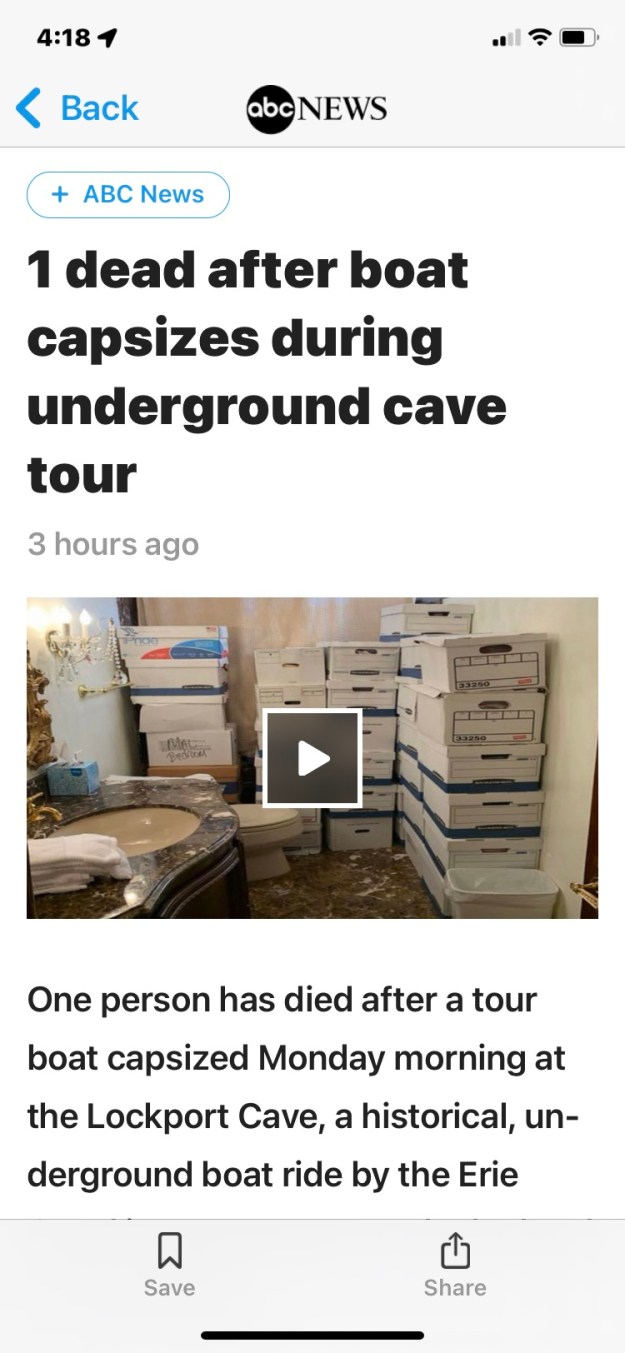
Almost immediately after posting the previous post, I came across this from ABC News:

Once again, the video with the story is about Donald Trump and promotes the idea that he is innocent. The story is about the tragedy of the sinking of the tour boat with loss of life. SHAME on ABC for using this to promote Donald Trump.

ABC News appears to be taking over where CNN left off.

ABCNews — What is Going On Here?

The headline and story is about a fire and the collapse of the roadway on I-95, the major north-south interstate between, among many others, Washington, Philadelphia and New York. The video is Donald Trump declaring his innocence!

How can this be explained?  What is ABC News doing?

An Appalling Failure of a Great City

I just posted New York City is Back! https://shiningseausa.com/2023/06/03/new-york-city-is-back/ And it is.

But I remain astonished and appalled that New York City, whose history is bound so closely to the subway system used by millions of people to get around the vast city every year, has failed to address the problem of access for the elderly and physically limited traveler in any meaningful way after all these years.

The passenger-use data tells an interesting story – the subway system consists of more than 6,455 cars that collectively traveled about 331,000,000 miles in 2021 through 472 stations on 665 miles of track. https://tinyurl.com/muksdukt Too big to comprehend but not too big to fail. In 2021, the first year of post-pandemic recovery, about 760,000,000 people rode the rails. While that is an amazing figure, it is less than half the volume that rode in 2016 (nearly 1.8 billion)!

I was forcefully reminded of this on our Memorial Day weekend trip, when, already worn out, we approached the 30thStreet Station in Astoria to find an elevated platform. The only observable means of getting to the train platform was to climb not one but two flights of stairs. I did it but I cannot imagine that many people my age or with other physical limitations could do so.

The 30th Street Station in Astoria is not the only such problem site. Only 98 of the 472 stations (covering all boroughs but not counting the Staten Island Railway) are ADA-accessible. https://new.mta.info/document/25961 Many stations counted as ADA-accessible meet that test in only one direction, or only for some subway lines or only at some times of day.

I understand that adding escalators and elevators would be very costly and, given the physical constraints, could result in reducing stairwell access in some cases. Given the substantial reduction in ridership since 2016, there is no better time to fix this problem than now. I am astounded that the people of New York City put up with this situation for so long and that New York politicians have been able to escape accountability for their failure to require the MTA to act.

I have read that a Judge Approves MTA Deal to Make Subways 95% ADA-Compliant by 2055 as part of a class action settlement [https://tinyurl.com/yc5398d2] but, seriously, by 2055? No doubt this was a victory of sorts, but that deadline, even if met, is 32 years away. The number of New York City residents with some form of disability is close to one million and more than 15 percent are 65 or over. It is unconscionable that their transportation needs have been ignored for so long and still are.

No Way to Run a Railroad

Disclosure: Despite what follows, there is no way I would travel to New York City from Washington, DC except by railroad. Yet, Amtrak remains an extraordinarily unreliable organization.

We booked our Memorial Day travel on the Acela train from Washington, DC Union Station to New York’s “new” Moynihan Penn Station terminal on January 22, 2023, a full four months before the trip. Having had enough of listening to people yelling into their cell phones, oblivious to the disclosure of their personal and business information, we were determined to get into the Quiet Car and to sit next to each other in regular seats, not at a table with two strangers.

Thus, we (my wife actually) booked Acela 2170 departing Washington on May 26, 2023, at 3:00 PM and arriving in New York City at 5:49 PM, enough time to make it to a dinner engagement and then to a jazz show at Dizzy’s Club. The confirmation returned by Amtrak took us out of the Quiet Car. After several changes online, consuming some hours, we received a fourth confirmation showing we were in the Quiet Car and, we thought, not seated at a shared table. We had the same seats assigned in both directions. The return train (Amtrak 2155) was scheduled to depart New York City at 11:00 am on Monday, May 29 as we had seen in the schedules on the Amtrak app.

Perfect.

For reasons that defy understanding, Amtrak sent us a new confirmation on January 27, changing our seats on the return trip to DC to 8A and 8C. The message sending the PDF of the ticket simply said:

Thank you for choosing Amtrak.
Your travel documents are attached. Please print and bring them with valid identification to show the conductor aboard the train.

Concerned about the implications of this unexplained change, I tried to locate a seat map to be sure we were not seated at a table on the return trip. I could not find a seat map on Amtrak.com which was not recognizing our reservation number, so I engaged the Amtrak “chat” feature to be sure we had the seats we wanted. There ensued a 779-word “chat” with “Desiree.” I will spare you the details of this agony of miscommunication. Suffice to say that Desiree assured us that our new return seats were not at a table and were still in the Quiet Car. Exhausted, I accepted her assurance.

On February 16, my wife, but not me, received an UPDATED confirmation from Amtrak indicating a “modified” reservation, but in fact the details were the same as we had previously received. Puzzlement.

On April 5, we received another Amtrak unexplained email (labeled Change Summary), showing an issue time of 7:09 am PT, changing our return train to a different train number, later departure (11:20 instead of 11:00) and …  and … changing our seat assignments to two different cars!!!!

Car 2 Quiet Car – Seat 4D

Car 3 – Seat 10A

No explanation provided.

We called Amtrak yet again and succeeded in getting reassigned to adjacent seats in the Quiet Car:

Car 2 Quiet Car – Seats 4F, 4D

The confirmation, labeled Sales Receipt with PDF ticket attached, issued on April 5 and, curiously, also at 7:09 am PT.

Also, on April 5 at 7:09 am PT, Amtrak issued yet another email moving us out of the Quiet Car on the return trip:

Car 3 – Seats 10A, 10C

Followed by another email also at 7:09 am:

Car 2 Quiet Car – Seats 4F, 4D

I am not making this up.

In the chaos, I failed to record the change of train number and departure time. My bad. But not just me. How can Amtrak explain this turn of events? Wait.

As reported in my previous post, we had a truly remarkable weekend in New York City. We departed our hotel in plenty of time to make what we thought was our 11:00 am train to DC.

When we arrived at the Red Cap station in the Moynihan terminal, we noticed our train number (the original number on which we had been confirmed) was not listed on the departure board. I inquired.

We were informed that we had the wrong train number and that we were not in the Quiet Car and not seated together!!!!! Neither of us had any record of this change. Fortunately, the Red Cap was very polite and helpful and in a few seconds, using the Amtrak app in my cell phone, was able to change our car assignment to the Quiet Car in adjacent seats.

So, all’s well that ends well, right?

True enough, I suppose, but how can the above sequence of events be explained or justified? Amtrak’s technology and “self-awareness” of what it is doing seem to be mythologically screwed up. This is not the first time our trains and seats have been changed without being told. It happened on a previous New York trip and, when discovered at the last minute, could not be changed. We ended up traveling in different cars, each seated adjacent to a stranger and not in the Quiet Car.

Amtrak is the only feasible alternative to flying to New York, especially on a holiday weekend when the roads are packed with cars and huge delays are commonplace. Surely this is not the best Amtrak can do. In a real sense Amtrak is a monopoly – at least in the sense that it is the only way to travel to NYC by train. Obviously, there are options – driving, the dreaded airlines (one to two hours taxi/Uber/Lyft ride into the city) but for many of us there is no real choice. Knowing its position in the hearts of many travelers, we would hope Amtrak would be better at its job. It’s not. A mystery.