The Presumption of Innocence

With all the Republican handwringing about Trump’s multiple indictments and efforts to interfere with the administration of justice (including defunding the Special Counsel’s office – to be covered in separate post), it may be useful to consider what the “presumption of innocence” means.

Some people appear to believe that the presumption of innocence has some meaning outside the courtroom and that a person cannot be “guilty” when “presumed innocent. That belief is wrong. The presumption is a legal process concept not found as such in the Constitution but implied by the right to a fair trial. The Sixth Amendment provides:

In all criminal prosecutions, the accused shall enjoy the right to a speedy and public trial, by an impartial jury of the state and district wherein the crime shall have been committed, which district shall have been previously ascertained by law, and to be informed of the nature and cause of the accusation; to be confronted with the witnesses against him; to have compulsory process for obtaining witnesses in his favor, and to have the assistance of counsel for his defense.

The practical result of those words is that the accused cannot be convicted, i.e., formally found “guilty” of the alleged crimes without a trial and process that complies with the Sixth Amendment and other applicable sections of the Constitution and laws. But that does not mean that the accused is “innocent.” It means that in court, the accused enjoys the protections associated with “fair trial” at the end of which a decision of “guilt” or “innocence” will be made. It means he hasn’t been found guilty yet. This may seem like a “dancing on the head of a pin” issue, but Trump’s acolytes make much of it and the media constantly repeat it.

Being “presumed innocent” doesn’t mean you are innocent. It means you haven’t yet been found guilty by the proper process. If you are not guilty, you cannot be kept in jail pending trial unless some limited conditions are met and appropriate, evidence-based findings are made. These include being a flight risk. Or a threat to witnesses.

So, Donald Trump may be “presumed innocent” but he is not “innocent.” No one, even his most ardent sycophantic idolizers, has argued that the facts alleged in the four criminal indictments against him are untrue. Nor could they make credible arguments to that effect. Instead, they deflect and distract with unproven and unprovable claims that the various governments that charged Trump have been “weaponized” for purposes of political revenge, or to keep Trump out of the 2024 race, or Trump shouldn’t be held accountable because others for whom no meaningful evidence of criminal conduct was ever brought forward have not been charged with crimes. Or or or or something anything, look a flying squirrel, look a UFO!

Trump’s only defense is delay. On the merits, on the facts, he is dead in the water. And yes, yes, he has the legal right to ask the state courts to remove the cases to federal court [all should be denied] and the legal right to ask that trial dates be put off to 2050 [denied].

Yes, Trump has us right where we want him. American justice is painfully slow, but Trump’s standard playbook is toast. The only real question is how long this is going to take.

One other thing. Various of Trump’s political allies are trying to have Jack Smith’s Special Counsel office defunded as a means of stopping the prosecution. In Georgia, efforts are under way to impeach or otherwise halt the prosecution by Fanni Willis. I believe all of these efforts constitute obstruction of justice, and it is past time for the governments involved to say so. Republicans in Congress have no business interfering with a criminal prosecution any more than they could pass a law saying that prior conduct of a particular individual, criminal at the time, was retroactively no longer criminal. The Republican Party has lost its claim to being the party of “law and order.”

Questions the Media Should Ask Republican Defenders of Trump

It’s past time that the media did its job.

Have you read the federal and Georgia indictments? Answer yes or no.

If no, why not? How can you defend someone against serious criminal charges you haven’t even read?

If yes, do you think the factual allegations are correct?

If the factual allegations are not correct, how are they wrong, precisely and factually?

If the factual allegations are correct, do you believe it is acceptable to elect to the presidency a criminal who tried to steal the 2020 election? Answer yes or no.

****

We can reasonably anticipate from past behavior that Republicans will try to deflect with their customary “weaponization of the justice system” claims. Or the “what about Hillary” claims. Or the “what about Hunter Biden” claims. Or any of the other deflections that they use to avoid addressing difficult truths about Donald Trump and his co-conspirators.

The media, if they were to do their jobs, would demand in the strongest terms possible that the above questions be answered and that deflections be rejected. They should ask these questions every day until they get an answer. An actual answer, not a lecture on some other topic.

The job of journalists is to report the news. Ask questions, find and report information. For reasons I don’t pretend to understand, most of the political stories I read in mainstream media and obviously slanted sources are a mix of factual reporting and opinion, speculations, implied messages, what-about-isms and other misinformation and deflection. Headlines are frequently written as click-bait when the actual story is about something else.

Ask good questions and report the answers. If the person is lying or deflecting, report facts that show that but leave the commentary out. Just like Joe Friday used to say, “just the facts, ma’am.”

Just to be clear, the same rules should apply to Democrats.

The Music We Cannot Hear

I have finally finished my slog through the third book by Siddhartha Mukherjee, The Song of the Cell (2022). You may know that Mukherjee won the Pulitzer Prize in 2011 for the extraordinary work, The Emperor of All Maladies: A Biography of Cancer.

I say “slog,” because I understood only a fraction of what I read in this remarkable book and could only take it in small doses. Even then it was a challenge, not because of exposition issues but because I simply cannot understand how scientists know what they know. Much of the story of the cell, which is really a multitude of highly differentiated “things,” has been learned in fairly recent times, but that reality is one of the keys to what I did come to realize as I moved through the astonishing complexities of cell-level biology.

The realization was how most of what we think is known by those who know this stuff is the product of accumulated trial, and sometimes egregious error, by a vast array of people over extended periods of time. Typically, someone in a laboratory somewhere comes up with some idea, inspiration, theory, call it what you will. He (typically a “he,” but thankfully less so over time) works on it, sometimes for years and then, with or without a meaningful or useful conclusion, moves on to other pastures.

Then, and this is the key to the whole story, years, sometimes decades later, some other scientist in a lab somewhere else, or maybe just in a library, finds a paper about the earlier person’s work, decides to take it up for further exploration perhaps with the benefit of intervening developments in the science, expands the theory, tests it and … sometimes … makes a major new discovery. The old idea may be rejected entirely or merely extended with the use of new technologies.

This narrative occurs over and over and over again through time. One discovery or idea builds on another, then is added to by someone else, then another person or entire team takes it up and … discovery occurs. Truth emerges. Theory becomes practice. Concepts become medical solutions to previously unsolvable mysteries of illness. One thing builds on another. Along the way there are many false starts, mis-directions, failed experiments, misunderstandings.

Sometimes the “establishment” rejects out of hand a new idea that challenges the current orthodoxy. Reputations are ruined for some along the way. Some give up and just move on to other subjects until someone else, somewhere, picks up the trail, has a new insight, solves a seemingly unsolvable mystery.

Thus, are born immunotherapy and a multitude of medical “miracles” never conceived of. Transplants of organs become possible. Open heart surgeries. On and on. It’s never easy and there is often resistance to progress. When embryonic stem cells were being investigated,

…critics, mostly from the religious right, would have none of it. They argued that human embryos had been destroyed – defiled – during the production of these cells and that embryos constituted humans. That these IVF [in vitro fertilization]-produced embryos were yet to acquire sentience, had no organs, were no more than a ball of undifferentiated cells that would otherwise have been discarded anyway, hardly placated them; it was their potential to form future humans that made them currently human …. In 2001 President George W. Bush, pressured by opponents of ES cell research, passed a law restricting federal funding to research involving ES cells that had already been derived …; any attempts to make new ES cells could not be federally supported. In Germany and Italy, too, research on human ES cells was highly restricted and, in some cases, banned.

The book touches on other “cutting edge” dilemmas, as well, such as human enhancement through genetic engineering.

But for me, the main story was the way in which science moves forward. Working scientists separated by time and space find each other and each other’s work, building on it and bring humanity the most remarkable discoveries. Not least of these were the vaccines that brought an end, more or less, to the COVID pandemic. At least for now. The work will continue, just as the challenges will continue to come. And the song of the cell will expand into new rhythms, new stanzas, new understandings without end.

Governor DeSantis – Herald for a Second Dark Age

Way back when, a herald was a man (of course) who made public pronouncements, often on behalf of a king. He was the “bringer of news,” as it were. Also, way back when, we had the Dark Ages, a term apparently disfavored now, but still in use to signify a period of intellectual and cultural decay in the Middle Ages (roughly the 5th through 10th centuries). Then came the Renaissance and Scientific Revolutions leading to the Enlightenment, roughly the 17th & 18th Centuries, characterized as including,

a range of ideas centered on the value of human happiness, the pursuit of knowledge obtained by means of reason and the evidence of the senses, and ideals such as natural law, liberty, progress, toleration, fraternity, constitutional government, and separation of church and state.

Western Europe and the United States (born in 1789 with ratification of the Constitution) were in the ascendancy and eventually the U.S. became one of the world’s so-called superpowers. In the U.S. freedom of expression, intellectual disputation and many other forces of democracy and personal freedom flourished on and off, at least compared with what came before and what was going on in most other countries.

Democracy as practiced here and in most other countries that have it (not many) is a rough and tumble messy affair. Many people have disparate ideas about what constitutes the good life, moral behavior and just about everything else. But underlying all the chaos was, we have believed, the underlying agreement that it was ok to have disparate ideas as long as everyone was treated with some measure of tolerance and respect. It was, in short, okay to disagree.

And, to seal the deal, the U.S. Constitution makes clear in the very first Amendment after initial adoption that “freedom of speech” is among the five most prized freedoms we have in this country: (the full five are freedom of speech, press, petition, assembly, and religion).

The governor of Florida, Ron DeSantis, nicknamed DeathSantis because his policies during the COVID pandemic almost certainly led to the unnecessary deaths of many thousands of Floridians, sees things differently now that he wants to be president of the United States. His path to glory lies through the delusional mass of Trump acolytes, and DeSantis is fine with catering to their every fear and bigotry if it paves his path to power.

Thus, we have the spectacle of DeSantis opposing the use of Advance Placement courses that cover topics he, on behalf of the STATE, finds objectionable. The topics in question? Well, of course, it was the new AP African American studies course.

The state education department, based on its view of preliminary documents, declared in January that the African American studies course “lacks educational value.”  [https://wapo.st/3nihZ92]

Of course, Florida’s governor doesn’t want Florida’s students to learn about African American history. He’d rather put Florida students at a competitive disadvantage against other states’ kids in the highly competitive arena of college education. Keep ‘em ignorant and in Florida. That’s the ticket.

But to prove it’s not just about bigotry, DeSantis suggested at a press conference that he had problems with allAP classes in Florida schools. These long-standing programs cover many subjects, including math, science, social sciences, humanities, languages and more. In fact, some AP courses were being offered a hundred years ago when I was in high school. Who knew what terrible consequences would result from having educated students, steeped in history and the rest?

The Washington Post reports that more than 199,000 Florida students enrolled in AP classes in 2020-21. Some 366,000 AP tests were given in Florida in 2021, more than in any other state except Texas (527,000) and California (683,000). Florida’s students must think these courses are valuable.

But, no worries, the state government under DeSantis will straighten them out:

The state Department of Education contends that the class is “inexplicably contrary to Florida law.” A new education law championed by DeSantis requires lessons on race be taught in “an objective manner” and “not used to indoctrinate or persuade students to a particular point of view.” Some education advocates and teachers say the law is so broadly framed that it is having a chilling effect on the teaching of Black history.

The state Education Department, under the governor’s thumb, listed “concerns” in the curriculum, including topics covering “Intersectionality and Activism,” “Black Feminist Literary Theory” and “Black Queer Studies.”

“Now who would say that an important part of Black history is queer theory?” DeSantis said at a news conference this week. “That is somebody pushing an agenda on our kids.”

There are indications that the College Board is considering modifications to the AP curricula to mollify DeSantis. A Florida Department of Education spokesman was quoted to claim that “Critical Race Theory, Black Queer Studies, Intersectionality, and other topics … violate our law.” What law that is remains something of a mystery, but it seems clear that the current government of Florida wants to keep its students ignorant of subjects that are mainstream issues in America today. Ignorance, the saying claims, is bliss.

This article from January 2023 recounts much of the controversy. https://www.washingtonpost.com/nation/2023/01/25/desantis-african-american-studies-black-history/

Here are a collection of articles discussing the DeSantis fascist impact:

Florida teachers strip classroom shelves of books in response to DeSantis ban https://tinyurl.com/bderbwmk

Florida GOP Senate advances bill to revoke Disney’s special tax status https://tinyurl.com/mtn7xv8j

DeSantis takes on Disney in a culture war with national implications https://tinyurl.com/4f3m35j5

DeSantis signs bill requiring survey of Florida students, professors on their political views https://tinyurl.com/4fkm9tvu

‘Goes beyond ignorance’ Historians slam DeSantis’ claims about American slavery https://www.alternet.org/2022/09/ron-desantis-2658332899

OpinionBeware, DeSantis is as much a threat to America as Trump  https://tinyurl.com/5n8xb29y

DeSantis pushes to permanently ban Covid-19 mandates in Florida https://www.cnn.com/2023/01/18/politics/desantis-covid-policy-florida/index.html

Florida, Missouri tell Justice Department voting monitors to stay outside polling places https://tinyurl.com/zjxn2cj2

Disney World halts vaccine requirement for workers after Florida restricts employer mandates https://tinyurl.com/bs7a6fbk

University of Florida bars faculty members from testifying in voting rights lawsuit against DeSantis administration https://tinyurl.com/bdhncjus

Ron DeSantis Is Getting His Mask Advice From A Psychiatrist Pushing Ivermectin https://tinyurl.com/mr3mhsu4

In Florida, DeSantis cut jobless aid just as virus began terrifying new wave https://tinyurl.com/2mrd9vm4

In push against ‘indoctrination,’ DeSantis mandates surveys of Florida college students’ beliefs https://tinyurl.com/2eypzdp4

DeSantis says he will pardon Floridians charged with violating pandemic rules: ‘They’ve been treated poorly’ https://tinyurl.com/4rrfzy4b

YouTube removes video of DeSantis coronavirus roundtable https://tinyurl.com/2rnh4jak

Coronavirus ravaged Florida, as Ron DeSantis sidelined scientists and followed Trump https://tinyurl.com/2p977ps6

The College Board Strips Down Its A.P. Curriculum for African American Studies https://tinyurl.com/2kfsakw8

The essence of the DeSantis phenomenon is that he is trying to out-Trump Trump to siphon Trump’s most deranged supporters and get himself elected president. It’s a fool’s errand, but DeSantis is determined. In the process, Florida will be a place where ignorance is valued over knowledge and, ironically, “political correctness” right-wing style will become essential to electoral success. At least unless and until the people of Florida wake up to the reality of how their national standing is going to be undermined by the arrival of the new Dark Ages in their state.

Our Burning World

[Note: This post has been in development for a long time. I was inspired to finally post it when I finished Lopez’s essays, discussed below, and then by the tragedy that has unfolded in Maui. The devastation of Hawaii’s island gem is just the latest example of the fate that awaits us if global action is not taken promptly to combat climate change. We’ve seen it in California and many other places in the United States and the world over. Time is running out.]

Reading the accomplishments of author/environmentalist Barry Lopez, author of the National Book Award-winning masterpiece, Arctic Dreams, is more than enough to give anyone a deep sense of inadequacy. https://tinyurl.com/4wpfch3a I recently finished his posthumous collection of essays, aptly titled Embrace Fearlessly the Burning World (2022).  I was stunned to learn that Lopez had died on Christmas Day 2020, shortly after my wife and I moved back to the Washington DC area (in DC itself for the first time), after having survived the pandemic in New York City.

Lopez wrote Of Wolves and Men a decade earlier than Arctic Dreams. According to Wikipedia, “López is a surname of Spanish origin. It was originally a patronymic, meaning “Son of Lope”, Lope itself being a Spanish given name deriving from Latin lupus, meaning “wolf”. https://en.wikipedia.org/wiki/L%C3%B3pez This is an interesting juxtaposition in light of Lopez’s interest in natural history. Of Wolves and Men was a National Book Award finalist. Of that book, Amazon.com accurately says that it,

reveals the uneasy interaction between wolves and civilization over the centuries, and the wolf’s prominence in our thoughts about wild creatures. Drawing on an astonishing array of literature, history, science, and mythology as well as considerable personal experience with captive and free-ranging wolves, Lopez argues for the necessity of the wolf’s preservation and envelops the reader in its sensory world, creating a compelling picture of the wolf both as real animal and as imagined by man. A scientist might perceive the wolf as defined by research data, while an Eskimo hunter sees a family provider much like himself. For many Native Americans the wolf is also a spiritual symbol, a respected animal that can make both the individual and the community stronger. With irresistible charm and elegance, Of Wolves and Men celebrates scientific fieldwork, dispels folklore that has enabled the Western mind to demonize wolves, explains myths, and honors indigenous traditions,

Lopez’s profound ability to think deeply about everything he observed and to connect his observations to larger principles was amazing. And he did it with prose so powerful that you stop to reread sentences and whole paragraphs just to be sure you understood every insight he was recording. Here are a few examples from his 2019 memoir, Horizon:

It is here, with these attempts to separate the fate of the human world from that of the nonhuman world that we come face-to-face with a biological reality that halts us in our tracks: nature will be fine without us. Our question is no longer how to exploit the natural world for human comfort and gain, but how we can cooperate with one another to ensure we will someday have a fitting, not a dominating, place in it.

What cataclysm, I often wonder, or better, what act of imagination will it finally require, for us to be able to speak meaningfully with one another about our cultural fate and about our shared biological fate?

         ….

The desire to know ourselves better, to understand especially the source and the nature of our dread, looms before us now like a specter in a half-lit world, a weird dawn breaking over a scene of carnage: unbreathable air, human diasporas, the Sixth Extinction, ungovernable political mobs.

And this:

It might have been useful once to identify and denounce enemy cultures, those that were seen as ruthless and exploitive, obsessed with wealth and indifferent to social justice at the highest levels; but … I feel that this time has passed. People in every country today can identify with the very same threats to their lives and to the lives of their progeny. And many know their governments, elected or self-appointed, are too cowardly, too compromised, or too mean-spirited, to help them.

One of Lopez’s great gifts was the ability to view and understand situations through the eyes of multiple cultures. It was as if he had multiple minds in one body. Lopez, ever the brilliant storyteller, related the life of Ranald MacDonald, the product of a mixed marriage – a Chinook mother and a white father – who was born in 1824, a time when, not unlike today in some respects, being of “mixed blood” was a huge obstacle to advancement.

MacDonald traveled and had many jobs, coming to have a deep connection to the indigenous people of the Pacific and believing that the Japanese were related to American Indians. He also thought that Western industrialization was an imminent threat to Japan, that had been virtually sealed off for over a hundred years from Western contact. MacDonald managed to get to Japan and during a brief period of acceptance by the Japanese taught 14 members of the shogun’s court to speak English in the hope that it would help them deal with the Western merchants and military he believed, correctly, were soon coming to Japan. MacDonald died in relative obscurity, but Lopez gave a moving tribute to his life as one of the many people of talent and inspiration who was limited by racist and cultural biases throughout his life.

Then, there is Yuval Noah Harari, the author of Sapiens, A Brief History of Humankind, that I have not read, and the sequel, Homo Deus, A Brief History of Tomorrow, that I am about to describe. As I understand it, the central story line of Sapiens was the emergence of humans as the dominant animal on the planet. These people are us — empowered by superior intelligence, opposable thumbs, tool-making ability, and all the rest — to reshape the earth in ways that were perceived as important to the survival and continued dominance of humankind over all other species on the planet. The supreme irony is that “homo sapiens” refers to the only surviving sub-tribe of Hominina and translates to “wise men.”Deus translates, of course, to “god” or “deity.” I will just leave that there. You get the idea.

Harari opens Homo Deus with the assertion that the primary historical scourges of mankind – famine, plague and war – have largely been conquered. As a result, he predicts man will now turn his main attentions to “a serious bid for immortality,” the arguably logical extension of the struggle against famine and disease. The first 70 pages of Homo Deus lay the foundation for what is to come. He argues that it was not the larger brains as such, with attendant superior (to other animals) intelligence, that enabled the planetary domination by humans. Instead, he says, it was the ability of homo sapiens to cooperate with strangers that was the key to it all.

Harari’s opening argument is obviously a very big idea and likely some people will take issue with it. So be it. The point is that these are “frontier concepts,” things most of us likely have not often thought about in depth but that have a lot to do with the future of our species. They were certainly subjects of little or no interest to Trump and his cabinet of policy makers and grifters. But Harari has thought about these issues profoundly. I won’t be around to see if he’s right but I am powerfully interested in understanding his provocative thinking.

His writing will not appeal to evangelical Christians or others similarly inclined. Harari leaves no doubt that he does not believe in the existence of souls, human or otherwise, pointing to, among other things, the absence of evidence. Above all else, Harari, a historian by trade, is an evidence guy. If no evidence appears after extensive investigation, the “thing” most likely does not exist and never did. Me too.

There is another aspect to this, one that I have touched on before. See, for example, the post entitled The Larger Meaning of “Hidden Figures.”  https://shiningseausa.com/?s=hidden+figures  We have in these two people – Lopez and Harari — examples of humans who, in slightly different circumstances, might well have been ostracized and prevented from reaching their potential as students and later as teachers for the rest of us. Lopez was as American as apple pie, but he bore a family name of Spanish origin. It is not hard to imagine that the Trump administration saw him as a target, because of his name and because he was a truth-teller who wrote and lectured about environmental policies that are anathema to Trump and the Republican Party. Imagine what will happen if Trump, armed with years of new grievances, regains power.

Harari is an even easier target. He was born and grew up in a secular Jewish family with Lebanese and Eastern European roots. That might not have been a problem for the Trump administration, given its attachment to the right-wing leadership of Israel, but there is more: Harari is openly gay and married to a man (in a civil ceremony in Toronto – those Canadians again!). They live in a kind of cooperative agricultural community of individual farms, some might call it a commune. Or socialism! OMG! People working together for the common good. Outrageous.

Reading the challenging and awe-inspiring ideas of these two people, I am reminded yet again of all the other “non-white” men and women whose race-based suppression has deprived all of us of the untold benefits of people capable of seeing things more deeply and thinking in frontier concepts that open our minds to new possibilities.

And to what end? What coherent mental process leads people like Stephen Miller and Donald Trump to the conclusion that some people, solely because of their ethnic heritage, are a danger to American society and should be removed from it? How does Miller rationalize his strident opposition to immigration in light of his mother’s Jewish parents having come here from Belarus in 1903?

We will never know but the point is that suppression of the “other” risks the loss for everyone of life-enhancing contributions to the improvement of society. We will never be able to “know” what we have lost, but it is certain that the loss has happened and continues. If, as is often speculated, this suppression is based on fear of displacement by the unknown, the leaders of the suppression should look at what is known. THAT is what they should be afraid of, the “scene of carnage” described by Lopez.

Some of Lopez’s last words in print are compelling:

Evidence of the failure to love is everywhere around us. To contemplate what it is to love today brings us up against reefs of darkness and walls of despair. If we are to manage the havoc – ocean acidification, corporate malfeasance and government corruption, endless war – we have to reimagine what it means to live lives that matter, or we will only continue to push on with the unwarranted hope that things will work out. We need to step into a deeper conversation about enchantment and agape, and to actively explore a greater capacity to love other humans. The old ideas – the crushing immorality of maintaining the nation-state, the life destroying belief that to care for others is to be weak and that to be generous is foolish – can have no future with us….

Only an ignoramus can imagine now that pollinating insects, migratory birds, and pelagic fish can depart our company and that we will survive because we know how to make tools. Only the misled can insist that heaven awaits the righteous while they watch the fires on Earth consume the only heaven we have ever known….

In this trembling moment, with light armor under several flags rolling across northern Syria, with civilians beaten to death in the streets of Occupied Palestine, with fires roaring across the vineyards of California and forests being felled to ensure more space for development, with student loans from profiteers breaking the backs of the young, and with Niagaras of water falling into the oceans from every sector of Greenland, in this moment, is it still possible to face the gathering darkness and say to the physical Earth, and to all its creatures, including ourselves, fiercely and without embarrassment, I love you, and to embrace fearlessly the burning world?….

Change is coming fast, though, on multiple fronts. Most of us begin the day now uncertain of exactly where we are. Once, we banked on knowing how to respond to all the important questions. Once, we assumed we’d be able to pass on to the next generation the skill of staying poised in worrying times. To survive what’s headed our way – global climate disruption, a new pandemic, additional authoritarian governments – and to endure, we will have to stretch our imaginations. We will need to trust each other, because today, it’s as if every safe place has melted into the sameness of water. We are searching for the boats we forgot to build.

Rest in peace, Barry Lopez.

Is Trump Disqualified?

The New York Times reports that:

Two prominent conservative law professors have concluded that Donald J. Trump is ineligible to be president under a provision of the Constitution that bars people who have engaged in an insurrection from holding government office.

https://tinyurl.com/yh38rjyd

Oh, Lordy, I wish they were right.

But are they?

The NYT article says:

The professors are active members of the Federalist Society, the conservative legal group, and proponents of originalism, the method of interpretation that seeks to determine the Constitution’s original meaning.

Upon reading that, my first thought was Groucho Marx’s infamous saying that, “I don’t want to belong to any club that will accept me as a member.” But I digress. I do not adhere to such absolutist thinking about most things, and I suspect there’s a club somewhere that I might want to join, though whether there is one that would have me is another question for another day.

Returning to my new-found idols (if and only if they’re right) in the Federalist Society, they summarize their conclusion this way:

Donald Trump cannot be president — cannot run for president, cannot become president, cannot hold office — unless two-thirds of Congress decides to grant him amnesty for his conduct on Jan. 6.

Affirming what I and many others have been saying since at least January 6, 2021, the esteemed authors of a forthcoming law review article state there is:

“abundant evidence” that Mr. Trump engaged in an insurrection, including by setting out to overturn the result of the 2020 presidential election, trying to alter vote counts by fraud and intimidation, encouraging bogus slates of competing electors, pressuring the vice president to violate the Constitution, calling for the march on the Capitol and remaining silent for hours during the attack itself.

“It is unquestionably fair to say that Trump ‘engaged in’ the Jan. 6 insurrection through both his actions and his inaction,” ….

Abundant evidence. Yes. Unquestionably fair. Without a doubt, reasonable or otherwise.

But is saying it enough? What about innocent until proven guilty, etc. Right to a fair trial. All that.

The relevant sections of the 14thAmendment to the Constitution state:

No person shall … hold any office, civil or military, under the United States … who, having previously taken an oath, … as an officer of the United States … to support the Constitution of the United States, shall have engaged in insurrection or rebellion against the same, or given aid or comfort to the enemies thereof. But Congress may by a vote of two-thirds of each House, remove such disability.

The central question is, I think, whether the provision is self-executing or requires a judicial finding that the person in question has engaged in insurrection, etc. The least relevant question is whether Congress would give Trump a pass. Two-thirds of “each House” means what it says (originalists are stuck with that) and that’s not happening.

According to the Times, the article concludes that:

essentially all of that evidence pointed in the same direction: “toward a broad understanding of what constitutes insurrection and rebellion and a remarkably, almost extraordinarily, broad understanding of what types of conduct constitute engaging in, assisting, or giving aid or comfort to such movements.”

It added, “The bottom line is that Donald Trump both ‘engaged in’ ‘insurrection or rebellion’ and gave ‘aid or comfort’ to others engaging in such conduct, within the original meaning of those terms as employed in Section 3 of the 14th Amendment.”

I’m fully down with that so far but the question remains, I think.

The provision’s language is automatic, the article said, establishing a qualification for holding office no different in principle from the Constitution’s requirement that only people who are at least 35 years old are eligible to be president.

“Section 3’s disqualification rule may and must be followed — applied, honored, obeyed, enforced, carried out — by anyone whose job it is to figure out whether someone is legally qualified to office,” the authors wrote. That includes election administrators, the article said.

In an interview, apparently, Professor Steven Calabresi, a law professor at Northwestern and Yale and a founder of the Federalist Society, said those administrators must act:

“Trump is ineligible to be on the ballot, and each of the 50 state secretaries of state has an obligation to print ballots without his name on them,” he said, adding that they may be sued for refusing to do so.

Therein lies the rub. Republican secretaries of state, many of whom are abjectly committed to support Trump no matter what, cannot be assumed to perform the asserted duty, no matter how forcefully that obligation is confirmed by Federalist Society professors. Some enterprising journalist should immediately put the question to each of the fifty secretaries of state, starting tomorrow. What they say will not, of course, be binding but still would be good to know their answers in fashioning a way forward.

As much as I desperately want to believe that Section 3 of the Fourteenth Amendment is self-executing, the cynics among us (me) do not believe anything so simple could possibly work in the political world Trump has handed down to our country. Lawsuits are going to be necessary, complicated, I suggest, by the fact that Special Counsel Jack Smith elected not to charge Trump with insurrection under the relevant statute:

Whoever incites, sets on foot, assists, or engages in any rebellion or insurrection against the authority of the United States or the laws thereof, or gives aid or comfort thereto, shall be fined under this title or imprisoned not more than ten years, or both; and shall be incapable of holding any office under the United States. [18 U.S. Code § 2383-enacted June 25, 1948]

Why Smith did not bring that charge has not been, and likely will never be, explained, but Trump will try to drive his denial truck through that gap and, typically, more litigation will ensue if anyone tries to disqualify him through legal action.

A final observation. I just read that Alan Dershowitz, ready to defend Trump’s criminality at every turn, has reportedly declared that the 14thAmendment applies only to “those who served the Confederacy during the Civil War.” Reported in the Daily Caller (where else?) but published only in the SmartNews app, apparently. The piece notes that the “the text does not authorize Congress—or any other body or individual—to impose the disqualification in the first place.” Further, the article claims, “It wasn’t intended as a general provision empowering one party to disqualify the leading candidate of the other party in any future elections.”

That’s an odd claim for an ultra-originalist to make. That fact, moreover, undermines Dershowitz’s argument. If no mechanism for applying the law was created, the most reasonable conclusion is that Congress thought it was self-actuating. And, if it were true that the law was only to apply to ex-Confederates, it would be most reasonable to expect that the statutory text would have been explicit to that effect.

The contrary position states that

it was fairly evident who participated in the Civil War on the part of the South. No formal mechanism was needed for making that obvious determination. If the disqualification had been intended as a general rule applicable to all future elections, it would have been essential to designate the appropriate decision maker, the procedures and the criteria for making so important a decision.

That argument ignores that Marbury v Madison was decided by the United States Supreme Court establishing the principle of judicial review, that the Constitution was indeed the supreme law of the land that Congress could not by itself change. While the article lists all kinds of mischief that might ensue without explicit mandates of who decides what, the reality, I suggest, is that the claimed disabilities are overcome by the fact that judicial review of all actions inconsistent with the plain intent of the statute would be available. As with many other laws in which judicial oversight is not expressly mentioned, the supremacy of federal law and the even greater supremacy of the Constitution are sufficient to warrant the conclusion that Congress did not have to established a specific enforcement mechanism for the operative sections of the Amendment. The courts were available to adjudicate any conflicting claims.

Thus, the absence of an explicit provision for judicial review does not support the speculation that the courts “might regard as a political question” the issue of whether a candidate had engaged in insurrection. No reason exists to think of that as a political question beyond the courts’ purview or that “if the controversy were not resolved by the Supreme Court, there would be a constitutional crisis.” Such imaginings are the product of an overactive ultra-originalist imagination.

Dershowitz gives himself away in the ensuing argument that,

Interpreting this post-Civil War amendment as a general provision for disqualifying candidates who some people may believeparticipated in what they regard as an insurrection or rebellion—as distinguished from a protest or even a riot—would create yet another divisive weapon in our increasingly partisan war. It would be used by Republicans against candidates who may have supported (gave “aid or comfort” to) riots such as those that followed the killing of George Floyd or other violence-provoking events. [boldface added]

The Constitution articulated limited qualifications for presidential eligibility. Beyond those neutral criteria, the decision should be made by voters, who are free to consider the participation of a candidate in activities with which they disagree. Unless an amendment was clearly intended to further limit these qualifications, the voters are the ones to decide who is to be their president.

Quite clearly, Dershowitz is fine if “the voters” decide it’s acceptable to elect a criminal who tried to stop the peaceful transfer of presidential power and who has threatened violence and further insurrection if he is elected. That is not the argument of a “constitutionalist,” at least not the one that laid the foundation for the United States. No basis exists, I suggest, for interpreting the Constitution or any federal statute as permitting the overthrow of the government if a bare majority use the ballot box rather than armed revolt to accomplish it.

That said, I believe it is entirely appropriate for lawsuits to be instituted to present to the courts for adjudication the question whether January 6 was an unlawful insurrection and, if so, whether Donald Trump inspired, incited, and directed it. If yes, he’s out. Period.

Let’s get on with it. Somebody (ACLU?) sue to bar his candidacy for the presidency and let the future of our democracy be decided.


What Are the Chances …

that Donald Trump will comply with the Protective Order issued by Judge Chutkan in the January 6 case?

Near zero, I think. And his lawyers will be falling all over themselves to explain away or justify his violations when they are called before the judge, as they surely will be, to determine whether Trump should be held in contempt and, if so, what penalties should be imposed.

Trump will, I believe, continue attacking the judge, the justice system, the law, and anything else he believes will get attention in the media (who will duly report every outrage) and prepare his cultish supporters for what he hopes will be their next move, namely, a violent challenge to the law and order across the country. Trump likely believes that short of fleeing to a non-extradition country he may be out of options that his usual tactics of delay and obfuscation have achieved in the past. There is no reason to doubt that the carefully constructed evidentiary case against Trump for the January 6 insurrection will be persuasive beyond a reasonable doubt to any jury that fairly assesses it.

Trump’s trump card (sorry) is to force the judge to the edge of considering having him incarcerated, without his phone, pending trial. This prospect arises because no monetary penalty alone will suffice to control his behavior as long as he has free access, as he has in the past, to donated funds from his PACs and his rich benefactors. Money is literally no object to him in this circumstance.

Trump’s winning game therefore is to force the judge to order his arrest and detention, which will prevent him from campaigning, and thus drive his army of fanatical worshippers over the edge and into violent resistance. That is the true meaning of Trump’s social media post, ‘If you go after me, I’m coming after you.’

The judge has some alternatives, but none are going to suffice if Trump is determined not to be silenced. The judge could, for example, impose further restrictions on Trump’s access to the discovery materials that normally must be turned over by the prosecution to assist the defendant in preparing a defense. That approach hands Trump an additional claim that he was denied the opportunity for a fair trial because he could not participate fully in preparation of his defense.

The Protective Order issued by Judge Chutkan is not mysterious. It authorizes the Prosecution to designate various discovery documents as “Sensitive Materials” and imposes tight restrictions on their use [“defendant” replaced with “Trump”]:

Except as provided in this Order, without prior notice to the United States and authorization from the court, no Sensitive Materials, or information contained therein, may be disclosed to any person other than Trump, defense counsel, persons employed to assist the defense, or the person to whom the sensitive information solely and directly pertains and that person’s counsel….

… defense counsel may not allow Trump to write down any personally identifying information as identified in Federal Rule of Criminal Procedure 49.1 that is contained in the Sensitive Materials.

Of particular note:

…during any time that Trump reviews Sensitive Materials outside of defense counsel’s presence, Trump must not have access to any device capable of photocopying, recording, or otherwise replicating the Sensitive Materials, including a smart cellular device.

The trial judge has thus clamped the jaws of good order and justice tightly to send a clear message to Trump about what will be tolerated. That, of course, is a challenge Trump is unlikely to take lightly no matter how many assurances his lawyers offer up that he will comply.

Never forget that Trump has declared that “I have an Article II, where I have to the right to do whatever I want as president,” and he thinks he is still the president. People like Trump are unable to recognize that they have brought on themselves the troubles they face, by, in his case, and for example only, removing and mishandling top secret documents from the White House that he has claimed “are mine” and that he declassified just by thinking about declassifying them. He uses his abuses and law violations as a badge of victimization with which his cultish supporters sympathize because they see themselves also as victims. He hates and fears the same people they hate and fear, thus producing the perfect symbiosis.

Trump remorselessly directed his followers to attack the Capitol on January 6 to stop the transfer of executive power from him to Joe Biden. The whole world watched the attack on TV and has sense seen endless film of the assault in brutal detail, all the while Trump resisting calls from within and outside of his administration to call off the attack. Trump dug his own grave on this one, along with the Mar-a-Lago documents case, and has no one to blame but himself. He will, however, always true to his nature, almost certainly try to force the court’s hand because, well, that’s what he does.

Why Are Doctors Not Allowed to Practice Everywhere?

For reasons I don’t recall, I subscribe to the JAMA Network, which is a monthly medical journal published by the American Medical Association with a large variety of articles about the biomedical sciences. I’m reasonably sure my interest was driven by the pandemic. In any case, much of the contents are beyond my ability to understand. But every so often, I find something compelling either about some disease or, in the present case, about the manner and method by which medicine is practiced in our peculiar collection of regions we call “states.”

The present issue is how we have collectively prevented doctors from counseling patients across state lines into states where they are not “admitted to practice.”

As a retired lawyer, I certainly understand the reason we limit, with a notable exception, unadmitted lawyers from the practice of law in states in which they have not passed the state bar exam. That reason is that the laws of each state often vary significantly, particularly regarding the details of procedure but also in many substantive areas such as estate law. It would be problematic to permit lawyers with no knowledge of those laws and procedures to regularly give advice to clients in those states.

There is, as stated, a notable exception, which is that out-of-state lawyers may appear in trials and some other court proceedings if they associate with “local counsel,” an attorney who is admitted to practice in that jurisdiction. The “foreign” attorney may do all the work, but “local counsel” must sign off on it as assurance to the court that the foreign attorney is complying with local law and procedure.

Turning then to the issue of “foreign” doctors “practicing medicine” by, in modern times, counseling patients using technologies like Zoom for “televisits,” I have wondered for some time why the states restrict this activity. Laws and procedures differ from state to state, but is the science on which medical practice is based different from state to state? I am not aware that it is.

Yet, as reported in Jama Network, https://tinyurl.com/5dab4tcm, Providing Responsible Health Care for Out-of-State Patients:

while exceptions may have been made here and there during the pandemic, the states have returned to their prior position of barring “foreign” doctors from remotely advising patients:

…physicians have increasingly been told by lawyers and compliance officers that calling patients located in another state is a legal gray area and introduces a risk of sanctions. States have accelerated this concern. The New Jersey Attorney General’s Office recently warned out-of-state physicians that, without a New Jersey medical license, “any practice by way of telemedicine, will constitute the unlicensed practice of your profession, and may subject you to administrative and criminal action” (email communication, March 31, 2023). These restrictions are impeding other communications as well. When Virginia ended its temporary pandemic regulations around physician licensure, Johns Hopkins had to inform more than 1000 patients they were no longer eligible to utilize telehealth appointments with its providers.

Physicians given this advice are understandably frustrated because these restraints disrupt and reduce the quality of the care they provide. This is especially true for specialty physicians who serve a broad geographic area and physicians whose practice is near a state border. For example, many states lack any pediatric subspecialists and the majority of the population must travel more than 100 miles.

Notwithstanding the negative consequences for patients who may have a long-standing successful relationship with a doctor in another state where the patient, for example, once lived, state laws say such relationships must end. The law of Texas is typical:

Any “person who is physically located in another jurisdiction but who, through the use of any medium, including an electronic medium, performs an act that is part of a patient care service initiated in this state…that would affect the diagnosis or treatment of the patient, is considered to be engaged in the practice of medicine.

I didn’t know this, but the JAMA article notes that many telemedicine visits are now accomplished by persistent and/or desperate patients who “sit in cars or coffee shops on smartphones, searching for good WiFi and sharing tips about the best parking lots that are just across the state border.

 These constraints severely inconvenience patients, especially those with serious illness, physical disabilities, or lower income and limited resources; threaten patient privacy; encourage discontinuity of care; and might force private health care conversations to take place in ineffective and public settings.

Have we lost our collective minds?

Not only is this bad for patients, but it places doctors in a precarious legal situation in which the “best” solution for them is simply to “fire the patient.” Every doctor these days carries medical malpractice insurance. Is continuing to advise an out-of-state patient malpractice under those policies? Or is the opposite true, that failing to continue giving needed advice is malpractice? What about the not-unusual situation where the patient cannot reach a local doctor and seeks out his former doctor in the prior state of residence? Should that doctor respond? Not respond? It’s a Hobson’s choice.

The authors of the JAMA article propose several common-sense solutions that, for example, allow for “any follow-up care after a relationship has been appropriately established through in-person or virtual means.” A “bigger” solution would be federal preemption of the field that would override state laws. Examples include expansion of the principles in the Sports Medicine Licensure Clarity Act in which reasonable exceptions for licensure are created to cover clinicians who travel with a sports team to another state and provide care, even if they are not licensed in the state in which the sporting event occurs.

Interestingly, the authors note that:

the delivery of medical care could be defined as being rendered where the physician is located, although that could potentially upend our existing system and impact state licensure authority. Although congressional action would mean the federal government supersedes, or preempts, existing state regulations, the advantage of either federal legislative approach is uniformity and clarity, rather than requiring physicians to navigate through 50 different approaches to the issue.

Indeed, such action would likely face a gauntlet of opposition from local doctors wanting to preserve their “monopoly” on access to local patients, present and future. Therein lies, I believe, the root of this problem. If someone can convince me that medical practice should vary from state to state in the manner of local law, I will confess error. Until then, I will assign “blame” for the present shameful situation on doctor protecting their turf.

If it was medically acceptable to do interstate televisits during the pandemic, then it must be true that there is no medical problem in the post-pandemic period to allow interstate doctor-patient communications as they choose.

This situation cries out for a federal solution. I understand that some states limit medical services such as assistance in death (known as Death with Dignity) which is forbidden in Virginia but allowed in many other states. A federal solution would leave responsibility for knowing such local restrictions to the doctors in question. Beyond that, let them practice their magnificent craft unimpeded by artificial state boundaries and licensure rules designed to protect doctors’ incomes rather than promote the welfare of all patients.

Criminal Liar Donald Trump Attacks DC

Donald Trump’s understanding of “truth” is whatever comes out of his mouth, even when demonstrably false. His adoring followers appear to believe whatever he says even when a moment’s reflection would reveal what a pathological liar he is.

On Trump’s latest involuntary “visit” to the nation’s capital to be arraigned on multiple felony charges for the third time, Trump, as he typically does, lied about his guilt, lied about his “persecution,” and, of course, lied about the District of Columbia. In a post-arraignment diatribe for reporters, Trump said (as reported by Newsweek):

“This is a very sad day for America,” said Trump. “And it was also very sad driving through Washington, D.C., and seeing the filth and the decay, and all of the broken buildings and walls, and the graffiti. This is not the place that I left. It’s a very sad thing to see it.”

https://tinyurl.com/2s32p5by

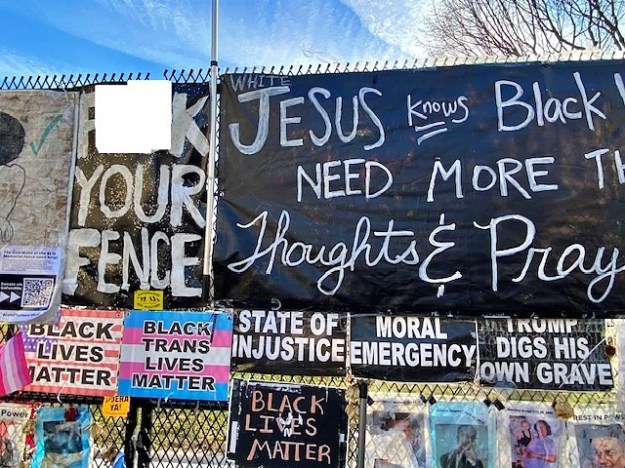
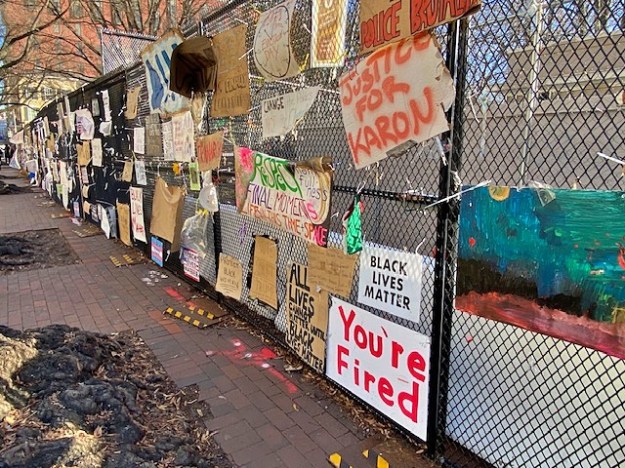
In case you have forgotten, here are some samples of what DC looked like under Trump:

Major areas around the People’s Houses, including both the White House and the Capitol (that Trump had directed mob to desecrate) were fenced off, with massive police and military presence. DC was effectively an armed camp, armed against the people by Trump, for Trump. Always for Trump.


Another Major News Entity That Needs Editors

The Internet has brought us many new and useful tools, but one of the glaring downsides is that it has undermined journalism in multiple ways. One response of the media has apparently been to either eliminate editing or significantly diminish its role in vetting articles before they are posted. Examples continue to multiple.

The latest glaring example comes from ABCNews.com that published a story about two US Navy sailors accused to spying for China. https://abcnews.go.com/US/2-us-navy-sailors-arrested-allegedly-spying-china/story?id=101990144  While the content of the story is important and interesting, there is no obvious reason why it had to be rushed to “print” without competent checking of the writing.

Examples:

  • Jinchao “Patrick” Wei, a 22-year-old petty officer 2nd class, was arrested Wednesday and charged with espionage — more specifically, conspiracy to and committing the communication of defense information to aid a foreign government.

Conspiracy to committing?  Conspiracy to the communication?

  • Petty Officer Wenheng Zhao, of Monterey Park, California, was also arrested Wednesday, by FBI and NCIS agents, and is charged with conspiracy and receipt of a bribe by a public official, officials said, according to Zhao’s indictment.

“According to Zhao’s indictment” does not belong at the end of the sentence. It should be placed at the beginning.

  • Zhao, 26, worked at the Naval Base Ventura County in Port Hueneme and had an active U.S. security clearance who had access to classified information, officials said.

As written, that sentence says that it was the “security clearance,” as a “who” rather than a “what,” that “had access to classified information.” I am reasonably certain that the sentence was intended to say that Zhao had the security clearance that gave him access to classified information.

  • His indictment states he had access to material classified as secret, as did Wei, who was born in China and became a U.S. citizen in 2022 as he was allegedly also sending information to his handler.

I’m not sure what to say about that sentence. The concluding phrase, “as he was allegedly also sending information to his handler,” is lost in space. With slight changes, it probably belongs after “secret.” The sentence would be improved by creating two sentences from it, one about the indictment and one about Wei’s background. Sigh.

  • “The alleged conduct also represents a violation of the solemn obligation of members of our military to defend our country to safeguard our secrets and to protect their fellow service members.”

What happened to the punctuation? Properly written, that sentence would read this way: “”The alleged conduct also represents a violation of the solemn obligation of members of our military to defend our country, to safeguard our secrets, and to protect their fellow service members.”

  • It was not immediately clear if either Wei or Zhao had retained attorneys who could comment on their behalf.”

I admit I am nitpicking a bit here, but wouldn’t that sentence read better this way: “It was not clear whether Wei or Zhao had retained attorneys who could comment on their behalf.” OR, even better, “It was not clear whether Wei or Zhao had retained an attorney who could comment on his behalf.”

  • Wei is alleged to have passed along imagery of the USS Essex, provided the locations of various Navy ships and provided dozens of technical and manual for systems aboard his ship and other Navy ships.

Open your blue books and answer this question: How many manual or manuals was Wei claimed to have shared?

  • “The case against Mr. Zhao is part of a larger national strategy to combat criminal efforts from nation state actors to steal our nation sensitive military information,” Estrada said.

Obviously, “nation” should have been “nation’s,” the singular possessive form. I suppose it’s possible that Estrada misspoke and said only “nation” but, if so, the authors should have inserted “[sic]” after the word to indicate their awareness of the mistake.

There are other problems with the piece but eight is enough to make the point. A final note: the article lists five contributors to the piece. Remarkably, none of the five apparently saw or raised any of the issues I have identified. If they did, they were ignored, which may be worse

Lest I be accused of picking on ABC, I hasten to assure you that problems like these are evident throughout Internet-published journalism.

Examples: click-bait titles are rampant.

Blue Jays Acquire Angels’ Star Shohei Ohtani In Blockbuster Trade Proposal That Would Instantly Shake Up The MLB

Maybe I’m being unfair, but I believe that headline in https://www.totalprosports.com/mlb/shohei-ohtani-angels-blue-jays-trade-rumor/ was written to lead the reader to believe that the Los Angeles Angels had agreed to trade Shohei Ohtani to the Blue Jays, which is about as likely as my being recruited as a pitcher for the Los Angeles Dodgers. In fact, the article makes clear that the acquisition of Ohtani was merely a proposal from the Blue Jays.

Another example of failed/missing proofreading:

The bomb squad “determined that the small grenade was insert,” according to a sheriff’s office update. [Miami Herald, July 11]

I have many more examples but, frankly, they are buried in my emails. In preparing to write this post, I realized that I have more than 9,150 emails in my Inbox. Many are routine items (“Your Amazon order has shipped”) and there are hundreds, possibly thousands, related to Donald Trump and his many crimes against the Constitution, the law, and humanity. One of these days I “plan” to find time to review them all and either act on them or delete them. One fine day.

Meanwhile, c’mon ABC and the rest. Do better.