Tag Archives: jazz

A New York State of Mind

Hopefully you’re familiar with that title of an anthem song about New York City that was written and made famous by Billy Joel. We achieved this euphoric condition last week with four glorious days there.

We took Amtrak as usual on Wednesday, arriving in plenty of time to get squared away in the Luxury Collection Hotel (formerly the Conrad), one of our favorites well-located on West 54th Street. The weather was perfect. We dined at PJ Clarke’s across the street from Lincoln Center, and walked there to see New York City Ballet perform Apollo, Ballo della Regina, Tschaikovsky Pas de Deux, and, finally, Chaconne. The dancing was, as always, perfectly performed. We weren’t thrilled by Apollo, but the ballerinas were exceptional. Another night to remember.

The next night we traveled out Broadway to Smoke, the post-pandemic remodeled version, where Cyrus Chestnut was performing. We’ve seen Cyrus many times, perhaps too many, but his playing still resonates, and his trio is always “on.” One odd but serendipitous thing was that we chose our seats from the online seat map that showed we would be seated immediately behind Cyrus and could thus follow his hands on the keyboard. But it turned out that the map was inaccurate, and we were going to be jammed in the back corner in an uncomfortably tight space.

As it happened a couple seated a few tables forward of the bandstand overheard our exchange with the maître d’. They told her that the couple who were to join them had come down with COVID and would not be present, so would we like to join them? [Finally, COVID fortuitously did something good for us.] We moved to their table and discovered two delightful New Yorkers who loved jazz as much as we do and have seen pretty much everyone we have. The man was a retired professor; his wife was a neuro-psychologist. They were most interesting and engaging companions for the evening.

The Cyrus Chestnut trio performed as expected and were applauded by a packed house of jazz enthusiasts.

The third night we traveled to the Winter Garden Theater that sits in the center of Times Square. Winter Garden dates to 1911 (remodeled in 1922) and while it is well-worn, the seats were surprisingly roomy. We were there to see Good Night, and Good Luck, starring George Clooney. We snagged our tickets early and avoided paying the current extremely high prices. In the event, it would have been worth almost any amount. Clooney’s acting was what you would expect, such that you tended to forget he was not Edward R. Murrow reincarnated.

The show tracked the movie very closely … except for the ending. I will not spoil it by revealing the ending here. Suffice to say, I have seen many plays over my long years and never was I stunned and moved by an ending like this one. Hopefully, you will see this play and experience it for yourself.

Incidentally, because of the way the play is staged, with normal action and dialogue on stage combined with screens of Joe McCarthy and others, it doesn’t much matter where you sit. You can see and hear just fine. Just be ready for the ending. I am still reeling.

The final night of our New York experience arrived with a challenging weather forecast but the details said it would clear by the time to line up (seats at Birdland are first come-first seated; there is always a line outside well before the doors open). We were meeting a New York friend (and my wife’s fellow hula dancer from the local dance group) who also loves the music and joins us for these shows when she is not traveling the world.

As our Lyft crept down West 44th Street in the usual stop-and-stop traffic, and we were 100 feet from the club, the clouds suddenly dropped their water (all of it) in an overwhelming deluge, zero to a hundred in one second. When we finally reached the club, the rain had intensified; our driver offered to pull over and let us stay in his car until the rain let up (tell me again about those rude New Yorkers). Seeing our friend being drenched in the rear of the line, we declined the offer, departed the car, and were promptly soaked. My wife approached the club people managing the line, and we were immediately admitted to the club. This led to everyone being admitted well before the official “doors” time (see prior parentheses).

The trio this night was led by Emmet Cohen at the piano, with Phillip Norris on bass, and Joe Farnsworth on drums. We had seen a different group under Cohen’s leadership on the first post-pandemic night of jazz at Birdland, so we didn’t know what to expect. We had thought Cohen was great that night, but part of the vibe was excitement that “jazz was back!”

There was no reason for concern. The band was “on” from the first note. And Joe Farnsworth put on a class in drum technique accentuated by his constant change of facial expressions as he and Cohen communicated in that mysterious way that jazz musicians have. Over my life of 150 years, I have had the pleasure of seeing many great jazz drummers, including the magical Eric Harland and Billy Kilson. Farnsworth left no room between him and the best. I told him so after the performance and he seemed genuinely delighted at the praise. I also spoke briefly with Norris who was open and welcoming to my approach.

One thing about Cohen and his ensemble – they seemed always to be having fun, and that vibe translated through the music to the audience. It was an extraordinary performance that left us exhilarated and spent when it was over. They played for almost an hour and a half, long by jazz group standards, and left nothing on the table. Halfway through, my wife leaned over and whispered to me, “this is an amazing show.” Indeed, it was.

Thus, ended our New York State of Mind for this trip, memorable in every way. We still talk about the play, something I will never forget. There is no place on earth like New York City. We miss it every day. I suspect that once you achieve that New York State of Mind, it never leaves you. I hope not.
T’was the Night Before the Night Before

And all through the land, everything was frozen. Bear with me. This is a happy-ending story. It is not satire, however. Every word is true.

Undeterred by predictions of a weather Armageddon (a “bomb cyclone” predicted for the East Coast – plunging temperatures, rain, snow, rapid freezing of everything – great!), we see that the remarkable jazz pianist Cyrus Chestnut is playing in DC at the Carlyle Room (not to be confused with the shuttered Carlyle Club in Alexandria which still appears on the internet as a live venue). We have seen Cyrus probably a dozen times over many years in New York, DC, Reston, and Maryland (a concert at his former high school). He remains one of the premier if not the best, living jazz improvisors in America.  https://www.cyruschestnut.net/about

We reserve tickets and amazingly the site lets us pick our table. We get Table 14 directly in front of the stage.

Seeing the food prices are somewhat high and there is a limited menu, we make the fateful decision to eat elsewhere. After making and canceling at least one reservation, we settle on a new place that looks great on the internet and is close to the music venue:

Dinner

Dine in a bright expansive warm filled space, where glam and modern design highlighted by bright color palettes with deep rich wood finishes.

Weather be dammed, we have a plan. I will not name the restaurant, however. It’s Christmas Eve and I’m feeling generous.

We should have known better by seeing this on the reservations portion of the website, following a long warning about the dress code (“Guests that arrive in t-shirts may not be allowed access into the venue and no refund or credits will be provided. Make sure to inform ALL guests!”) followed by this:

There will be a minimum $350.00 cleaning fee for tables/groups which require excessive cleaning due to the party’s inappropriate conduct such as, but not limited to, vomit, cake fights, intentional pouring of liquor on the table/carpet.

But as noted the place was very close to the Carlyle Room. How bad can it be?  We decide to go boldly where …. you know.

As predicted, the night is frigid beyond imagination and street parking is almost non-existent. We finally park several blocks away from the restaurant. Our new theory is that we walk to the restaurant, walk from there to the music venue, then walk back to the car. It immediately apparent that this plan is preposterous. The wind is blowing and temperatures are already in the mid-teens and falling. Nevertheless, we’re here and we’re going.

The restaurant is, well, noisy. Really really noisy, with multiple large TV screens everywhere. Evidently, this more night club than restaurant. But who wants to go out to a club, pay high prices for drinks and watch TV? Many people it seems. The place is packed. Everyone is talking loudly because they can’t otherwise be heard over the blaring music.

But I digress. We are told by the very polite gentleman tending the door that he will call the elevator to take us to the restaurant upstairs. I mention that I hope it’s not as noisy up there and he assures me not to worry, they will be happy to lower the volume of the music. Uh huh. We go up and … it’s just like downstairs. We order what turns out to be mediocre food, but it is promptly delivered by our very polite waitress. We eat. The bill comes.

I stare disbelievingly at the check where there is 20 percent “service charge” added. Since this is what I would have tipped anyway, I am only mildly alarmed, though still concerned whether this is a “forced tip” or something the restaurant planned to keep, hoping that we would tip the waitress independently.

We didn’t. The automatic surcharge was never disclosed on the restaurant website, so I decided this was indeed the substitute for the tip, notwithstanding that the charging bill arrived with a space for Tip to be added. I remain hopeful that the service charge” was given to the wait staff. I am assured by someone familiar with the DC bar scene that it is almost certain the charge did go to the staff. If so, good. If not, well, they should have disclosed the practice on the website.

We leave, hoofing back to the car in temperatures that now feel like single digits. I’ve been alive a long time but don’t recall anything like this. Nevertheless, we make it to the car, and after I stop shivering, drive around to the Carlyle Room to discover there is no valet parking. But then a Christmas miracle occurs.

There is parking space less than 50 feet from the front door. It has a confusing sign about a time-restricted loading zone, but this is not unusual for DC which is famous for bizarre and inexplicable parking signage.

We gamble and park there. We have an hour before the planned show time so the very polite lady at the door escorts us into the adjacent Brennan’s Bar, which is practically empty. Fine. We wait.

Finally, well after the 9:15 show time, we are admitted to the Room and our front table. This is what we see:

Now the second miracle occurs. Cyrus appears with his trio members, a female bass player and drummer. As with every other performance we have seen, Cyrus is a powerhouse on the piano, improvising tunes from Charlie Brown’s Christmas, throwing in Beethoven’s Für Elise (with the warning “this is not the Für Elise you’re expecting”—wasn’t) and generally making new music at every turn. His bandmates seem constantly bemused by what he is doing but they keep up. Overall, it is an extraordinary performance, as we have come to expect from Cyrus Chestnut. Sadly, it was witnessed by only a handful of people. The earlier show had been sold out, so we have to think the “weather is frightful” was largely responsible.

The Carlyle Room has no minimum beyond the ticket purchase which is highly unusual. The room is huge, more than 80 tables, widely separated, and as noted earlier you can pre-reserve where you want to sit, also very unusual. The Room has been open four months and with better promotion should have a permanent place in the DC entertainment scene, which could use another good jazz venue especially following the demise of Twins. We had dessert, a great chocolate cake slice — with whipped cream and raspberries. Keep an eye on this place. https://www.carlyleroom.com

All in all then, an extraordinary evening. We persevered through the weather, the noisy crowded restaurant/club with mediocre food and ended up front & center at a great jazz performance. A metaphor for the entire year. Don’t give up. Happy Holidays!!!!!

Steaming at Blues Alley

‘Twas a wet and blustery night

With cold descending on the town,

But the smoke was pouring hot

From the best jazz club around.

It was Saturday night and Kenny Garrett’s sextet was playing at Blues Alley, the premier Washington jazz club in the heart of Georgetown. The club is really located in an alley, which adds somehow to its charm. Inside, it’s the real deal. Tightly packed tables seating 140, surrounding a compact stage that is crowded on a night like this because the sextet has a lot of instruments.

We booked late, a bit unsure about attending such an event indoors, but we had seen Garrett several times before and the attraction of live jazz again, just a few blocks from our apartment, was too much to resist. Very wisely, the club has a firm policy: proof of vaccination to enter and masks-on when not eating or drinking. Even Garrett wore a mask before starting to play. All the audience seats appeared to be occupied as a few late walk-ins arrived to take the few remaining.

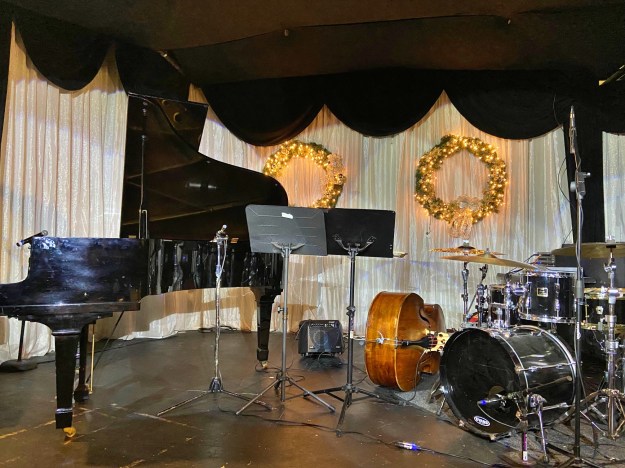
The traditional tools of the jazz trade jammed the stage: piano (baby grand, I think), drum kit (everything you can imagine), full-size bass, many microphones and, in this case, a full set of bongos, sound devices whose names I can’t guess and, in the center, a small electronic keyboard. In the hands of musical masters, these instruments enable the creation of the magical place a jazz club can be when a master of the art accompanied by others of surpassing talent are at the top of their game.

The people attending this event were primed for some top-level stimulation and they got it. Garrett’s sextet included: Vernell Brown Jr.: piano; Corcoran Holt: bass; Ronald Bruner Jr.: drums; Rudy Bird: percussion, snare; and Melvis Santa: vocals and keyboard, among other things. Those folks can play. For me, the drummer stood out, driving the music forward with powerful strokes and extraordinary energy. Few people can play like that for so long. But in truth the whole ensemble was a unit in an exceptional display of jazz at its most powerful.

At the end, Garrett called on the audience, already fully tuned up by the propulsive sound, to rise up and “work it out” to the closing number … and they did. I have never seen anything quite like that after attending many jazz performances over the years. Dancing in the aisles, even where there were no aisles.

Garrett’s style may not be for everyone (the first number lasted probably 15 or 20 minutes) but the crowd Saturday night was totally into it, as were all audiences in prior shows we saw. Typically, his entire body rocks back and forth to repeated riffs of sound. Maybe it’s how he keeps time. Doesn’t matter. The man can blow. He never seems to tire. His saxophone dominates the music, but the other instruments have their time as well when the tunes go from post-modern bop to Latin, Cuban, Afro something something, who knows. It’s all great.

At the end, Garrett dismissed each performer by name. The crowd erupted in appreciation and one-by-one the musicians exited. Garrett departed next-to-last, leaving the drummer, playing, for him, sedately. Then, he stopped and just walked off. It was all over but the vibrations. The steam subsided … until the next set.

Tickets are still available for tonight’s shows at 8 and 10.

Return to New York City—Jazz and More

That reads like the title of a novel, but it was just us finally getting back to the Great City for a visit, the first since moving to Washington on December 1, 2020. We stayed in the Loew’s Regency on Park Avenue, a nicely updated hotel with a surprisingly large room and, except for the bathroom, well designed.

We had planned this trip for some time and near the departure date learned that Birdland, one of New York’s legendary jazz clubs, would be re-opening for live performances just before our arrival. So, of course, we booked ourselves in there for Saturday night to see a group we had not known before – the Emmet Cohen Trio. The owner of the club opened the music part of the evening with a special welcome back to a packed and enthusiastic crowd, everyone excited to hear live jazz again. Then Cohen led the band in an opening medley of well-known jazz standards. Everyone was moved by the first piece—the classic Lullaby of Birdland made famous by George Shearing back in the day. An emotional and perfect way to start the evening.

Emmet Cohen proved an adept pianist in the jazz genre, moving easily among classical forms and more contemporary vibes. He and his musical mates, Russell Hall on bass (details about him here: http://www.russellhallbass.com/bio)  and Kyle Poole on drums (details about him here: http://www.kylepooledrums.com/about-1)  were perfectly matched and clearly had a great time entertaining the crowd.

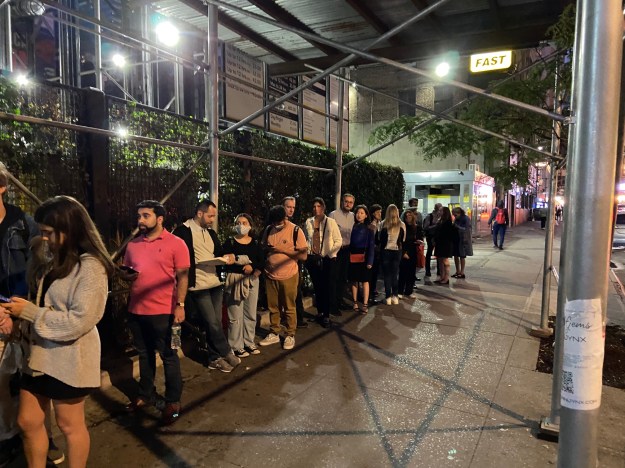
The food at Birdland was decent and the service excellent, especially considering they had just reopened two nights before. Interesting to us that there were so many young people in the audience. Here are photos of the line waiting to get in for the second show:

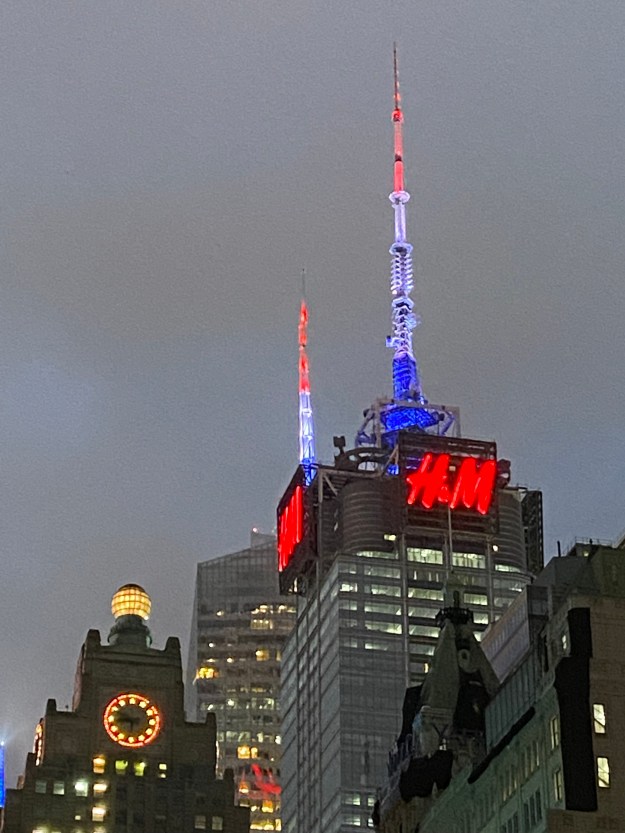
When we emerged after the show, we saw this:

a moving reminder of the scene just out of our apartment window during our three-year sojourn in the big city.

Sadly, we have lost the Jazz Standard to the pandemic, but the Village Vanguard and Smoke will hopefully reopen soon, and jazz will once again resound through the streets of New York.

On Sunday we lunched with a New York friend at Tavern on the Green, another great nostalgic return. That night, we dined at The Leopard at Des Artistes on West 67th. Our guest was my wife’s ballet instructor, Finis Jhung, New York City’s renowned ballet master. He danced with Joffrey Ballet, had his own company at one point and has trained some of the world’s greatest ballet dancers and Broadway stars. A very interesting person with whom to chat.

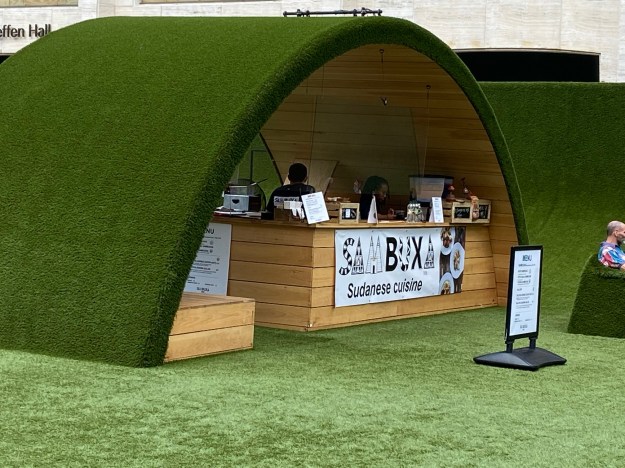
On Monday my New Jersey-resident daughter and family, my two grandsons in tow, joined us for lunch at Rosa Mexicano near Lincoln Center, which is just up the avenue from our old apartment. After lunch, we walked to Josie Robertson Plaza, the center element of the Center with its Revson Fountain running again. The Plaza has been completely covered in AstroTurf, with seats and other features (food stall, reading area) and is perfect for lounging around on a lazy day, which is just what we encountered:

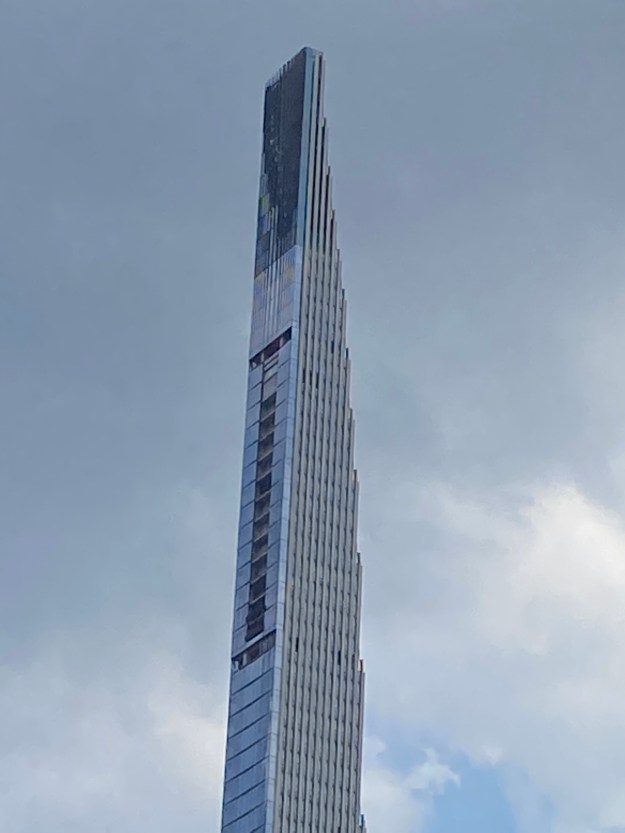
Finally, when in NYC, one should always look up. In addition to surprising art and architectural features, there is the sheer magnitude and daring of buildings like these:

If you don’t look up from time to time, you miss it.

Getting Jazz

I took a friend to a jazz club recently and, despite the powerhouse performance laced with complex improvisations, the experience was a disappointment to my friend. I had built up the event as something special, but he just didn’t “get” jazz. I suspect the root cause was that he was not properly prepared for the encounter, not schooled in the history of the music and thus unable to hear it in a context that made musical sense. He said it was just “interesting” and that he could “appreciate the mastery.”

My own appreciation of contemporary jazz is based in part on listening a lot to the precursors of the hard bop style and extended improvisations of modern jazz. This historical perspective is just as important in jazz as in classical music, where an informed listener can understand more modern classical forms in the context of, say, music from the Baroque Period. It is, for example, easier to hear the magic in Stravinsky’s Rite of Spring if you are familiar with what came before.

I have compiled a list of jazz performances that, in a manageable time frame, could provide a short course in the progression of the music from the original Dixieland originating in the back streets of New Orleans, progressing through ragtime, swing and the other major “movements” to the challenging styles of the present. This is not the “definitive list” or a “complete list” but it’s a pretty good one. More is omitted than is included, but anyone with a minimal ear can listen to the changes through time, without a detailed analysis of what is actually going on, and hopefully learn to dig the sound and the freedom that inheres in jazz music. Jazz deconstructs music to its core elements and reassembles it in new ways. As Cyrus Chestnut says at the end of the first set at each performance: “We’ve enjoyed playing these songs and we promise never to do it again.” He means that the improvisation will be different each time, a spontaneous reimagining of each tune. Like chess games, no two performances of the same tune are the same.

Here is my list:

Louis Armstrong                                  West End Blues

Sidney Bechet                                       Summertime

Jelly Roll Morton                                   Black Bottom Stomp

Pete Fountain                                        Rampart Street Parade

Art Tatum                                               Tiger Rag

Count Basie                                            One O’Clock Jump

Dorsey Brothers                                     St. Louis Blues

Charlie Parker                                         Cherokee

Charlie Parker                                         Scrapple From the Apple

Lester Young                                            Stardust

Ben Webster                                             Stormy Weather

Coleman Hawkins                                   Body & Soul

Bud Powell                                               Bouncing with Bud

Thelonious Monk                                    ‘Round Midnight

Thelonious Monk                                    Straight No Chaser

John Coltrane                                           Giant Steps

John Coltrane                                           One Up, One Down

George Shearing                                      Lullaby of Birdland

Art Blakey                                                  Moanin’

Modern Jazz Quartet                               Softly As In a Morning Sunrise

Erroll Garner                                             Autumn Leaves

Stan Getz                                                   Girl From Ipanema

Stan Getz                                                   These Foolish Things

Miles Davis                                                So What

Miles Davis                                                Oleo

Dave Brubeck                                            Blue Rondo a la Turk

Dave Brubeck                                            Take Five

Marcus Roberts                                         What Is This Thing Called Love?

McCoy Tyner                                              Passion Dance

Stefon Harris                                              Black Action Figure