Tag Archives: New York City

A Story for the Season … & All Seasons

Four years have passed since we returned from a three-year sojourn in New York City. We lived for two years in the District of Columbia and now two years back in Alexandria. As I have previously noted, I have tried to include in this blog a variety of topics, although politics came to dominate because of the troubled history we have lived through since 2016. The original idea behind the blog was to cover a potpourri of subjects about our country – hence the title, ShiningSeaUSA, borrowed from the song, “America the Beautiful. “

While in New York I started another blog, AutumnInNewYork, that was about our life in the great city in the autumn of my years. We expected New York to be the last place we would live. It turned out otherwise, thanks largely to the pandemic, and AutumnInNewYork was terminated.

The post that follows was originally published in AutumnInNewYork on December 24, 2018. I have reposted it before and am doing so again today in continued acknowledgement of both the person whom it concerns and the spirit of the holiday season. The scene is as vivid to me now as when I first witnessed it. We must remember in these troubled times there are still moments of beauty, kindness and joy. I was fortunate to witness one and I share it with you now.

A Story for the Season … & All Seasons

I can’t shake this story from my mind and, considering the season and everything that is going on, I must share it.

I recently visited a doctor in New York City for a follow-up to an earlier consultation. Not unexpectedly, there were patients sitting in the waiting room so I knew it might be a while before I was seen. I always have a book with me for such situations.

As I read, I happened to glance up and notice across from me a younger (30-something, I’m guessing) woman slumped sideways in her chair, obviously dozing. I continued reading but my attention turned to the young woman again when my doctor unexpectedly emerged from the back and approached her, quietly calling her name. The young woman did not react; she was “out cold.” The doctor, realizing the woman was deeply asleep, walked over to her, reached down and gently took each of the woman’s hands in her own. She did not pull or poke. She massaged them gently while speaking softly to the woman. This did the job of waking her, and, after a few moments to collect herself, they walked together into the back, the doctor asking her some question I didn’t catch.

I sat there for several minutes, reflecting on what I had seen. I was moved by it in ways I didn’t, and still don’t completely, understand. The power of witnessing the simple gesture of care and sensitivity took me by surprise. Then, my turn came; I went back, visited with a nurse to take the required “vitals” and waited in a room to see the doctor who came in very shortly.

After some small talk, I told her that I had witnessed what she had done, how gently and sweetly she had awakened the young woman. The doctor responded with “I’ve known her for years and she’s very special.” I said, “you are special, doctor. Doctors generally don’t do what you did.” She thanked me, somewhat embarrassed, I suspect, and we moved on.

I still often think about that simple gesture of kindness that, in most other circumstances I have witnessed over the years, would have been treated quite differently. The way my doctor chose to awaken her patient has stayed with me as an extraordinary example of how natural kindness can work with remarkable power. As I reflect on the scene, as vivid to me like it just happened, and as the holidays come on, it stands in vivid contrast to our national political life that is dominated by rancor, conflict and fear. We’re all trying to experience the holidays in a good way, and likely most of us will succeed in the end. And ‘will’ is the right word, because it feels more like an act of will than a natural thing to do at this time of year.

Part of the power of the doctor’s act was, I think, that it was so natural, so spontaneous. I am virtually certain she did not mull it over first; she just naturally reacted to the situation with humanity and compassion. That young lady is lucky, as am I, to have a doctor with such instincts for kindness. It’s a lesson we all need to learn and re-learn, especially when the times we live in are so burdened with acrimony and lack of concern for those in need of a helping hand. I suspect I will always have that image in my mind and hope to remain aware and grateful for its reminder of what is possible.

Happy Holidays.

New York City is Back!

You may recall that when the pandemic struck in 2020 with its epicenter at New York City, people, especially the well-to-do, fled the city in droves. Like many other predictions about the long-term effects of the pandemic, many observers declared the city permanently “dead.”

Turns out, like many a political poll, those doomsayers were wrong. To paraphrase the misquote attributed to Mark Twain, the reports of New York City’s demise were exaggerated. Recent data indicates large in-migration to the great city. While it’s not scientific, we can testify that the Big Apple is indeed back in business.

We took Amtrak from Washington for Memorial Day weekend and what a weekend it was! We arrived late Friday afternoon and were confronted with the usual late afternoon bedlam around the no-longer-new Moynihan Penn station. We rushed in a bone-jarring taxi ride up 8th Avenue to our hotel to change, met a dear friend for dinner at PJ Clarke’s, then walked with her to Dizzy’s Club to see the 9:30 performance of the Bill Charlap Trio. Because we were among the first to arrive, they seated us in the second tier of tables directly in front of the piano (the first row of tables is reserved for couples).

We have seen Charlap several times, and considered him the quintessential New York piano jazzman, playing tunes like Autumn in New York with somewhat mellow tones redolent of a moody late-night experience in the one of the world’s greatest cities. His music typically creates a sense of leaning into the vibe of the city, a kind of calm within a storm.

This night, however, Charlap was in a different zone, on full tilt from the first note and usually ending each song with a dramatic crashing of the keys, reminiscent of the great Cyrus Chestnut. It was a spectacular virtuoso performance from start to finish, accompanied by two of New York’s most in-demand sidemen: Peter Washington on bass and Kenny Washington on drums. We’ve seen both many times with different leaders, and they never disappoint. We were blown away by the power and musical drama of a world-class jazz trio, one of the greatest nights of jazz we’ve ever seen.

An additional treat we didn’t expect – Charlap rose from the bench several times to talk about the history of the music and the composers, something rare among jazz artists who mostly just want to play.

The final surprise occurred in the men’s room as I was leaving. Charlap and I ended up there together. I could not avoid engaging him, so I told him how spectacular we thought the performance had been. Characteristically, I think, he seemed genuinely moved and, after asking my name, thanked me profusely. No sign of artistic hubris, just happy that he had succeeded in making us happy.

We stumbled back to our hotel and collapsed, wasted, over-stimulated and completely thrilled by what we had seen.

Saturday arrived with some of the most spectacular Spring weather New York City has ever experienced. We met another friend at the Tavern-on-the-Green where the walkers, bikers, scooters, pedi-cabs, and runners were thronging on the main road around Central Park. People were everywhere soaking up the sun and blessedly mild temperature and humidity.

After brunch, we subwayed to Astoria and visited the Museum of the Moving Image, a surprisingly interesting place where my wife practiced her puppetry skills with one of the Muppet characters. The place is like many specialty museums – overwhelming in its scope and depth. Three learning experiences stood out to me: (1) most of the dialogue in movies is added after the filming of the (typically) multiple takes of each scene; (2) in televised baseball games, the camera shots (and dialogue of the broadcasters) are coordinated by a person who constantly directs which camera is live on the TV screen, often changing every few seconds, and the announcers have to keep up extemporaneously; and (3) the technology behind the Muppets is extraordinarily sophisticated and complex, remarkable to see in action.

We highly recommend this museum to everyone interested in how things work and the illusions that television and movies create.

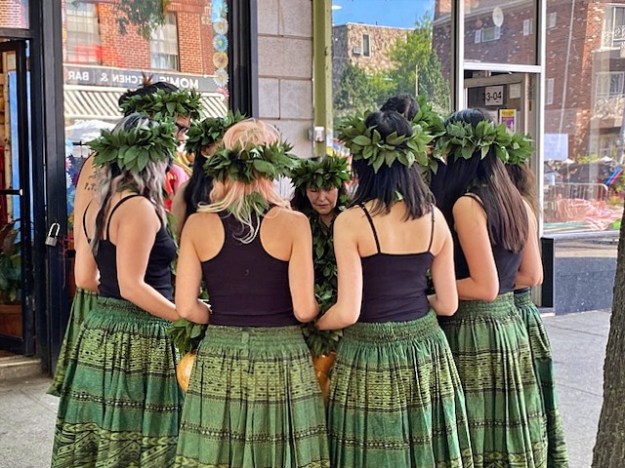
We taxied to 31st Avenue for the Asia & Pacific Islander Festival, a smallish gathering on a closed-off street where my wife’s New York hula troupe was performing. She had a joyous reunion with some old friends not seen since 2019, before the pandemic shut everything down. The aloha was strong in this group.

We raced back to Manhattan on the subway, changed clothes, had dinner at The Smith and walked across the street to the always spectacular Lincoln Center. We had great orchestra seats to what became one of the most exciting ballet evenings we have ever experienced.

New York City Ballet never disappoints and often just takes your breath away with the precision, stamina and virtuosic moves that are their trademark. This night was no exception.

Fancy Free was first up and surprised me with its energy and interest. The concept is that a trio of sailors are in town at a bar looking for companionship (it was in fact Fleet Week in NYC, so this made sense). A competition ensues when they meet just two women and, after a brief encounter with a third, end up with no one. The ladies are simply not having it. The contest for the females’ allegiance is sometimes intense, but in the end the young men are drawn back to their comradeship. Fancy Free is not my favorite style of ballet, but the dancers were amazing, and the choreography kept my attention throughout.

The music is by Leonard Bernstein with choreography by Jerome Robbins, whose work is, of course, brilliant. The musical and dancing style connection with West Side Story soon became very clear. Familiar but not distracting.

We knew this was the teaser for what followed: Agon, which means “struggle” or “conflict” in Greek. Music by Igor Stravinsky, choreography by, who else, George Balanchine. We did not know what to expect but had seen a video about the famous pas de deux narrated by Maria Kowroski [https://www.youtube.com/watch?v=CiPOZ0NS_2E] that helped us understand what was going on. Agon was described in the Playbill this way:

The dance critic Alistair McCauley says that many who saw the first performance of Agon were struck by how the music and movement created an impression of “shapes, phrases, rhythms and sounds that hadn’t been encountered before, but embodied New York modernism itself.”

https://tinyurl.com/3hm6ysmb The ballet is more than 60 years old but seems completely modern in style and costumes. Remarkable in every way, and, as usual, NYCB was at the top of its game. We both were entranced by the spectacle.

The evening was completed with Brandenburg, music by Johann Sebastian Bach and choreography by Jerome Robbins. Performed to excerpts from four of the Brandenburg Concertos with a large ensemble, the dancing was joyous. We were delighted to see Mira Nadon, who was promoted to the rank of soloist dancer in January 2022, and to principal just a year later. She is the first Asian-American female principal dancer at NYCB and a delight to watch. Brandenburg is long, maybe too much for us, although we were exhausted after our busy Friday and Saturday. There is, however, no denying the exceptional quality of the dancing throughout.

The next morning, we subwayed to Brooklyn to have brunch with another couple, also dear friends, and enjoyed, as always, a lively discussion of many things New York and beyond. We then walked together to the riverfront where the view of the Statue of Liberty was stunning in the late morning sun.

Sunday afternoon was, for me, yet another wonderful surprise. We had front row tickets at the Shubert Theatre for the matinee performance of Some Like It Hot, the updated adaptation of the Tony Curtis-Jack Lemon 1959 movie. Two down-on-their-luck musicians witness a mob hit and must flee for their lives. They disguise as women and join a newly formed, also struggling, all-female band.

I had given little thought to this show and expected an overly loud rock-music-based show. Wrong in every aspect. This was one of the funniest shows we have ever seen, and we’ve seen most of the great Broadway musicals. The music, dancing, acting were spectacular in every way. We both thought sitting so close might be problematic, but it was fascinating to see the dancers so close, performing incredibly high-energy moves in a somewhat constrained space and never missing a beat. Each dancer attending to his or her own space and actions with the result reminiscent of whirling dervishes. I noticed particularly the racial expressions and eye contact the dancers had with the audience – subtle but essential to the overall effect of the action. Perfect synchrony and stunning to see up close.

Each of the primary actor/singers was exceptional but note must be made of the role of Sugar played this day by the understudy, Kayla Pecchioni, who was remarkable in every way. Returning to my earlier mention of an updated adaptation, for this show, one of the two musicians is a Black man, played to perfection by J. Harrison Ghee. His facial expressions alone were worth the price of admission, but the man can also sing, dance and act. The updated show touches issues of race and gender, both handled with great humor in, for example, the song, You Can’t Have Me (If You Don’t Have Him), that gave the show a modern relevance.

While obviously presenting a very different vibe than masterpieces like Miss Saigon that have moved me to tears, Some Like It Hot is one of the most entertaining shows I have ever seen. It was, we both thought, flawless. If you get the chance to see it, don’t miss the opportunity. You will not be disappointed.

Our weekend escapade ended that evening with dinner at a wonderful New York style red-sauce Italian restaurant called Il Corso at 54 West 55th Street. The waiters were extremely attentive and helpful, and the food was phenomenal, especially the soup of the day, a puree of chickpeas and potatoes with some special spices. Remarkable and highly recommended.

Overall, then, our weekend in New York City was a smash hit in every way. Spectacular weather and phenomenal entertainment by the best-of-the-best. Unforgettable. Can’t wait to return.

Return to New York City—Jazz and More

That reads like the title of a novel, but it was just us finally getting back to the Great City for a visit, the first since moving to Washington on December 1, 2020. We stayed in the Loew’s Regency on Park Avenue, a nicely updated hotel with a surprisingly large room and, except for the bathroom, well designed.

We had planned this trip for some time and near the departure date learned that Birdland, one of New York’s legendary jazz clubs, would be re-opening for live performances just before our arrival. So, of course, we booked ourselves in there for Saturday night to see a group we had not known before – the Emmet Cohen Trio. The owner of the club opened the music part of the evening with a special welcome back to a packed and enthusiastic crowd, everyone excited to hear live jazz again. Then Cohen led the band in an opening medley of well-known jazz standards. Everyone was moved by the first piece—the classic Lullaby of Birdland made famous by George Shearing back in the day. An emotional and perfect way to start the evening.

Emmet Cohen proved an adept pianist in the jazz genre, moving easily among classical forms and more contemporary vibes. He and his musical mates, Russell Hall on bass (details about him here: http://www.russellhallbass.com/bio)  and Kyle Poole on drums (details about him here: http://www.kylepooledrums.com/about-1)  were perfectly matched and clearly had a great time entertaining the crowd.

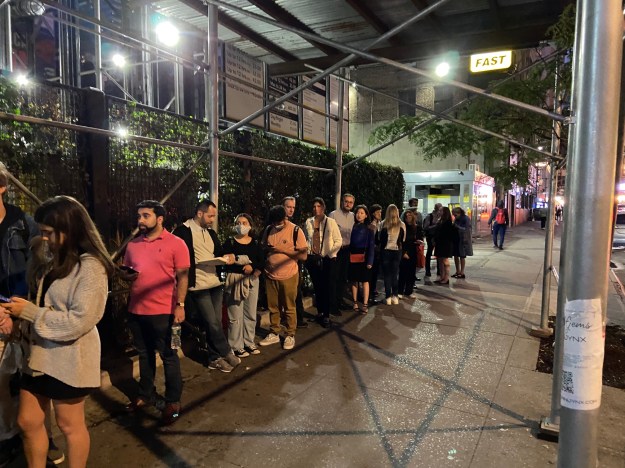
The food at Birdland was decent and the service excellent, especially considering they had just reopened two nights before. Interesting to us that there were so many young people in the audience. Here are photos of the line waiting to get in for the second show:

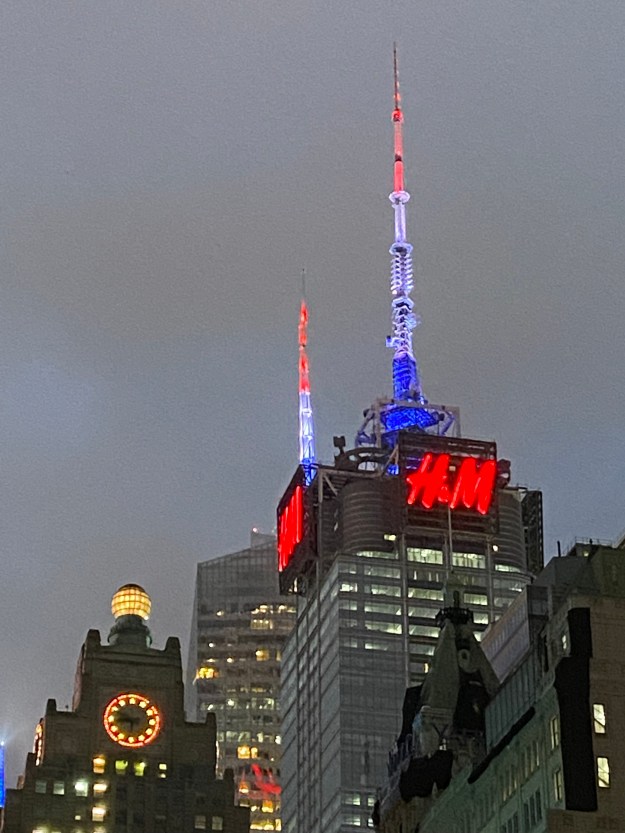
When we emerged after the show, we saw this:

a moving reminder of the scene just out of our apartment window during our three-year sojourn in the big city.

Sadly, we have lost the Jazz Standard to the pandemic, but the Village Vanguard and Smoke will hopefully reopen soon, and jazz will once again resound through the streets of New York.

On Sunday we lunched with a New York friend at Tavern on the Green, another great nostalgic return. That night, we dined at The Leopard at Des Artistes on West 67th. Our guest was my wife’s ballet instructor, Finis Jhung, New York City’s renowned ballet master. He danced with Joffrey Ballet, had his own company at one point and has trained some of the world’s greatest ballet dancers and Broadway stars. A very interesting person with whom to chat.

On Monday my New Jersey-resident daughter and family, my two grandsons in tow, joined us for lunch at Rosa Mexicano near Lincoln Center, which is just up the avenue from our old apartment. After lunch, we walked to Josie Robertson Plaza, the center element of the Center with its Revson Fountain running again. The Plaza has been completely covered in AstroTurf, with seats and other features (food stall, reading area) and is perfect for lounging around on a lazy day, which is just what we encountered:

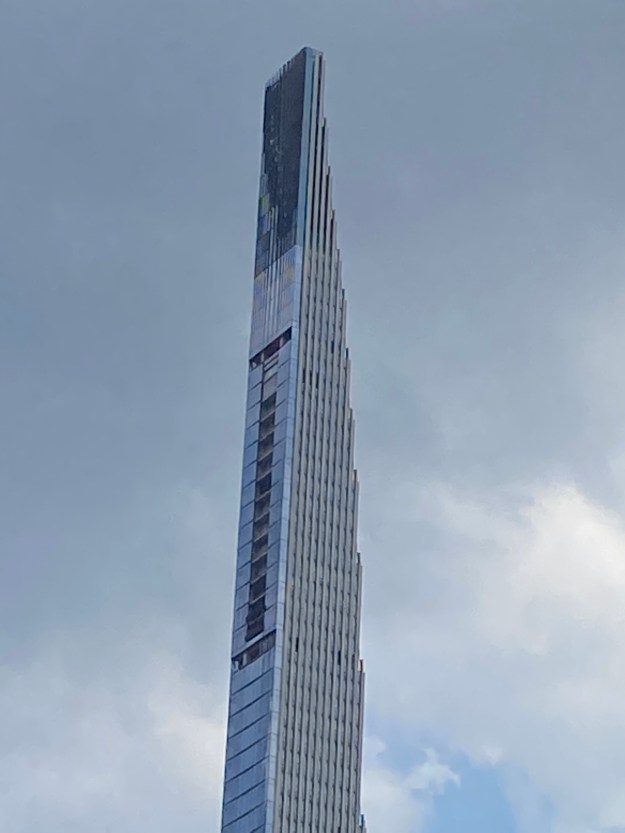
Finally, when in NYC, one should always look up. In addition to surprising art and architectural features, there is the sheer magnitude and daring of buildings like these:

If you don’t look up from time to time, you miss it.

New York As a Dead City

We have no balcony but many windows from which we can see south down Ninth Avenue into the 30s and east on West 58th to Columbus Circle and even parts of Central Park. In normal times West 58th would be teeming with foot traffic in both directions, much of it related to either Mt Sinai West Hospital that sits next to our apartment building and the John Jay College of Criminal Justice (enrollment of more than 13,000 undergraduates). Now, almost no one is on the street and there is little traffic. Few of the distinctive yellow taxis because no one is looking for rides.. Even the ambulances that normally come and go all day and night with sirens blasting are few and far between. The city is silent.

We remain self-sequestered in our 50th floor apartment. I have left it only twice since March 10, once for a disturbing walk around the block and once to go to a clinic where my “symptoms” were judged to be caused by a cold I’ve had since before coronavirus was recognized as rampant among us. I returned home from that experience chastened and profoundly disturbed at the incoming hourly news of the spreading catastrophe. I finally determined not to watch any more Coronavirus Task Force “press briefings” from the White House. The last straw was the dragging onstage of the Bible-thumper Pillow Guy who used the occasion to proclaim that the president was brought to us by God to save us from the virus. The constant slavering pandering to the president’s ego is more than I can bear to watch as thousands are dying and hundreds of thousands are suffering.

As you know if you follow the news, all of New York City is the epicenter of the pandemic in the United States, a dubious distinction of the worst type in the current circumstances. Broadway shows, ballet at Lincoln Center, Jazz at Lincoln Center and elsewhere, all shuttered along with the restaurants. Food deliveries are no long permitted to be brought to our door; someone must venture to the lobby to pick up everything. Absent a genuine emergency, medical appointments must be conducted by videoconference. How fortunate we are that such technology is available to us. We recently had a Zoom visit with some friends in Brooklyn, a delightful respite from the bleakness everywhere we look.

Which brings me to what is really most puzzling and disturbing. From up here, it appears that the people of New York are observing the social distancing practices recommended by the government and health experts. Of course, we can only see a tiny portion of the city, but you must wonder why the social distancing practices would vary dramatically from the limited area we can view. In any case, the number of new COVID-19 cases in New York City continues to surge. Experts are now suggesting that the early advice about how the virus spreads in the community was inaccurate. That is not a criticism because this is a new virus and the experts are learning more about it every day. But the reality appears to be that social distancing as thus far practiced has not “flattened the curve” sufficiently. The peak or apex day when the number of new cases begins to reverse is at least a week away. Maybe no one really appreciated how fast and how deeply the virus had reached before the true scale of the threat was understood.

Elsewhere, irrationality borne of cult-like beliefs in the unbelievable are causing the leaders of numerous states, mainly in the south, to either reject the experts’ medical advice entirely or to apply it very selectively. Only when the inevitable occurs and COVID-19 cases begin to surge do these geniuses decide that some response is required. Meanwhile, thousands of people crowd still-open beaches and continue about their daily lives as if nothing had happened. This is not, I must admit, solely a product of southern, religious or other regional misjudgment of reality. Even in New York City when the decision was made to leave open the many public playgrounds that dot the city, many New Yorkers flocked to them and behaved as if it was just another day in the park. The city noticed that social distancing practices were being ignored and closed the playgrounds.

I cannot leave this subject without noting another stark difference between New York and the Republican stronghold states around the country. I refer to leadership. As I was considering this post, a piece by Jon Katz appeared in the Bedlam Farm Journal, The Cuomo Brothers Versus The President: What A Show! https://bit.ly/2x2eHx8 Katz is a “former journalist and media critic” who compares the leadership performances of Donald Trump and New York Governor Andrew Cuomo during the COVID-19 crisis. I think Katz’s analysis is excellent with one major exception. He seems to think that Trump and Cuomo are basically the same except that Cuomo is better at presentation. I, on the other hand, believe that the differences are so stark and fundamental that they are a difference in kind, not merely in style.

Katz’s article contains much of what I had intended to say after watching Cuomo’s press briefing on Friday. He sat at a table flanked by senior advisors and experts in health and finance. His presentation was not accompanied by a cast of business executives parading to a microphone to sing the governor’s praises. Instead, Cuomo’s remarks related to a series of charts and graphs showing the extent of the challenges New York City and state face from the coronavirus. Much of it was bad news: “At the current burn rate we will be out of ventilators in six days.” The little good news was marked with warnings about undue optimism that could mislead people into taking unnecessary and dangerous (to themselves and others) risks by departing too soon from the social distancing and other measures designed, it is hoped, to “flatten the curve” in virus case growth and deaths. Hospitals and the doctors, nurses, orderlies and others laboring there are reaching the breaking point.

The data was clear and stark and frightening. Cuomo glossed over nothing. He spoke in full sentences in simple New York-accented English. No word salad, no gibberish, no self-praise. Just simple language, elegant in its simplicity and directness, intended to communicate both concern about the harsh realities and encouragement that we will get through this together. He carefully avoided engaging Trump in a war of words and recriminations when reporters tried to bait him into reacting to Trump’s verbal insults to New York and its health care workers.

And, in total contrast to the self-referential obsessions of the president, Cuomo said “If we fail, it’s on me.” Near, I think, to the limits of emotional control, he said “I’m doing everything I can, but people are still dying. It is very hurtful and painful. I take it very personally.” Then, after an hour of speaking hard truths and answering questions, Cuomo looked to his advisors: “Anything I said that is wrong? Now is the time to speak up.” The cameras were still rolling and there is no doubt that if any of his experts had something to qualify about his presentation, they were being called out in public to do it in full public view.

You likely will never see Donald Trump do anything like that. He maintains that everything he does and says is perfect. He is anointed and therefore cannot make mistakes. Remember that after downplaying the risks of the coronavirus while the rest of the world was being overrun by it, after claiming it was completely under control and predicting that it would soon drop to zero cases in the United States, Trump said, on camera, “No, I do not take responsibility.”

So, Cuomo: If we fail, it’s on me.

And Trump: I take no responsibility and deny I said what I said.


Racism at Ground Level

My wife and I emerged from a Broadway show into a cold downpour. The weather folks had predicted it and this time they were right. We had coats and umbrellas, of course, but the wind was strong and puddles were everywhere among the thousands of people on the street in Times Square, many of them without any apparent protection against either the cold or the rain. Tourists? New Yorkers who simply won’t yield to reality? No way to know and we really didn’t care.

Our first plan was to go to the closest subway station and take the train to Columbus Circle, from which it is just over a long block walk to our apartment. As fate would have it, both of the nearby stations were locked shut, due, we later learned, to “track improvements.”

Nothing for it but to walk the 10 or so blocks to our building and we set out. But just two blocks later, a taxi with top light on pulled up to the stoplight right in front of us. The diminutive driver signaled us into the cab and away we went. Sort of. Traffic was, of course, in total gridlock with a lot of angry horn honking and jockeying for position among the yellow cabs and the other cars that, for whatever unimaginable reason, had chosen to drive into the Times Square area that evening. This is to be expected. In every rainstorm since the automobile arrived in New York, there has been gridlock, horn honking and jockeying for position. Everyone knows it’s going to happen.

We slowly made our way across town toward 8th Avenue which would take us directly to Columbus Circle. Then, while still on West 51st Street our driver and the driver of a larger van-style car came side by side of each other. Looks were exchanged and then our driver lowered his window and began shouting at the other driver who returned the favor with his middle finger. Our driver said something about how the other guy should learn to drive “like a gentleman, you Pakistani m*****f***r!” Fortunately, that was the end of the exchange. I suspect that if it had not been raining so hard, these two men might have faced off in the street, while their passengers were ignored in favor of settling the racial score that had erupted between them. I don’t know if the other driver was working a ride-hailing service like Uber or was just out in the evening for other reasons. I have seen serious words exchanged by NY cabbies with Uber drivers before, but never in these circumstances. In this case it was hard to understand how our driver could tell anything about the other one through the downpour but he was clear enough about what he thought.

Had it not been raining, we would have left the cab with the fare unpaid. But it was and we didn’t. The drive, however, got only a nominal tip, for picking us up in the first place. This is not the experience anyone should have in a public conveyance. I well understand some of the bad blood between the taxis and the ride-hailing services, but even today many of the New York cabs are neither clean nor comfortable and the cabbies often seem to pride themselves on being surly. This episode was a sad reminder of the hostilities and tensions that stain our world.