Tag Archives: NYCB

A New York State of Mind

Hopefully you’re familiar with that title of an anthem song about New York City that was written and made famous by Billy Joel. We achieved this euphoric condition last week with four glorious days there.

We took Amtrak as usual on Wednesday, arriving in plenty of time to get squared away in the Luxury Collection Hotel (formerly the Conrad), one of our favorites well-located on West 54th Street. The weather was perfect. We dined at PJ Clarke’s across the street from Lincoln Center, and walked there to see New York City Ballet perform Apollo, Ballo della Regina, Tschaikovsky Pas de Deux, and, finally, Chaconne. The dancing was, as always, perfectly performed. We weren’t thrilled by Apollo, but the ballerinas were exceptional. Another night to remember.

The next night we traveled out Broadway to Smoke, the post-pandemic remodeled version, where Cyrus Chestnut was performing. We’ve seen Cyrus many times, perhaps too many, but his playing still resonates, and his trio is always “on.” One odd but serendipitous thing was that we chose our seats from the online seat map that showed we would be seated immediately behind Cyrus and could thus follow his hands on the keyboard. But it turned out that the map was inaccurate, and we were going to be jammed in the back corner in an uncomfortably tight space.

As it happened a couple seated a few tables forward of the bandstand overheard our exchange with the maître d’. They told her that the couple who were to join them had come down with COVID and would not be present, so would we like to join them? [Finally, COVID fortuitously did something good for us.] We moved to their table and discovered two delightful New Yorkers who loved jazz as much as we do and have seen pretty much everyone we have. The man was a retired professor; his wife was a neuro-psychologist. They were most interesting and engaging companions for the evening.

The Cyrus Chestnut trio performed as expected and were applauded by a packed house of jazz enthusiasts.

The third night we traveled to the Winter Garden Theater that sits in the center of Times Square. Winter Garden dates to 1911 (remodeled in 1922) and while it is well-worn, the seats were surprisingly roomy. We were there to see Good Night, and Good Luck, starring George Clooney. We snagged our tickets early and avoided paying the current extremely high prices. In the event, it would have been worth almost any amount. Clooney’s acting was what you would expect, such that you tended to forget he was not Edward R. Murrow reincarnated.

The show tracked the movie very closely … except for the ending. I will not spoil it by revealing the ending here. Suffice to say, I have seen many plays over my long years and never was I stunned and moved by an ending like this one. Hopefully, you will see this play and experience it for yourself.

Incidentally, because of the way the play is staged, with normal action and dialogue on stage combined with screens of Joe McCarthy and others, it doesn’t much matter where you sit. You can see and hear just fine. Just be ready for the ending. I am still reeling.

The final night of our New York experience arrived with a challenging weather forecast but the details said it would clear by the time to line up (seats at Birdland are first come-first seated; there is always a line outside well before the doors open). We were meeting a New York friend (and my wife’s fellow hula dancer from the local dance group) who also loves the music and joins us for these shows when she is not traveling the world.

As our Lyft crept down West 44th Street in the usual stop-and-stop traffic, and we were 100 feet from the club, the clouds suddenly dropped their water (all of it) in an overwhelming deluge, zero to a hundred in one second. When we finally reached the club, the rain had intensified; our driver offered to pull over and let us stay in his car until the rain let up (tell me again about those rude New Yorkers). Seeing our friend being drenched in the rear of the line, we declined the offer, departed the car, and were promptly soaked. My wife approached the club people managing the line, and we were immediately admitted to the club. This led to everyone being admitted well before the official “doors” time (see prior parentheses).

The trio this night was led by Emmet Cohen at the piano, with Phillip Norris on bass, and Joe Farnsworth on drums. We had seen a different group under Cohen’s leadership on the first post-pandemic night of jazz at Birdland, so we didn’t know what to expect. We had thought Cohen was great that night, but part of the vibe was excitement that “jazz was back!”

There was no reason for concern. The band was “on” from the first note. And Joe Farnsworth put on a class in drum technique accentuated by his constant change of facial expressions as he and Cohen communicated in that mysterious way that jazz musicians have. Over my life of 150 years, I have had the pleasure of seeing many great jazz drummers, including the magical Eric Harland and Billy Kilson. Farnsworth left no room between him and the best. I told him so after the performance and he seemed genuinely delighted at the praise. I also spoke briefly with Norris who was open and welcoming to my approach.

One thing about Cohen and his ensemble – they seemed always to be having fun, and that vibe translated through the music to the audience. It was an extraordinary performance that left us exhilarated and spent when it was over. They played for almost an hour and a half, long by jazz group standards, and left nothing on the table. Halfway through, my wife leaned over and whispered to me, “this is an amazing show.” Indeed, it was.

Thus, ended our New York State of Mind for this trip, memorable in every way. We still talk about the play, something I will never forget. There is no place on earth like New York City. We miss it every day. I suspect that once you achieve that New York State of Mind, it never leaves you. I hope not.
New York City is Back!

You may recall that when the pandemic struck in 2020 with its epicenter at New York City, people, especially the well-to-do, fled the city in droves. Like many other predictions about the long-term effects of the pandemic, many observers declared the city permanently “dead.”

Turns out, like many a political poll, those doomsayers were wrong. To paraphrase the misquote attributed to Mark Twain, the reports of New York City’s demise were exaggerated. Recent data indicates large in-migration to the great city. While it’s not scientific, we can testify that the Big Apple is indeed back in business.

We took Amtrak from Washington for Memorial Day weekend and what a weekend it was! We arrived late Friday afternoon and were confronted with the usual late afternoon bedlam around the no-longer-new Moynihan Penn station. We rushed in a bone-jarring taxi ride up 8th Avenue to our hotel to change, met a dear friend for dinner at PJ Clarke’s, then walked with her to Dizzy’s Club to see the 9:30 performance of the Bill Charlap Trio. Because we were among the first to arrive, they seated us in the second tier of tables directly in front of the piano (the first row of tables is reserved for couples).

We have seen Charlap several times, and considered him the quintessential New York piano jazzman, playing tunes like Autumn in New York with somewhat mellow tones redolent of a moody late-night experience in the one of the world’s greatest cities. His music typically creates a sense of leaning into the vibe of the city, a kind of calm within a storm.

This night, however, Charlap was in a different zone, on full tilt from the first note and usually ending each song with a dramatic crashing of the keys, reminiscent of the great Cyrus Chestnut. It was a spectacular virtuoso performance from start to finish, accompanied by two of New York’s most in-demand sidemen: Peter Washington on bass and Kenny Washington on drums. We’ve seen both many times with different leaders, and they never disappoint. We were blown away by the power and musical drama of a world-class jazz trio, one of the greatest nights of jazz we’ve ever seen.

An additional treat we didn’t expect – Charlap rose from the bench several times to talk about the history of the music and the composers, something rare among jazz artists who mostly just want to play.

The final surprise occurred in the men’s room as I was leaving. Charlap and I ended up there together. I could not avoid engaging him, so I told him how spectacular we thought the performance had been. Characteristically, I think, he seemed genuinely moved and, after asking my name, thanked me profusely. No sign of artistic hubris, just happy that he had succeeded in making us happy.

We stumbled back to our hotel and collapsed, wasted, over-stimulated and completely thrilled by what we had seen.

Saturday arrived with some of the most spectacular Spring weather New York City has ever experienced. We met another friend at the Tavern-on-the-Green where the walkers, bikers, scooters, pedi-cabs, and runners were thronging on the main road around Central Park. People were everywhere soaking up the sun and blessedly mild temperature and humidity.

After brunch, we subwayed to Astoria and visited the Museum of the Moving Image, a surprisingly interesting place where my wife practiced her puppetry skills with one of the Muppet characters. The place is like many specialty museums – overwhelming in its scope and depth. Three learning experiences stood out to me: (1) most of the dialogue in movies is added after the filming of the (typically) multiple takes of each scene; (2) in televised baseball games, the camera shots (and dialogue of the broadcasters) are coordinated by a person who constantly directs which camera is live on the TV screen, often changing every few seconds, and the announcers have to keep up extemporaneously; and (3) the technology behind the Muppets is extraordinarily sophisticated and complex, remarkable to see in action.

We highly recommend this museum to everyone interested in how things work and the illusions that television and movies create.

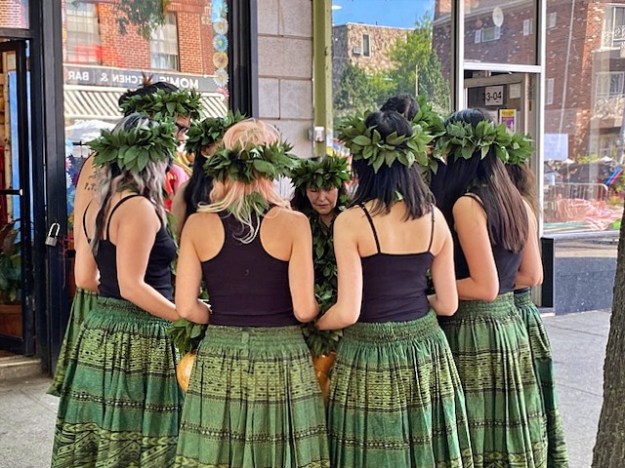
We taxied to 31st Avenue for the Asia & Pacific Islander Festival, a smallish gathering on a closed-off street where my wife’s New York hula troupe was performing. She had a joyous reunion with some old friends not seen since 2019, before the pandemic shut everything down. The aloha was strong in this group.

We raced back to Manhattan on the subway, changed clothes, had dinner at The Smith and walked across the street to the always spectacular Lincoln Center. We had great orchestra seats to what became one of the most exciting ballet evenings we have ever experienced.

New York City Ballet never disappoints and often just takes your breath away with the precision, stamina and virtuosic moves that are their trademark. This night was no exception.

Fancy Free was first up and surprised me with its energy and interest. The concept is that a trio of sailors are in town at a bar looking for companionship (it was in fact Fleet Week in NYC, so this made sense). A competition ensues when they meet just two women and, after a brief encounter with a third, end up with no one. The ladies are simply not having it. The contest for the females’ allegiance is sometimes intense, but in the end the young men are drawn back to their comradeship. Fancy Free is not my favorite style of ballet, but the dancers were amazing, and the choreography kept my attention throughout.

The music is by Leonard Bernstein with choreography by Jerome Robbins, whose work is, of course, brilliant. The musical and dancing style connection with West Side Story soon became very clear. Familiar but not distracting.

We knew this was the teaser for what followed: Agon, which means “struggle” or “conflict” in Greek. Music by Igor Stravinsky, choreography by, who else, George Balanchine. We did not know what to expect but had seen a video about the famous pas de deux narrated by Maria Kowroski [https://www.youtube.com/watch?v=CiPOZ0NS_2E] that helped us understand what was going on. Agon was described in the Playbill this way:

The dance critic Alistair McCauley says that many who saw the first performance of Agon were struck by how the music and movement created an impression of “shapes, phrases, rhythms and sounds that hadn’t been encountered before, but embodied New York modernism itself.”

https://tinyurl.com/3hm6ysmb The ballet is more than 60 years old but seems completely modern in style and costumes. Remarkable in every way, and, as usual, NYCB was at the top of its game. We both were entranced by the spectacle.

The evening was completed with Brandenburg, music by Johann Sebastian Bach and choreography by Jerome Robbins. Performed to excerpts from four of the Brandenburg Concertos with a large ensemble, the dancing was joyous. We were delighted to see Mira Nadon, who was promoted to the rank of soloist dancer in January 2022, and to principal just a year later. She is the first Asian-American female principal dancer at NYCB and a delight to watch. Brandenburg is long, maybe too much for us, although we were exhausted after our busy Friday and Saturday. There is, however, no denying the exceptional quality of the dancing throughout.

The next morning, we subwayed to Brooklyn to have brunch with another couple, also dear friends, and enjoyed, as always, a lively discussion of many things New York and beyond. We then walked together to the riverfront where the view of the Statue of Liberty was stunning in the late morning sun.

Sunday afternoon was, for me, yet another wonderful surprise. We had front row tickets at the Shubert Theatre for the matinee performance of Some Like It Hot, the updated adaptation of the Tony Curtis-Jack Lemon 1959 movie. Two down-on-their-luck musicians witness a mob hit and must flee for their lives. They disguise as women and join a newly formed, also struggling, all-female band.

I had given little thought to this show and expected an overly loud rock-music-based show. Wrong in every aspect. This was one of the funniest shows we have ever seen, and we’ve seen most of the great Broadway musicals. The music, dancing, acting were spectacular in every way. We both thought sitting so close might be problematic, but it was fascinating to see the dancers so close, performing incredibly high-energy moves in a somewhat constrained space and never missing a beat. Each dancer attending to his or her own space and actions with the result reminiscent of whirling dervishes. I noticed particularly the racial expressions and eye contact the dancers had with the audience – subtle but essential to the overall effect of the action. Perfect synchrony and stunning to see up close.

Each of the primary actor/singers was exceptional but note must be made of the role of Sugar played this day by the understudy, Kayla Pecchioni, who was remarkable in every way. Returning to my earlier mention of an updated adaptation, for this show, one of the two musicians is a Black man, played to perfection by J. Harrison Ghee. His facial expressions alone were worth the price of admission, but the man can also sing, dance and act. The updated show touches issues of race and gender, both handled with great humor in, for example, the song, You Can’t Have Me (If You Don’t Have Him), that gave the show a modern relevance.

While obviously presenting a very different vibe than masterpieces like Miss Saigon that have moved me to tears, Some Like It Hot is one of the most entertaining shows I have ever seen. It was, we both thought, flawless. If you get the chance to see it, don’t miss the opportunity. You will not be disappointed.

Our weekend escapade ended that evening with dinner at a wonderful New York style red-sauce Italian restaurant called Il Corso at 54 West 55th Street. The waiters were extremely attentive and helpful, and the food was phenomenal, especially the soup of the day, a puree of chickpeas and potatoes with some special spices. Remarkable and highly recommended.

Overall, then, our weekend in New York City was a smash hit in every way. Spectacular weather and phenomenal entertainment by the best-of-the-best. Unforgettable. Can’t wait to return.