Author Archives: shiningseausa

New York City is Back!

You may recall that when the pandemic struck in 2020 with its epicenter at New York City, people, especially the well-to-do, fled the city in droves. Like many other predictions about the long-term effects of the pandemic, many observers declared the city permanently “dead.”

Turns out, like many a political poll, those doomsayers were wrong. To paraphrase the misquote attributed to Mark Twain, the reports of New York City’s demise were exaggerated. Recent data indicates large in-migration to the great city. While it’s not scientific, we can testify that the Big Apple is indeed back in business.

We took Amtrak from Washington for Memorial Day weekend and what a weekend it was! We arrived late Friday afternoon and were confronted with the usual late afternoon bedlam around the no-longer-new Moynihan Penn station. We rushed in a bone-jarring taxi ride up 8th Avenue to our hotel to change, met a dear friend for dinner at PJ Clarke’s, then walked with her to Dizzy’s Club to see the 9:30 performance of the Bill Charlap Trio. Because we were among the first to arrive, they seated us in the second tier of tables directly in front of the piano (the first row of tables is reserved for couples).

We have seen Charlap several times, and considered him the quintessential New York piano jazzman, playing tunes like Autumn in New York with somewhat mellow tones redolent of a moody late-night experience in the one of the world’s greatest cities. His music typically creates a sense of leaning into the vibe of the city, a kind of calm within a storm.

This night, however, Charlap was in a different zone, on full tilt from the first note and usually ending each song with a dramatic crashing of the keys, reminiscent of the great Cyrus Chestnut. It was a spectacular virtuoso performance from start to finish, accompanied by two of New York’s most in-demand sidemen: Peter Washington on bass and Kenny Washington on drums. We’ve seen both many times with different leaders, and they never disappoint. We were blown away by the power and musical drama of a world-class jazz trio, one of the greatest nights of jazz we’ve ever seen.

An additional treat we didn’t expect – Charlap rose from the bench several times to talk about the history of the music and the composers, something rare among jazz artists who mostly just want to play.

The final surprise occurred in the men’s room as I was leaving. Charlap and I ended up there together. I could not avoid engaging him, so I told him how spectacular we thought the performance had been. Characteristically, I think, he seemed genuinely moved and, after asking my name, thanked me profusely. No sign of artistic hubris, just happy that he had succeeded in making us happy.

We stumbled back to our hotel and collapsed, wasted, over-stimulated and completely thrilled by what we had seen.

Saturday arrived with some of the most spectacular Spring weather New York City has ever experienced. We met another friend at the Tavern-on-the-Green where the walkers, bikers, scooters, pedi-cabs, and runners were thronging on the main road around Central Park. People were everywhere soaking up the sun and blessedly mild temperature and humidity.

After brunch, we subwayed to Astoria and visited the Museum of the Moving Image, a surprisingly interesting place where my wife practiced her puppetry skills with one of the Muppet characters. The place is like many specialty museums – overwhelming in its scope and depth. Three learning experiences stood out to me: (1) most of the dialogue in movies is added after the filming of the (typically) multiple takes of each scene; (2) in televised baseball games, the camera shots (and dialogue of the broadcasters) are coordinated by a person who constantly directs which camera is live on the TV screen, often changing every few seconds, and the announcers have to keep up extemporaneously; and (3) the technology behind the Muppets is extraordinarily sophisticated and complex, remarkable to see in action.

We highly recommend this museum to everyone interested in how things work and the illusions that television and movies create.

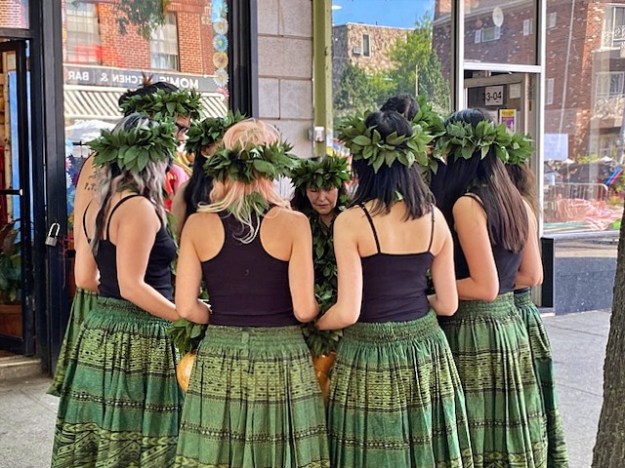
We taxied to 31st Avenue for the Asia & Pacific Islander Festival, a smallish gathering on a closed-off street where my wife’s New York hula troupe was performing. She had a joyous reunion with some old friends not seen since 2019, before the pandemic shut everything down. The aloha was strong in this group.
We raced back to Manhattan on the subway, changed clothes, had dinner at The Smith and walked across the street to the always spectacular Lincoln Center. We had great orchestra seats to what became one of the most exciting ballet evenings we have ever experienced.

New York City Ballet never disappoints and often just takes your breath away with the precision, stamina and virtuosic moves that are their trademark. This night was no exception.

Fancy Free was first up and surprised me with its energy and interest. The concept is that a trio of sailors are in town at a bar looking for companionship (it was in fact Fleet Week in NYC, so this made sense). A competition ensues when they meet just two women and, after a brief encounter with a third, end up with no one. The ladies are simply not having it. The contest for the females’ allegiance is sometimes intense, but in the end the young men are drawn back to their comradeship. Fancy Free is not my favorite style of ballet, but the dancers were amazing, and the choreography kept my attention throughout.

The music is by Leonard Bernstein with choreography by Jerome Robbins, whose work is, of course, brilliant. The musical and dancing style connection with West Side Story soon became very clear. Familiar but not distracting.

We knew this was the teaser for what followed: Agon, which means “struggle” or “conflict” in Greek. Music by Igor Stravinsky, choreography by, who else, George Balanchine. We did not know what to expect but had seen a video about the famous pas de deux narrated by Maria Kowroski [https://www.youtube.com/watch?v=CiPOZ0NS_2E] that helped us understand what was going on. Agon was described in the Playbill this way:

The dance critic Alistair McCauley says that many who saw the first performance of Agon were struck by how the music and movement created an impression of “shapes, phrases, rhythms and sounds that hadn’t been encountered before, but embodied New York modernism itself.”

https://tinyurl.com/3hm6ysmb The ballet is more than 60 years old but seems completely modern in style and costumes. Remarkable in every way, and, as usual, NYCB was at the top of its game. We both were entranced by the spectacle.

The evening was completed with Brandenburg, music by Johann Sebastian Bach and choreography by Jerome Robbins. Performed to excerpts from four of the Brandenburg Concertos with a large ensemble, the dancing was joyous. We were delighted to see Mira Nadon, who was promoted to the rank of soloist dancer in January 2022, and to principal just a year later. She is the first Asian-American female principal dancer at NYCB and a delight to watch. Brandenburg is long, maybe too much for us, although we were exhausted after our busy Friday and Saturday. There is, however, no denying the exceptional quality of the dancing throughout.

The next morning, we subwayed to Brooklyn to have brunch with another couple, also dear friends, and enjoyed, as always, a lively discussion of many things New York and beyond. We then walked together to the riverfront where the view of the Statue of Liberty was stunning in the late morning sun.

Sunday afternoon was, for me, yet another wonderful surprise. We had front row tickets at the Shubert Theatre for the matinee performance of Some Like It Hot, the updated adaptation of the Tony Curtis-Jack Lemon 1959 movie. Two down-on-their-luck musicians witness a mob hit and must flee for their lives. They disguise as women and join a newly formed, also struggling, all-female band.

I had given little thought to this show and expected an overly loud rock-music-based show. Wrong in every aspect. This was one of the funniest shows we have ever seen, and we’ve seen most of the great Broadway musicals. The music, dancing, acting were spectacular in every way. We both thought sitting so close might be problematic, but it was fascinating to see the dancers so close, performing incredibly high-energy moves in a somewhat constrained space and never missing a beat. Each dancer attending to his or her own space and actions with the result reminiscent of whirling dervishes. I noticed particularly the racial expressions and eye contact the dancers had with the audience – subtle but essential to the overall effect of the action. Perfect synchrony and stunning to see up close.

Each of the primary actor/singers was exceptional but note must be made of the role of Sugar played this day by the understudy, Kayla Pecchioni, who was remarkable in every way. Returning to my earlier mention of an updated adaptation, for this show, one of the two musicians is a Black man, played to perfection by J. Harrison Ghee. His facial expressions alone were worth the price of admission, but the man can also sing, dance and act. The updated show touches issues of race and gender, both handled with great humor in, for example, the song, You Can’t Have Me (If You Don’t Have Him), that gave the show a modern relevance.

While obviously presenting a very different vibe than masterpieces like Miss Saigon that have moved me to tears, Some Like It Hot is one of the most entertaining shows I have ever seen. It was, we both thought, flawless. If you get the chance to see it, don’t miss the opportunity. You will not be disappointed.

Our weekend escapade ended that evening with dinner at a wonderful New York style red-sauce Italian restaurant called Il Corso at 54 West 55th Street. The waiters were extremely attentive and helpful, and the food was phenomenal, especially the soup of the day, a puree of chickpeas and potatoes with some special spices. Remarkable and highly recommended.

Overall, then, our weekend in New York City was a smash hit in every way. Spectacular weather and phenomenal entertainment by the best-of-the-best. Unforgettable. Can’t wait to return.

Bonanza Weekend with the Friendly Bird People

On Saturday, a sunny pleasant spring day, we ventured down the road a short way to the Dyke Marsh Wildlife Preserve that runs beside the Potomac River for about a mile. The trail is fine gravel and dirt, a level walk that ends at a short boardwalk overlooking the Potomac. There are some picturesque views of boats at anchor but usually not much wildlife beyond the Red-winged Blackbird habitat at the far end of the trail.

However, on recent trips there we have seen gaggles of photographers with the birders’ favorite tool – the tripod mounted very long lens mounted on a full-frame camera body. These cost many thousands of dollars but the serious birders at Huntley Meadows and elsewhere must have them.

The long-lens folks were out in force on this visit to Dyke Marsh because the owls were there. Perched high in the trees on the short road leading to the river, they are very hard to see even when you know what you’re looking for. But, as my wife says, once you see one, you can’t unsee it.

We joined the gaggle and finally got a few shots on my low-range Nikon, the cropped results of which are set out below. This is the Barred Owl:

We knew from a prior trip that about a third of the way down the Dyke Marsh trail, there was a cluster of trees beside the river in which an owl mother and baby had been resident but invisible to us on a prior trip. We walked there next and, sure enough, another gaggle of birders with long lenses was already staked out. As usual, birders are very helpful and friendly, so they immediately set about helping us spot the owls so perfectly camouflaged by the dense leaves in the upper branches. Those shots are below. This is the Great Horned Owl:

After a good time in awe of these magnificent birds, we started back down the trail to the car. But what to our wondering eyes appears but a lone photographer with his long tripod-mounted lens, pointed up to the non-river side of the trail into a tall tree in which was lodged a cluster of dark sticks. An eagle’s nest, we are told, with two or three large eaglets almost ready to fledge.

We are transfixed by this as I try to take some shots that I hope can be cropped and brightened into something worth having.

Then, without warning, it happens:  mom appears out of nowhere with food for the eaglets. Here is the nest and the arrival of mom, the time between her appearance in our view and arrival on the nest being only a few seconds.

Apologies for the quality problems but my camera lens is just not up for this kind of photography.

We finished the walk in something of a daze. The owls were great. The eagles almost too much.

Sunday dawned cool and overcast but in the afternoon we ventured out to a familiar spot: the National Wildlife Refuge at Mason Neck State Park, on Belmont Bay of the Occoquan River. We walked the Bay View Trail, a relatively flat mile-long walk through the woods bounded by bogs with many frogs clicking and singing their mating calls. Eventually the trail opens to the Bay and passes along it.

As with Dyke Marsh, we usually don’t see much wildlife on this trail, but this turned out to be a two-snake day that made all the difference. Photos follow:

The moral, if there is one, is I suppose that one should not prejudged the day but just go and see whatever turns up. Some days, not much, just a walk in the woods, and others a bonanza of amazing sights that lift the spirits and nourish the soul.

Shameless Corruption on the Supreme Court

I have written about this before. See The Stench From the Bench, https://bit.ly/3Grp7qq, mainly about the conservative icon Antonin Scalia, Justice Alito’s Masquerade, https://bit.ly/3nVfWs7, and now, yet again, we have Clarence Thomas. https://bit.ly/3mgojhq

I begin with the observation that, in its most recent reporting about Clarence Thomas’ corruption, USAToday has tried to divert the issue into a problem for President Biden. Consider the headline: “Following furor over GOP-donor luxury trips, Joe Biden reckons with another Clarence Thomas scandal.” The first five paragraphs are about the mishandling of the Clarence Thomas confirmation hearings in 1991. After a brief reference to the latest revelations that Thomas has been taking “lavish trips from a billionaire Republican donor for more than 20 years without disclosing them, a possible violation of federal law,” the article returns to the confirmation hearings and the criticism of Biden for allowing the abuse of Anita Hill who testified to Thomas’s sexual harassment of her.

The author finally gets around to noting that then-Senator Biden voted against confirming Thomas but deflects quickly to reciting that Hill refused to accept Biden’s later expressions of regret. In a minor bit of irony, Thomas was also unforgiving.

In that regard, Thomas shares much with Donald Trump. He never forgives, never forgets, every slight against him. And he remained silent while his wife worked to overturn the 2020 election. The author states that Ginni Thomas tried to cover her tracks with this statement:

“You know, it was an emotional time,” she said in explaining the text messages to Meadows. “I’m sorry these texts exist.”

No doubt, she is sorry the messages exist. Not sorry that they were sent, mind you, just that they exist and were discovered. Like fingerprints on the murder weapon the killer always regrets. She’s still a Trumper, election conspiracist and avowed supporter of the January 6 insurrection. And Clarence Thomas: silent, just as he was about the trips. For 20 years. And no one noticed.

If you read my prior posts, you know that Thomas is not the first Justice of the High Court to enjoy this largesse. Scalia was a major taker. But, no worries, these “gifts” never had any bearing on the decisions of these jurists.

We now know that “Justice” Thomas has accepted extravagant gifts from a billionaire GOP megadonor for two decades and failed to report them. These weren’t just expensive ties or Godiva chocolates at Christmas. They included vacations on his benefactor’s superyacht and trips on his private jet as well as a week each summer at his pal’s private resort in the Adirondacks.

  In an act of extreme tone-deafness, reeking with irony, Thomas’s billionaire benefactor said, “he and his wife’s “hospitality” to Thomas and his wife “is no different from the hospitality we have extended to our many other dear friends.”

No doubt it was no different. I take care of you, and you take care of what I care about. That’s how political contributions tend to work. If it were otherwise, people with lots of money would not make big money contributions to politicians. There is no reason to think the usual rule did not apply to Thomas and his benefactor. Thomas has a lifetime appointment to the highest court in the land. That Thomas purportedly did not understand his higher obligation for full disclosure is beyond astonishing. I think he understood it perfectly but decided not to comply because he didn’t think anyone would force him to do so.

Thomas has said that he was advised by … unnamed people … that disclosure of his billionaire friend’s largesse was not required.

Not required? Even if true, and that seems absurd, Thomas had an obligation to avoid even the appearance of conflict. His decision stinks of dishonesty.

There is more. We learned recently that the same billionaire benefactor bought property from Thomas, “the first knowninstance of money flowing from the Republican megadonor to the Supreme Court justice. https://bit.ly/3MViaBY And these were not just any old real estate parcels Thomas happened to own. Thomas’s mother lived in the house on one of the parcels involved. Thomas’s benefactor.

Federal law (5 U.S. Code § 13104) requires the reporting of such a transaction. Curiously, shortly after the sale major improvements to the mother’s house were initiated by the buyer. According to the reporting,

Crow still owns Thomas’ mother’s home, which the now-94-year-old continued to live in through at least 2020, according to public records and social media. Two neighbors told ProPublica she still lives there.

Crow’s company pays the property taxes formerly paid by the Thomases.

Unsurprisingly, “Thomas did not respond to detailed questions” about the transactions.

“Harlan and Kathy Crow are among our dearest friends,” Thomas wrote. “As friends do, we have joined them on a number of family trips.” Crow told ProPublica that his gifts to Thomas were “no different from the hospitality we have extended to our many other dear friends.”

Interestingly, Thomas signed the sale paperwork personally, according to reporting. While his financial reports for the year of his Supreme Court appointment are very detailed but he failed to reveal at any time his trips at his benefactor’s expense nor the sale of the properties.

The latest sordid revelation about Clarence Thomas’s financial affairs, reported in the Washington Post, https://wapo.st/3UFfqup, indicates he has reported receipt of,

rental income totaling hundreds of thousands of dollars from a firm called Ginger, Ltd., Partnership. But that company — a Nebraska real estate firm launched in the 1980s by his wife and her relatives — has not existed since 2006. That year, the family real estate company was shut down and a separate firm was created, state incorporation records show. The similarly named firm assumed control of the shuttered company’s land leasing business, according to property records. Since that time, however, Thomas has continued to report income from the defunct company — between $50,000 and $100,000 annually in recent years — and there is no mention of the newer firm, Ginger Holdings, LLC, on the forms.

Thomas is well-practiced at evading discovery of his financial activities.

In 2011, after the watchdog group Common Cause raised red flags, Thomas updated years of his financial disclosure reports to include employment details for his wife, conservative activist Virginia “Ginni” Thomas. The justice said at the time that he had not understood the filing instructions. In 2020, he was forced to revise his disclosure forms after a different watchdog group found he had failed to report reimbursements for trips to speak at two law schools.

Sure. Thomas did not understand the filing instructions. Sure. And being a member of the Supreme Court, he doesn’t know how to get good advice about disclosure requirements. And there’s this:

Ginni Thomas earned more than $686,000 from the conservative Heritage Foundation from 2003 until 2007, according to the nonprofit’s tax forms. Clarence Thomas checked a box labeled “none” for his wife’s income during that period. He had done the same in 2008 and 2009 when she worked for conservative Hillsdale College.

Thomas acknowledged the error when he amended those filings in 2011. He wrote that the information had been “inadvertently omitted due to a misunderstanding of the filing instructions.”

In some years before those omissions, however, Thomas had correctly reported his wife’s employment….

Thomas also did not report reimbursement for transportation, meals and lodging while teaching at the universities of Kansas and Georgia in 2018. After the omission was flagged by the nonprofit Fix the Court, Thomas amended his filing for that year. He also amended his 2017 filing, on which he had left off similar reimbursements while teaching at Creighton Law School, his wife’s alma mater.

Until forced to do so by journalists digging for the truth, it seems clear “Justice” Thomas cannot be trusted to comply with financial disclosure laws. How then can he be trusted to make honest decisions on the Supreme Court?

The latest: CNN reports that Thomas will, yet again, amend his financial reports to disclose the real estate transactions. https://cnn.it/3KFgDNT

Too little, too late.

Thomas is a disgrace to the High Court and should just step down.

Michael Cohen is a Better Man than Donald Trump

Michael Cohen, Donald Trump’s former attorney, did something very important that Trump has never done and will never do. He admitted to lying to the government along with other crimes and accepted his punishment. He served prison time and was disbarred. I write this not to admire Michael Cohen. He fell under the sway of Donald Trump, committed crimes and got what he deserved.

Donald Trump has told many thousands of lies, documented by the Washington Post fact checkers and many others, continues to lie about the 2020 election, the January 6 insurrection, the stolen secret government files he sequestered at Mar-a-Lago and refused to return, and has lied the multitude of other crimes he has committed.

Trump still walks free, and the media are in a frenzy over the fact that Trump is about to be arraigned in New York City for a host of criminal charges. Finally. And unlike Cohen, Trump continues to lie and rage at the District Attorney and everyone else who thinks he should be held accountable for his crimes.

I’m not going to spend more time on this. I just wanted to note for the record that Michael Cohen, who is being vilified by Trump and his defense counsel, not to mention the other sycophants who don’t care what Trump does., is a better man than Donald Trump. Not a perfect man, obviously. But better than Donald Trump by light years.

StubHub – Total Fail

Apparently the breakdown of American business order has now spread to the secondary market for tickets to events. I have bee trying for two weeks to get StubHub to list two orchestra seats for the Ballet Flamenco Sara Baras: Alma show at the Kennedy Center tonight. I called at least give times, was repeatedly assured the request to list the event (prerequisite to selling tickets) has been “escalated,” only to find on the next call that there was no record that the escalation had occurred. Finally, I did get an escalation ID number but when I called about that, StubHub said they could only send another message to yet another group who were supposed to respond to escalations. They never did. The event was never listed and the tickets were not sold.

The event was Sold Out, so it’s very unfortunate not only for me in having wasted the money on tickets we could not use, but unfortunate that someone else who might have wanted to attend could not do so because StubHub never gave them a chance to buy the tickets.

Total failure of performance by StubHub.

Fascism in Florida – Come & Get Me

Subtitle: Your papers, please.

Subtitle: “We must believe in the power and the strength of our words. Our words can change the world.” – Malala Yousafzai

*******************

Florida Senator Jason Brodeur has introduced legislation (2023 SB 1316) to, among other things, require bloggers who are compensated in any way for articles “about” certain state officials (including the governor) to register with the state and file regular reports.

Brodeur is a Republican (I know, I had you at “Florida Senator”). Brodeur’s background can be read here: https://www.flsenate.gov/senators/s10/?Tab=Personal  He is not stupid, in the sense that he has earned a Master’s in Public Health from Dartmouth College. That can’t be easy. But, of course, we’ve learned that intelligence and high educational achievement do not necessarily produce rational or coherent politicians. See, e.g., Josh Hawley and Ted Cruz.

Brodeur is a very busy guy – he has nine committee assignments. But he’s not too busy to propose a law that must have been copped from a first-year law school exam question: “draft a law that violates the First Amendment in at least ten ways.”

Brodeur’s brainchild legislation applies to bloggers who receive “anything of value” for posting blog pieces “about” Florida political leaders. “Blogger” means “any person as defined in s. 1.01(3) that submits a blog post to a blog which is subsequently published.”  If the “anything of value” is not currency, then the term means the fair market value of the item or service received. The triggering action includes that the blogger has received or “will receive” compensation and thus requires registration even if the blogger has only been promised something of value, whether or not it is actually received later.

I have questions. First, what is “anything” in “anything of value?” Are “likes” posted in response to the blog post “anything of value?”  How about readers’ reposts on other blogs? What if someone just sends me money as a “reward” for my bold reporting of the truth about Florida politicians? So many questions.

I could not find “s.1.01(3)” that the bill says contains the definition of “blogger.” Search and Advanced Search of Florida statutes turned up no documents. Search of the proposed bill for the definition – same, nada. But you can get there by additive analysis of the key operative language.

Missing, however, is any geographic limitation, leaving the question whether the bill’s authors intend it to apply to bloggers everywhere. I can’t wait. I’m going to send this post to the bill’s author and ask if I’m in violation. Come for me. Please. Pulleeesee come for me. I’ll be visiting Florida in a few weeks, so if you guys hurry, you can make me a violator while I ‘m there. While there, I plan to publish another blog post entitled, Governor DeathSantis – Herald for the Second Dark Age. I can reasonably guarantee that Hiz Honor, the Govnah isn’t going to like it.

Back to the merits. The Brodeur bill requires bloggers whose post is “about” an “elected state officer” or “mentions an elected state officer” to register with the state within five (5) days after the posting. An “elected state officer” includes the “Governor, the Lieutenant Governor, a Cabinet officer, or any member of the Legislature.” Once registered, the blogger must file monthly reports, unless the blogger does not have “a blog post” on a blog during a given month. Presumably, “a blog post” refers to only those that “mention” an “elected state officer” in some way, but this is unclear.

No time limit for the reports can be found in the bill so presumably the filing requirement continues in perpetuity unless the blogger stops blogging about “elected state officers.” That, of course, is the point, isn’t it? To use the power of the state to suppress criticism of elected politicians.

But wait, there is more. The bill states exactly what must be reported:

  • The individual or entity that compensated the blogger for the blog post.
  • The amount of compensation, rounded to the nearest $10 increment, received from the individual or entity, regardless of how the compensation is structured.
  • If the compensation is for a series of blog posts or for a defined period, the blogger must disclose the total amount to be received upon the first blog post being published. Thereafter, the monthly report must disclose the actual date(s) of additional compensation received for the series of posts.
  • The date of publication of each post.
  • The website and website address where the blog post can be found.

Late reports are subject to fines of $25 per day late subject to a maximum of $2,500 per report. Fines are paid into trust funds created by Florida law to fund the administration of lobbyist registrations, including salaries and other expenses and to pay expenses incurred by, for example, the state legislature in “providing services to lobbyists.” The state legislature provides “services to lobbyists?” What?

Thus, the underlying concept of this legislation is that blog posts “about,” say, a legislator are by legislative fiat, lobbying and are to be treated as such for purpose of fining late-filed reports. This is so even if the blog post is in no way related to attempts to influence legislation. A blog post “about” a state legislator might be an exposé of asserted corruption by the legislator, but if the blogger doesn’t file the report on time, her fines are to be paid into the legislative fund for managing lobbying registrations and the cost of services for lobbyists.

Brodeur was quoted in an interview claiming that people who write about the legislature are indistinguishable from lobbyists who talk to legislators. What? Do lobbyists in Florida openly criticize the legislators whose favor they’re seeking? Not likely. People who write critically about legislators (for present purposes, “bloggers”) are in no way similar to lobbyists who try to curry favor with legislators to get (or prevent) legislation.

Even Newt Gingrich has labeled this legislation “insane” and an “embarrassment.” Yes, it’s true. Even the Newtster thinks this legislation is nuts. He urged its withdrawal. https://bit.ly/3ZPeXYc Not likely. Your papers, please.

I will not waste more time on this nonsense. The notion that a state government can compel a compensated person (“anything of value”) who writes “about” the Governor or a legislator of the state to register and file reports is so blatantly a violation of the First Amendment to the U.S. Constitution that detailed analysis is unnecessary. Recall that Florida is among the leading states banning books about various aspects of American history that politicians don’t want anyone to read. If the Republicans in Florida have their way, the state will have justly earned renaming to Gilead.

Stay tuned for publication of Governor DeathSantis – Herald for the Second Dark Age. I will never register nor pay a dime in fines to Florida so ….

The Answer is Blowin’ in the Wind

Those of you close to my generation will recognize that phrase as part of the refrain from Bob Dylan’s famous song that became a 1960s anthem against oppression and war. The song was made broadly famous by Peter, Paul & Mary, singing it here in 1966: https://bit.ly/3J6WK2w Joan Baez, among others, sang it in 1967: https://bit.ly/3SHSEB8

The lyrics to that song came immediately to mind when I read the report that the Department of Justice has, at long last, rejected Trump’s claims to be above the law. DOJ filed a brief arguing that Donald Trump’s claims of “absolute immunity” from civil suits must be limited at least regarding the January 6 abomination he sent to descrate the Capitol  https://bit.ly/3moh3jm

You know the story: Trump summoned the mob to DC and incited them to attack the Capitol to stop the final certification of Joe Biden’s electoral victory. True, he mentioned in passing that they should be peaceful, but that was classic Trump. Say one thing, then the opposite again and again. He also said, for example, “if you don’t fight like hell, you’re not going to have a country anymore.” His message was received loud and clear as evidenced by what the mob did. One of the many remarkable videos was produced by the New York Times, showing exactly what happened: Day of Ragehttps://nyti.ms/3mlhISw Many of those later arrested have testified under oath that they understood Trump had invited them to Washington and urged them to do just what they did.

Those revelations can come as no surprise to anyone with a fully functioning mind. Recall that Trump famously said, “I have Article II where I have the right to do whatever I want as president.” It’s on tape. He said it. He believed it. Still does. Often wrong, but never in doubt.

As recounted in the USAToday story, a group of House Democrats filed two civil suits and two Capitol police officers filed the third one. USAToday reports that Trump’s lawyers have argued to the Court of Appeals for the District of Columbia Circuit that, “The underlying question here is simple: is a president immune from civil liability when he or she gives a speech on a matter of public concern? … The answer is undoubtedly, yes.”

The Department of Justice rejected that position: “The district court also correctly rejected President Trump’s categorical assertion ‘that whenever and wherever a President speaks on a matter of public concern he is immune from civil suit.’”

Let’s briefly examine the “absolute immunity” claim. Let’s pretend you’re in law school. You adopt Trump’s position that he was addressing the election results, a “matter of public concern” and thus just “doing the job of the president.” He should, you contend, be immune from vexatious and meddlesome civil suits [law students love to talk like that] that could interfere with his ability to carry out his many constitutional responsibilities.

Having adopted the role of professor of law, I hook my thumbs in my vest [law profs love vested suits, or did back in the day], frown, pace a bit, spin, and face you: “That sounds pretty good, doesn’t it? Don’t we have to protect the nation’s chief executive and chief law enforcement officer from being hauled into court every time he says something that someone doesn’t like? Isn’t it true that someone always objects to virtually everything the president, any president, says?”

You smirk at having been recognized as oh-so-clever as to receive that rare law school commodity: praise from a professor. You are sure the other students are burning with envy at your achievement and recognition.

Then I, thumbs out of the vest now, lean forward closer to you, and you start to get a queasy feeling. I glare into your eyes and ask, “but suppose the president’s January 6 speech included this statement:

…and if you meet resistance from police at the Capitol, just knock them down, beat the hell out of them. Anybody gets in your way, kill them. I don’t care, but get the job done. Safe our country! Save meeee!

President still immune? Suppose Trump further said, “Mike Pence, the vice president I mistakenly chose to elevate from well-earned obscurity, failed to do his job. He needs to be set straight. Punished if he won’t do what needs to be done. If he refuses to comply, I say, Hang Mike Pence! Repeat after me, Hang Mike Pence! Hang Mike Pence!”

You spend the rest of class looking at your shoes, wondering why you didn’t just get a job.

You think back to Trump’s penchant for lying and making outrageous claims, then, when called out for it, saying, “oh, that? I was just joking.” On January 6, his followers knew he wasn’t joking. They understood exactly why he summoned them and what he wanted them to do.

The claim of “absolute immunity” is utterly implausible in a country with a democratic republican Constitution that sets up a three-part balance of power structure in which each of the three main branches acts as a check on the other two. It makes for complex problems and many troublesome questions, to be sure. Democracy is “messy,” according to a popular formulation. But one thing is clear: no man is above the law.  A president who incites violence in an effort to interfere with constitutionally mandated processes designed for the peaceful transfer of power must be held accountable by those directly harmed by his conduct.

Now, to return to our law school conceit for a bit longer, some will argue that the proper method for holding the president accountable is impeachment and nothing more. Impeachment certainly would work … if it worked. But Trump was impeached twice and not convicted because the Republican members of Congress refused to hear all the evidence, refused even to hear witnesses, and announced they would support him even before the “trial” occurred. Republicans thus made that constitutional process a sham.

It follows that the inherently political process of impeachment is not sufficient to hold a president accountable for inciting violence that harms not only the democratic system but individual citizens as well. Therefore, there must be another remedy.

To paraphrase Trump, if you don’t hold a president accountable for inciting insurrection, you’re not going to have a country anymore.

Now to conclude today’s lesson, let’s look at the broader implications of the position taken by the Justice Department. Despite what I’ve said above, I have little hope that the courts are going to agree with the Department of Justice. I am especially doubtful that the 6-Justice conservative majority on the Supreme Court, where the case is inevitably headed, is going to hold the president accountable as DOJ has proposed.

However, many observers, the writer included, have repeatedly expressed frustration that the Attorney General was going to let Trump skate despite his many crimes. While this set of civil cases is a far cry from a criminal indictment, the position taken by Justice signals that even its relatively conservative approach to “presidential law” has its limits. It may also signify that the Special Counsel appointed to independently investigate Trump’s many crimes has more juice behind his mandate than first appeared. Hope that it is so because our survival as a democratic republic depends on it. The answer, my friends, is blowin’ in the wind.

 [Pedagogical Note: in law school, the professor rarely jumped from one proposition you thought was right to the death blow to your sense of self-worth. Instead, they usually proceeded in small steps, slowly sucking the life out of what you thought was the intellectually plausible content of your thoughts, then delivering the coup de grace at the end. I have collapsed the dialogue in the interest of time and space. It was always worse.]

PayPal Updated

I recently reported on this blog an issue involving  the use of PayPal to perpetrate sophisticated scams.  https://bit.ly/3Eldbp6

Since that post, two things have occurred. An article in the UK’s Telegraph reported that PayPal was joining other large tech companies and firing 2,000 staff. https://bit.ly/3IE0A33 Second, I checked my PayPal account again and discovered that the bogus charge and fake American Express security phone line are still listed in my account. This is so many weeks after I reported the problem and was assured that PayPal was hard at work fixing it.

I must wonder how many other phony transactions are showing up on PayPal accounts with bogus phone numbers to call to cancel the transactions. Why is it still possible for foreign actors to post false information in individual PayPal accounts and have them remain for weeks or longer?

I can only repeat my warning to everyone with a PayPal account. Beware.

What Pence’s Subpoena Resistance Means

Special Counsel Jack Smith has subpoenaed former Vice President Mike Pence to testify before a Grand Jury investigating attempts to overturn the 2020 election. Pence has stated he will not testify, citing the Speech & Debate Clause of the U.S. Constitution (Article I, Section 6, Clause 1). https://politi.co/3xw9GZs

That Clause states:

They [Members of Congress] shall in all Cases, except Treason, Felony and Breach of the Peace, be privileged from Arrest during their Attendance at the Session of their respective Houses, and in going to and returning from the same; and for any Speech or Debate in either House, they shall not be questioned in any other Place.

Pence claims that because his involvement in the coup was limited to presiding over the Congress’s final tally of electoral votes and certification of Joe Biden’s victory, he was acting in a “legislative capacity” and thus cannot be questioned.

On its face there are a multitude of problems with Pence’s position. First is that he has insisted, correctly, that his acts on January 6 were purely ministerial and that he lacked any discretion under the Constitution and laws to evaluate the validity of state vote counts or other acts leading to the election certification. His job was to open envelopes and announce their contents. This alone raises fundamental doubts about the “legislative nature” of what was intended to be protected by the Speech & Debate Clause.

Second, even if his January 6 actions were covered to some extent by the Clause, he cannot justify total refusal to be questioned about other matters arising out of the January 6 coup attempt and subsequent insurrectionist activities by Trump and others of which Pence may have knowledge. His immunity claim sweeps too broadly. In fact, it seems unlikely Special Counsel is much interested in Pence’s non-discretionary acts on January 6. Rather, the investigation more likely seeks his knowledge about actions by Donald Trump and others supporting his coup/insurrection attempt to overturn the election. As far as I am aware, Mike Pence conducted no legislative activities about any of that, other than his non-discretionary overseeing of the final electoral count tally.

Thus, Pence cannot plausibly argue that “because I performed one legislative act that day, I am immune from disclosing any information I may have about other matters related to the insurrection that day.”

To my knowledge, no one has suggested that Pence’s conduct on January 6 was questionable constitutionally or otherwise. Except Donald Trump, of course, who want berserk when Pence refused to go along with the false attack on the election.

Politico reports that Pence “feels it really goes to the heart of some separation of powers issues. He feels duty-bound to maintain that protection, even if it means litigating it.” Maybe, but it’s more than coincidental that, as Politico also notes, Pence’s resistance ”will allow him to avoid being seen as cooperating with a probe that is politically damaging to Trump, who remains the leading figure in the Republican Party.”

I do not understand how “Trump’s months-long crusade to pressure his vice president to derail Biden’s win — which is central to Smith’s investigation — focused entirely on Pence’s [ministerial] duties as Senate president, which legal scholars say lends credence to Pence’s case.” Josh Chafetz, a Georgetown University constitutional law professor, supports the argument that Pence may be on to something by observing that “a lot of the action here took place in terms of arguments about how he should rule from the chair.”

But the “action” around this issue was generated by Trump, not by Pence, who consistently resisted the argument that he had any more authority/responsibility on January 6 than opening envelopes and announcing their contents. Such “acts,” even if judged “legislative,” were not likely what the framers had in mind in protecting the legislators from encroachment by the other two branches.

Roy Brownell, former counsel to Senate Minority Leader Mitch McConnell has suggested that “Pence … could characterize his pre-Jan. 6 conversations with Trump and others as research into how he might rule on matters related to the Electoral College.” True, Pence could try that, but the courts are not bound by claims like that. Pence was researching anything and if he had been, it would certainly not have been by asking Donald Trump whose credentials as an expert on the Constitution are less than zero.

In any event, the question here is not whether some specific aspects of Pence’s conversations were privileged – he is refusing to testify at all, arguing that there is nothing the Special Counsel could legitimately ask him about his knowledge of Trump’s attempt to overthrow the government. That, I suggest, is facially preposterous and inconsistent with extensive case law on the limitations of privilege assertions in all contexts.

As reported elsewhere by Politico,

A three-judge panel of the Atlanta-based 11th U.S. Circuit Court of Appeals unanimously rejected the South Carolina Republican’s [Senator Lindsey Graham] claim that he is constitutionally immune from such questioning. Though Graham may not be questioned about any conversations he had in support of his legislative activity, the panel ruled, prosecutors may question him about his “coordination” with the Trump campaign to arrange his calls with Georgia officials, as well as efforts to pressure those officials amid their ongoing audit of Georgia’s presidential election results.

The Supreme Court declined to intervene on Graham’s behalf.

We should also have regard for the literalist interpretation of the Constitution favored by “conservatives” and “originalists.” The Speech & Debate Clause refers expressly to “Senators and Representatives.” The Vice President is neither of those. The fact that he has limited, ministerial duties to perform in the legislative branch every four years does not make him one. He is there as the Vice President, conducting ministerial, non-discretionary acts involving no legislative work.

United Press International reports that Pence said at a campaign rally:

I’m going to fight the Biden DOJ’s subpoena for me to appear before the grand jury because I believe it’s unconstitutional, and it’s unprecedented. No vice president has ever been subject to a subpoena to testify about the president with whom they served. [https://bit.ly/3lC9Co9]

Unprecedented it may be, but no president has ever tried to overthrow the government and reinstall himself despite having lost the election. Arguing the lack of precedent just doesn’t work here.

At the end of the day, what Pence’s position comes down to is this: he is desperate to appease Trump’s loyalist political base and in fact supported Trump’s attempt to overturn the election while cleverly, but rightly, refusing to actively participate in the coup attempt. Pence wants it both ways – no responsibility for the insurrection but avoiding the appearance of attacking Trump, while simultaneously undermining Trump. He hopes Trump’s loyalists will overlook his refusal to play along on January 6 if he appears to defend Trump while not actually defending him.

Pence thinks Trump’s loyalists are a bunch of cultish dopes who will, when push time comes, choose him as Trump’s successor.

Pence is only slightly less a traitor than Trump. Special Counsel Smith is not going to fall for this nonsense and should vigorously contest Pence’s claim to immunity from subpoena by the Grand Jury.