Category Archives: Consumer Issues

The Free Press on the Brink

I read in Sunday’s New York Times an “Opinion” piece, entitled “The Free Press Needs Our Help.” https://nyti.ms/32c2wNh where the title is “Independent Journalism Is at Risk. Here’s How to Save It.” The article is co-authored by a Nobel Peace Prize winner (Maria Ressa) and a former NYT chief executive and director general of the BBC (Mark Thompson). Their argument is a familiar one.  It makes a compelling case for its main point: “around the world, independent journalism is on the brink of extinction.”

Their solution is the creation of the International Fund for Public Interest Media that will be funded by governments, foundations and private companies and then make grants to “promising and trustworthy independent news providers worldwide.” Clearly an ambitious undertaking, likely to be challenged by, among other things, the reality that governments in some cases have been the primary force undermining the free press. That said, it’s a good idea.

I was most intrigued, however, by the reference to “trustworthy independent new providers.” What exactly is that? Is there a commonly understood meaning for it? In the United States, how does that concept square with the existence of entities like Fox News, Breitbart, OAN, Newsmax and the others? Not a day goes by that I don’t see someone in social media screaming for the government to “shut down Fox!” That, of course, is not going to happen as long as TrumpPublicans do not control the government and those entities continue to toe the right-wing line with the proper fervor. [There is also the First Amendment, but a second Trump administration faced with (however improbably) an insufficiently sycophantic Fox News would likely have no problem with a direct attack to compel compliance or else].

These random thoughts led me to reflect on certain “realities of American life,” the main one being that if it’s not prohibited, you may, legally, do it. That is one of the root/core principles that govern the American legal and political systems. On the other hand, the “ideal” of total freedom had some dire consequences. Thus, we regulate practices like law, medicine, hair-styling and other occupations who, absent qualifying instruction and demonstrations of minimum [or minimal] competency could make a real hash of things.

Still, even those principles have a fuzzy edge. Some people with doctorate degrees call themselves “Dr.” and mostly no one objects. Most people with doctorates don’t add that appellation outside interactions within their discipline, but some do. It burnishes one’s image in some circles to be known as “Dr.” Mainly, in the U.S., the status of having earned a Ph.D. is added at the end of one’s name, as in ShiningSeaUSA, Ph.D. (or JD for lawyers).

As with all such matters, the history is fraught and complicated. See https://en.wikipedia.org/wiki/Doctor_(title) if you have time on your hands.

My central idea (at last!) is that in “journalism,” almost anyone can claim the title, regardless of training, certification, experience or, well, regardless of just about anything. Thus, I can claim to be a journalist when I’m covering a protest at the Supreme Court for a potential blog post and who is to say nay? Armed with a camera (Nikon, if you please), and, if needed, a home-made “press badge,” I am indistinguishable from the other “real” journalists who write for actual media like the New York Times and Washington Post.

It occurs to me, then, that we have an opportunity to improve our situation by establishing some criteria of legitimacy for people who want to use the term “journalist.” We could, for example, establish national standards for the use of the term that, like the practice of law and medicine, would sanction persons with demonstrable relevant education and knowledge to call themselves journalists.

I well understand this would be complex and controversial. And, of course, someone (likely someone wanting to be considered a journalist but having neither education, training nor demonstrable knowledge of the field) would bring up the First Amendment. A good argument can be made that the 1A would not be implicated in a proper regulatory system because the requirements do not prevent anyone from speaking or reporting. They would only forbid the unqualified from calling themselves journalists.

I can hear the screams of outrage now, but I think this is an idea worth considering. It would not shut Fox News or Breitbart down, but a properly constructed code of ethics could go some distance to prevent such entities from passing themselves off as journalism. And, by the way, the same goes for the likes of CNN which, over time, has made a practice of presenting right-wing shills as “journalism” when it’s really something else.

This suggestion will not solve the entire problem, which is obviously complex, but this may well be a situation where we should be careful not to make the perfect the enemy of the good.  Something to think about.


Steaming at Blues Alley

‘Twas a wet and blustery night

With cold descending on the town,

But the smoke was pouring hot

From the best jazz club around.

It was Saturday night and Kenny Garrett’s sextet was playing at Blues Alley, the premier Washington jazz club in the heart of Georgetown. The club is really located in an alley, which adds somehow to its charm. Inside, it’s the real deal. Tightly packed tables seating 140, surrounding a compact stage that is crowded on a night like this because the sextet has a lot of instruments.

We booked late, a bit unsure about attending such an event indoors, but we had seen Garrett several times before and the attraction of live jazz again, just a few blocks from our apartment, was too much to resist. Very wisely, the club has a firm policy: proof of vaccination to enter and masks-on when not eating or drinking. Even Garrett wore a mask before starting to play. All the audience seats appeared to be occupied as a few late walk-ins arrived to take the few remaining.

The traditional tools of the jazz trade jammed the stage: piano (baby grand, I think), drum kit (everything you can imagine), full-size bass, many microphones and, in this case, a full set of bongos, sound devices whose names I can’t guess and, in the center, a small electronic keyboard. In the hands of musical masters, these instruments enable the creation of the magical place a jazz club can be when a master of the art accompanied by others of surpassing talent are at the top of their game.

The people attending this event were primed for some top-level stimulation and they got it. Garrett’s sextet included: Vernell Brown Jr.: piano; Corcoran Holt: bass; Ronald Bruner Jr.: drums; Rudy Bird: percussion, snare; and Melvis Santa: vocals and keyboard, among other things. Those folks can play. For me, the drummer stood out, driving the music forward with powerful strokes and extraordinary energy. Few people can play like that for so long. But in truth the whole ensemble was a unit in an exceptional display of jazz at its most powerful.

At the end, Garrett called on the audience, already fully tuned up by the propulsive sound, to rise up and “work it out” to the closing number … and they did. I have never seen anything quite like that after attending many jazz performances over the years. Dancing in the aisles, even where there were no aisles.

Garrett’s style may not be for everyone (the first number lasted probably 15 or 20 minutes) but the crowd Saturday night was totally into it, as were all audiences in prior shows we saw. Typically, his entire body rocks back and forth to repeated riffs of sound. Maybe it’s how he keeps time. Doesn’t matter. The man can blow. He never seems to tire. His saxophone dominates the music, but the other instruments have their time as well when the tunes go from post-modern bop to Latin, Cuban, Afro something something, who knows. It’s all great.

At the end, Garrett dismissed each performer by name. The crowd erupted in appreciation and one-by-one the musicians exited. Garrett departed next-to-last, leaving the drummer, playing, for him, sedately. Then, he stopped and just walked off. It was all over but the vibrations. The steam subsided … until the next set.

Tickets are still available for tonight’s shows at 8 and 10.

The 2022 Pulitzer Prize for Fiction–My Nomination

The Pulitzer Prize for Fiction is awarded each year (usually) for books published the previous year. Thus, the 2021 Pulitzer went for a book published in 2020.

I am, therefore, in time to make my sole nomination for the Prize this year. I have never done this before.

My nomination is Late City by Robert Olen Butler. Butler already has a Pulitzer for the remarkable, A Good Scent from a Strange Mountain. But that was way back in 1993. With Late City, I believe Butler should be considered for the rarified club of double winners occupied by my favorite author, John Updike plus Booth Tarkington, William Faulkner and Colson Whitehead.

I cannot improve upon the dustjacket’s description:

A visionary and poignant novel centered around former newspaperman Sam Cunningham as he prepares to die, Late City covers much of the early twentieth century, unfurling as a conversation between the dying man and a surprising God. As the two review Sam’s life, from his childhood in the American South and his time in the French trenches during World War I to his fledgling newspaper career in Chicago in the Roaring Twenties and the decades that follow, snippets of history are brought sharply into focus, moments that resonate profoundly forward even into our own century.

Given that story line, I was surprised at the deep impression the book made. Butler’s prose is remarkable, and his storytelling has few equals. This book is cleverly constructed and brilliantly written. Part history, part memoir and more. I give you three short examples with little context.

Sam is often beaten by his father. At age twelve, he reads a report of the 62 lynchings of Negroes that year. Sam asks aloud “What’s wrong with us?” and more. Sam’s father prods him with his foot and says, “Stand up.” Sam knows what is coming “But I understand this blow is different. It’s the first one for an idea. An idea that feels like my own.” His father speaks,

“You will not indict America for this, he says. “You will not even indict the misguided white men who did this. These men are your people. They were hasty. They acted unlawfully. But they have grievances. They rely on you for understanding, not censure. Is that clear?”

Elsewhere, in another context entirely, Butler’s gift for prose shines in phrases like “the chaste seemliness of the age, which we have inevitably assimilated.” In another scene, “… our thighs tightly and unwaveringly aligned, ardent but chaste, as our shoulders square around to each other and our lips speak wordlessly of what we have become.”

This is, I believe, a genuine masterwork. Maybe it will surprise, delight and move you as it did me.

An Anti-Masker Walked Into a Bar ….

Actually, no, it’s not a bar and it’s not a joke. They’re boarding airplanes, knowing full well that there is a federal policy requiring that masks always be worn except when actively eating or drinking. Yet they continue to reject compliance and, in many cases, verbally and physically abuse flight crews and fellow passengers.

The situation is so bad that the Federal Aviation Administration is publishing monthly Unruly Passenger Statistics. See https://www.faa.gov/unruly

It’s time to stop calling these miscreants “unruly passengers” and call them by their true name: Criminals. Why?

As stated by the FAA:

Interfering with the duties of a crewmember violates federal law

“Unruly passengers” can be fined by the FAA and criminally prosecuted by the FBI.

“Can be,” yes, but are they? Some are, for sure. You can read about some of the fines imposed in Travel Pulse: FAA Fines 10 Unruly Passengers $225K for Alleged Assault, https://bit.ly/3qGcoJm That’s some serious coin. The Washington Post reports that the FAA has referred 37 cases to the FBI for prosecution. https://wapo.st/3BQT5iq

The problem, as I see it, remains that only a small share of the cases is being pursued, despite a “zero tolerance” policy adopted by the FAA at the beginning of 2021:

The FAA reported 5,033 incidents of unruly passengers as of November during this year, 3,642 of which were related to mask-wearing. From the total number of incidents, the FAA initiated 950 investigations, a sixfold increase from last year.

The agency initiated enforcement action in 227 cases, some of which will lead to a civil penalty. Of the 227, 37 of the most egregious cases of disruptive or violent passenger behavior were referred to the FBI for possible criminal prosecution.

The progression from 5,033 incidents to 950 investigations to 227 enforcements to 37 possible criminal prosecutions suggests to the irresponsible anti-masker (who thinks it’s perfectly fine to violate federal law, assault flight attendants and possibly endanger the safety of an entire aircraft in flight) that his chances of getting away with “unruly behavior” are pretty good.

The words we use are important. Calling someone’s misconduct “unruly” diminishes its significance. It superficially equates attacks on flight attendants with talking too loudly, playing music without earbuds and generally being a slob. But those latter misbehaviors – obvious acts of unruliness — are in a completely different category from refusing to comply with masking rules and, even more obviously, physically attacking a flight crew member.

Aircraft in flight are no place for scuffles and fist fights. Nevertheless, in many cases other passengers have engaged miscreant anti-maskers in efforts to protect flight attendants and to restore order. It’s good that there are people prepared to engage in this way, but it should never escalate to that stage.

I well understand that airlines are reluctant to sound too “authoritarian” in presenting passengers with the “rule of the airways” after boarding, but the fact remains that the dangers of violent passengers on an aircraft present a uniquely problematic situation – for the passengers and crew as well as people on the ground.

The AFA-CWA International that represents flight attendants has argued that,

Expeditiously referring the most violent, physical assaults against crewmembers and passengers to the Department of Justice for public prosecution is the most effective way to deter bad actors and put a stop to the spike in disruptive passengers. https://bit.ly/3Cj0eZh

Absolutely right, but I would go even further and argue for criminal referral of every act of assault against crew members, as well as every act of refusal to follow flight crew instructions to “mask up.” If in the off chance that a crew member oversteps, the passenger can take it up with the airline after the flight, not by verbally or physically attacking the crew. Based on experience to date, it seems clear that the only way to deter this dangerous criminal behavior is to create the certainty that criminal prosecution will ensue.

So, FAA, start using the right words to describe the conduct and refer all the cases to the FBI. And while you’re at it, adopt the flight attendants’ union’s call for,

the creation of a centralized list of violators who will be denied the freedom of flight on all airlines. If a passenger physically assaults crewmembers or other passengers on one airline, they pose a risk to passengers and crew at every airline. They should be banned from flying on all airlines. Period.

The time has passed for putting that issue “on the table,” as suggested by Transportation Secretary Pete Buttigieg. It’s time to act.

Dear Mayor Bowser

I am inspired to publish this now because I received your News message of October 15 entitled Accelerating Roadway Safety Projects. You stated a planned “acceleration of roadway safety improvements across DC,” driven by a wave of “traffic violence.” One of the primary solutions was the reduction of the default speed limit to 20 mph, although you recognized that speed is not the only problem – it’s also “distracted driving or a refusal to share the road.” Indeed.

One of the major “solutions” proposed is your request to DDOT “to move forward with a campaign to accelerate the construction of roadway safety improvement projects that will better protect pedestrians. This includes the installation of speed humps, stop signs, and right turn hardening measures. Starting this week, and continuing annually, DDOT will target 100 intersections that are within the District’s high-crash, high-injury corridors.”

Before going further, I suggest that solving the “traffic violence” problem is not achievable by placing obstacles in the path of already frustrated drivers. Speed humps may slow a car temporarily but if they lead to rapid acceleration after driving over one, the purpose seems defeated. Similarly, stop signs work if drivers stop and look before proceeding. If not, they can create more of a hazard as people in a hurry run through them. This happens every day all over the city.

While it may appear otherwise initially, rest assured that I am on your side. You have a difficult job for reasons too well known to reiterate here. Take what I offer as a good faith effort to help. As background, I moved to the District in December 2020, following three years in New York City. Before that, I lived in Northern Virginia (Falls Church, Reston, Alexandria) beginning in 1967, so I am no stranger to this area.

It is useful to begin with consideration of some general principles. The government is essentially a joint effort, funded with community money, to establish some rules within which a civilized society can function safely and fairly. This includes rules designed to establish order in what would otherwise be a chaotic, every-person-for-himself madhouse with high risks for everyone. Without such rules, the situation would resemble the Tragedy of the Commons in which each person would act in a manner designed to benefit him alone even though the result is destruction of the common good and losses for everyone. Today, DC roads resemble the Tragedy of the Commons because gross and serious violations of the laws, rules-of-the-road and common sense are rampant.

To be clear, I am not referring to “law and order” in the Republican/Tea Party/right-wing sense of the term, nor do I want to live in a “police state.”  The goal is a regime that, with reasonable compliance, benefits everyone – drivers, bicyclists, pedestrians. Everyone enjoys the benefits of more order, smoother traffic flow, less stress and more safety. There is an irreducible minimum of order that must be maintained to prevent chaos and avoidable harms.  DC appears to be well beyond that threshold.

For context, most days I drive two roundtrips from the West End (Washington Circle area) to the east end of town (10th & K), using L Street and returning west on I Street. When the traffic is unusually slow on I Street, I often move up to K Street for the return leg. Total roundtrip distance is exactly 4.1 miles. What occurs around me almost every day borders on unbelievable but it’s all true. A very select example includes:

Just this morning, we were confronted by a car traveling the wrong way on a one-way street (11th Street NW). The driver just kept coming, veering away at the last minute and turning the corner behind us. He was either completely oblivious or determined to place himself and us at risk to avoid turning around and driving in the proper direction.

Later, as I sat waiting for the light to change at Pennsylvania and 25th Street NW, two people, at least in their 30s, walked across Pennsylvania in reliance on the “walk” sign that was clearly lit. A car headed east on Pennsylvania ran the red lights facing west, passing between the pedestrians. Apparently, neither of them was aware of the danger – each had his nose buried in a cell phone and never looked up as the car raced between them.

A white Range Rover on K Street going west abruptly moved into the right lane in front of me with no signal, then a few blocks later, drove through a red light, turned left in front of the cars in the left lane and continued down the cross street, thereby also illegally crossing the service road on the other side.

A red truck in Washington Circle stopped at a red light, then drove thru it.

A driver ran three red lights in rapid succession in Dupont Circle.

It is routine to encounter drivers on M Street in Georgetown going 40 mph and more with impunity.

Illegal parking during rush hours is rampant. By taking up what would be traffic lanes, these parkers restrict the driving space for cars, leading to congestion, anxiety and angry, reckless driving behavior. Many sections of L Street are down to one lane in many places due to rush hour parking on sections already narrowed by construction sites. Many days a week the van in the photo below is illegally parked during evening rush in front of 1100 L Street NW:

Speaking of narrowed streets, the decision to block the left lane of the L Street/20th Street corner with pylons while allowing parking along the right side has reduced L Street at that intersection to one lane.
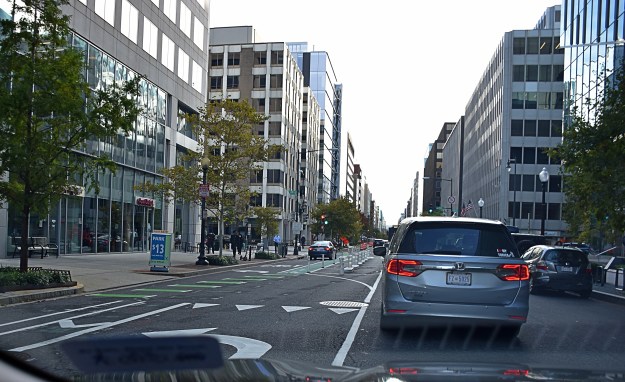
The result is that many drivers are surprised to find the left lane blocked and struggle at the last moment to enter the traffic flow in the one remaining lane of traffic. Conflict!

Worse yet, the complexity of the pylon arrangement misleads many drivers who then make a left turn from the remaining traffic lane, crossing the bike lane and the actual left turn lane, defeating the purpose of the pylon arrangement to provide additional protection to bicyclists.

The apparent absence of law enforcement in the city has led to other dangerous practices:

Pedestrians routinely slow-walking through intersections with nose buried in can’t-wait-to-be- read cell phone messages

Scooters/motorcyclists/bicyclists lane-splitting among cars in traffic lanes, zigzagging among the cars to get ahead

Scooters suddenly flying off the sidewalk at intersections to enter traffic

Red-light violations everywhere – by cars, trucks and bicyclists – often without even showing down

Left turns on K Street across multiple traffic lanes to enter the service road going the opposite way, in effect a risky U-turn, causing much sudden lane shifting

Turning from the wrong lane, usually with no signal – failure to use turn signals is rampant everywhere

The city’s installation of bus-only lanes, sometimes changing every block or two, has created additional parking space for trucks and cars alike. Buses for which the lanes were intended are forced to veer into car traffic lanes to get back. There is no apparent enforcement.

The most egregious and often-repeated violations of good driving practices are (1) failing to use the turn signal to indicate lane-changes/turns on the streets and in the roundabouts, and (2) turning from the center lane in either direction across the actual turning lane. These happen every day on my short roundtrip.

Then there is the matter of noise. As noted, I have lived in New York City and am no stranger to the realities of compacted urban living. There is, however, a difference between the unavoidable sounds of a city, cars and buses, aircraft overhead, etc. and the entirely preventable racket made by people who get some bizarre satisfaction from drawing attention to themselves by making unnecessary noise. These include motorcycles with punched-out mufflers, or no real mufflers at all, and cars with mufflers designed to make huge bursts of sound during acceleration and braking. These cars often display spoilers on the trunk and are in the style of “muscle cars.” The drivers who race the engines in traffic, do high-rpm “jack rabbit” starts and engine-assisted stops are trying to draw attention and they do, along with a large dose of irritation at the unnecessary noise they produce. Their behavior screams “look at me, look at me!” It is irritating and distracting.

The city has, apparently, determined to address these issues by trying to force traffic to slow down, as noted in the Mayor’s news message above. Reducing speed limits may seem an easy and appropriate defense, but speed limits that are too low likely cause more problems than they solve. Take a drive on the 40 mph GW Parkway, for example. Anyone trying to comply with that speed limit on the four-lane divided road will find other drivers speeding around them, frequently showing anger, impatience and dangerous driving. Average actual speeds in those areas are vastly higher whenever traffic volume permits and often even when it doesn’t.

It seems most drivers most of the time assess the risk of getting a ticket or being involved in or causing an accident as vastly lower than the costs of being a few minutes later at their destination. There is little question that this happens on DC streets every day all day everywhere. My casual but repeated observation of DC driving behavior suggests a widespread belief among drivers that there simply are no meaningful constraints on their behavior – no laws, no rules, no risk of being caught while endangering others.

Studies in the Netherlands support the idea that higher speeds, both generally and in relation to other cars, produce more crashes with greater damage to drivers and others affected. https://www.littlerock.gov/media/2484/the-relation-between-speed-and-crashes.pdf [the Institute for Road Safety Research] But US studies suggest that may not be the whole story and that “posted limits are not the cause of auto accidents – reckless driving is.” https://www.hg.org/legal-articles/the-effects-that-speed-limits-have-on-auto-accidents-30226

The last cited article states that

A method known as the “85th percentile” is used by traffic engineers to establish speed limits. This tactic operates under the assumption that most drivers will travel at a speed that is reasonable, sensible and comfortable to them on any given roadway, regardless of the posted limit. Speed limits are set at a number that separates the bottom 85% from the top 15%. For example, if the speeds of 100 vehicles are measured and 85 vehicles are traveling at 37 mph or less, the speed limit for the road could be set at 35 mph. [emphasis added]

A California study,

showed that higher speed limits set in 1995 and 1996 did not increase the rate of fatal or injury traffic crashes. In fact, actual travel speeds on roads with increased speed limits barely changed. People were already traveling faster than previous speed limits, and once speed limits were altered they generally did not speed faster than their comfort zone…. Although findings across the country are conflicting, they have shown that drivers are by-and-large practical and cautious. In essence, posted limits are not the cause of auto accidents – reckless driving is. [emphasis added]

At the risk of exposing my confirmation bias, those US observations are consistent with my day-to-day experience in DC. Lowering speed limits to levels that most drivers will find unreasonably constraining and putting speed bumps and stop signs in more places, will not change that. Such policies simply make more people into scofflaws, but they won’t likely change outcomes much if at all.

What then to do?

First, identify some of the main drivers of the problem and put resources against them. These would certainly include illegal parking in rush hour and in places where such parking materially increases congestion and conflict. The return on investment to DC from a well-managed team of “meter monitors would likely be very high.

Second, hire, train and deploy small teams to monitor driver behavior on problematic streets and intersections. Take videos of excessively dangerous practices and have another team member stop the car and issue tickets. This is not much more complicated than fielding teams of police to use radar and then flag down speeders. Observation of vehicles in the “circles” alone would likely more than pay for the costs of the teams.

Third, use the email addresses of DC-licensed drivers to remind them of certain rules-of-the-road. Explain in stark terms that certain behaviors will no longer be tolerated and that if stopped after being notified, the consequences will be serious.

I do not suggest these steps will solve all the problems. Even a 25 percent reduction in aberrant driving would be a worthy achievement and city revenues would increase significantly.

As for noise, the solutions are similar. There is no reason that the city should put up with people who deliberately make noise just to attract attention. Horn honking by automobiles (and frequently by impatient bus drivers) should be outlawed unless essential in an emergency. You get what you tolerate. DC has a Noise Ordinance.

Section 20-2700 of the DC Municipal Regulations states,

It is the declared public policy of the District that every person is entitled to ambient noise levels that are not detrimental to life to life, health, and enjoyment of his or her property. It is hereby declared that excessive or unnecessary noises within the District are a menace to the welfare and prosperity of the residents and businesses of the District. It is the declared public policy of the District to reduce the ambient noise level in the District to promote public health, safety, welfare, and the peace and quiet of the inhabitants of the District, and to facilitate the enjoyment of the natural attraction of the District.

This regulation reflects a serious quality-of-life problem in the city. Enforce it.

The cars in question usually are Mustangs or sports cars/muscle cars that look like them, often fitted with a rear spoiler. The noise they emit is usually coincident with moving at high speed through crowded streets in places like Georgetown’s M Street and less-crowded (at least now) thoroughfares like Pennsylvania Avenue. Even casual observation by enforcement would readily identify locations where deliberate noise violations, and often related dangerous driving, occur daily. This past Sunday I observed a motorcyclist riding twice through the same Georgetown neighborhood gunning his unmuffled engine for no purpose other than making noise.

In addition to the obvious benefits to safety and good order, active enforcement of traffic safety and noise control would also benefit the city’s finances. The cost of a reasonably trained force of meter monitors, traffic monitoring teams (all of whom do not have to be police officers) focused on serious violations and repeated noise ordinance violations would contribute significant revenue to fund the city’s other obligations. Everyone wins.


Artists Speak in Tongues

I often don’t understand. I recently had this experience again at DC’s Hirshhorn Museum https://hirshhorn.si.edu/about-us/ when we visited the huge Laurie Anderson exhibit, https://hirshhorn.si.edu/exhibitions/laurie-anderson-the-weather/ that will be displayed until July 31, 2022.

The museum describes Anderson as a “groundbreaking multimedia artist, performer, musician, and writer.” While I’m not qualified to judge, the description seems accurate. She’s going to be performing live at the museum next year, at times yet to be published, and, to my surprise, I think I want to see her. This woman has designed new musical instruments! Hirshhorn describes her thus:

As a Grammy Award-winning musician, performer, writer, and artist, Anderson has an international reputation as an artist who combines the traditions of the avant-garde with popular culture. Anderson’s theatrical works combine a variety of media, including performance, music, poetry, sculpture, opera, anthropological investigations, and linguistic games, to elicit emotional reactions. As a visual artist, Anderson has been shown at the Guggenheim Museum, SoHo, and extensively in Europe, including the Centre Georges Pompidou in Paris. She has also released seven albums for Warner Brothers, including Big Science, featuring the song “O Superman,” which rose to No. 2 on the British pop charts. She is currently Charles Eliot Norton Professor of Poetry at Harvard University.

Her particular style/mode of artistic expression is not one to which I have been drawn in the past, but the two expressions below got my attention and I am something of a convert:

These photos are but a tiny portion of the full exhibit that includes many forms of multi-media, including video of Anderson dancing with electronic devices strapped to her body that make drum sounds when slapped.

You probably should read this before visiting the exhibit, https://www.nytimes.com/2021/10/06/magazine/laurie-anderson.html, but visit you should. I am still thinking about what I saw. Such stimulation of a distracted mind (you know, the destruction of our democracy) must mean something important is going on. Note that when the Hirshhorn first proposed a retrospective on Anderson’s long career (74 now), she refused and proposed an all-new show.

Places to Go, Things to See

The weekend looms. A good opportunity to review some of the places we’ve visited recently for relief from the continuing gloom of a city not yet recovered from COVID’s shutdown of the economy.

Over a span of a few months we have been on the road quite a bit. A very brief sample of some of the available delights follows, starting with the most distant from Washington:

Savage River Lodge

This place is located at the end of a 1.5 mile gravel road in upper northwest Maryland, best attempted only if you have at least a front-wheel drive vehicle and (in winter) 4-wheel drive. The lodge has a restaurant with outdoor seating and a collection of cabins and yurts for rent. The site is remote and hilly but abounds in natural beauty. It is an easy drive to Grantsville, MD and close to Frostburg.

In one day we saw about a dozen deer, a personal record. The Casselman Bridge in the last photo is in Grantsville whose principal attraction is the Hill Top Fruit Market which is mainly a candy store, lined with bins of all manner of sweet stuff, including many you haven’t seen since childhood. You can also buy fresh fruits and vegetables there. The Fernwood Soap shop and the flowers are in the Spruce Forest Artisan Village, adjacent to the Penn Alps Restaurant & Craft Shop.

Be advised that for a more accessible but still interesting “remote” experience, the cabins in New Germany State Park are very hospitable and inexpensive. They are a fun place to use as a base for exploring the area, maybe doing a little fishing, rafting and such.

Skyline Drive

This, of course, is the 105-mile mountain-top ride in Shenandoah National Park in the magnificent Blue Ridge Mountains of Virginia, Don’t  think about driving the full length of the Drive unless you plan to stay overnight at some of the few on-site lodges. The speed limit is low and the road curves, rises and falls incessantly so fast driving is not in the cards. Besides, you’ll miss the scenery.

Great Falls Park After Hurricane Ida

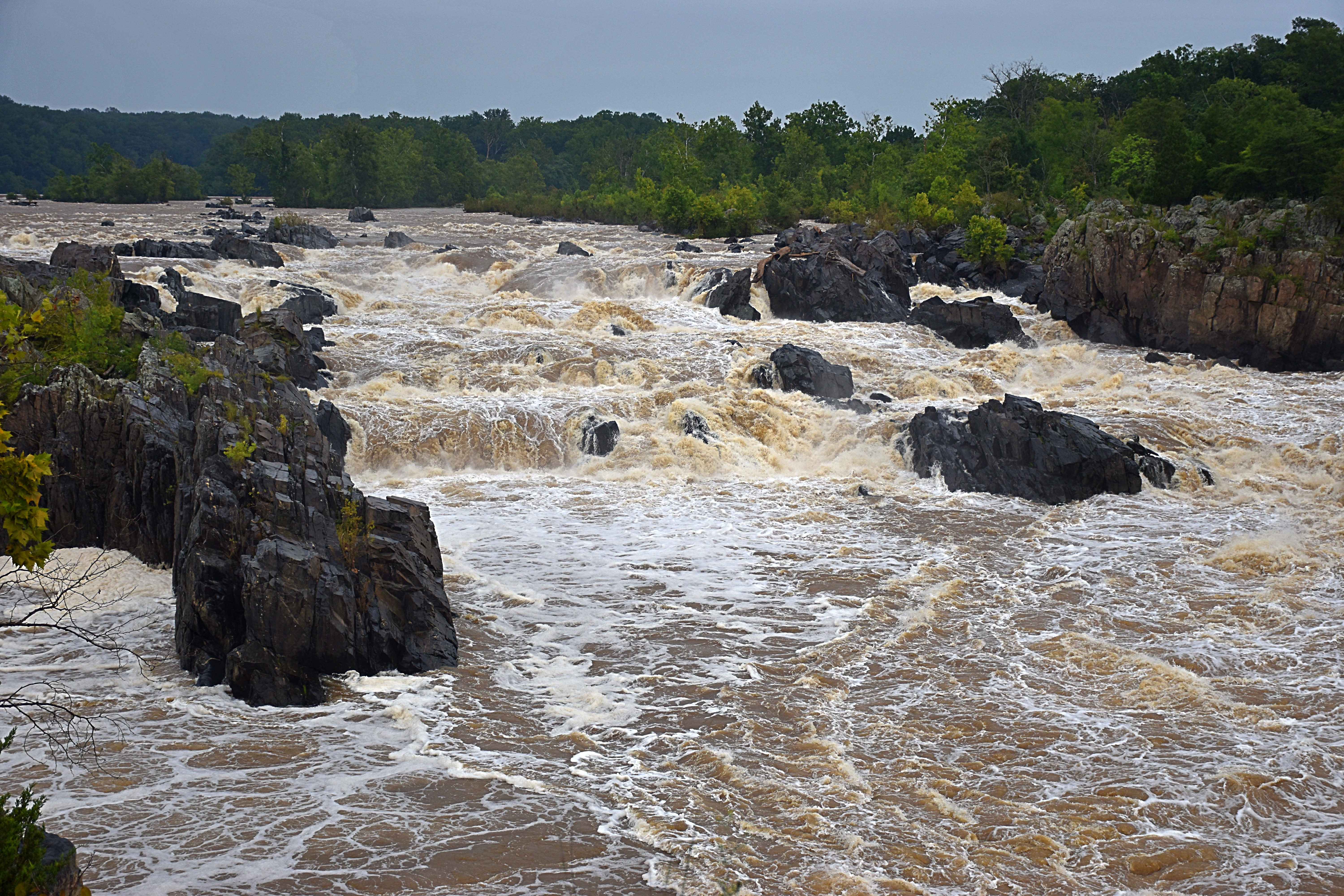
One of the interesting aspects of Great Falls Park is that it is radically affected by upstream rainfall, which is evident in this small sample of photos showing the impact of Hurricane Ida having dropped massive water upstream. The water is high and brown. Impressive but you wouldn’t want to fall in.

Dyke Marsh

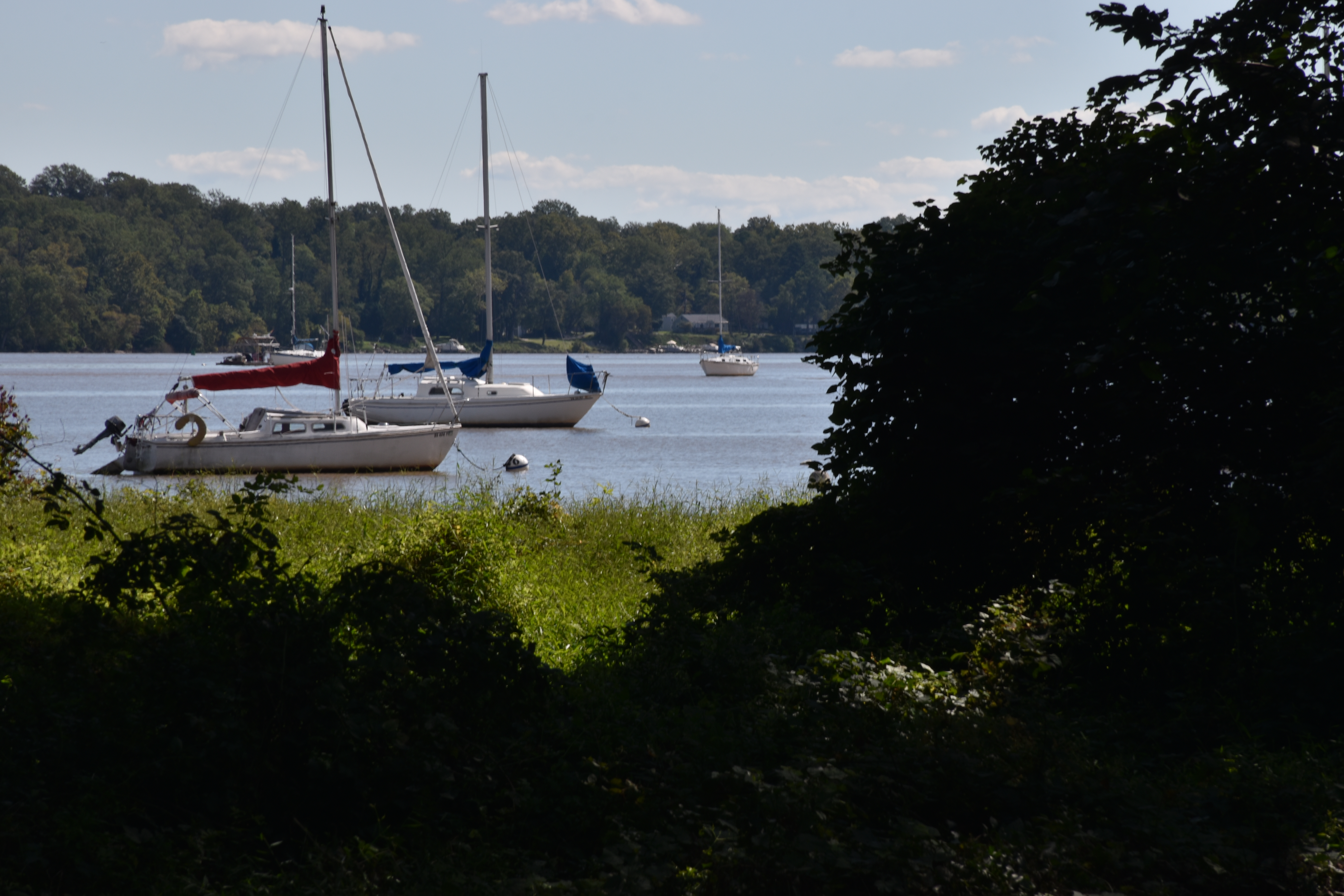
This little gem, about two miles roundtrip, flat as a pancake, can surprise you with unexpected visual delights. In the right season, red-wing blackbirds make the adjoining vegetation their nesting grounds. The Potomac River runs alongside. There are usually a few walkers along the way but even on weekends, we have found Dyke Marsh trail uncrowded and pleasant for a short easy walk. My wife’s uncanny ability to spot creatures in the wild accounts for the grasshoppers and Blue-tailed Skinks that I would have missed entirely.

Sadly, there is always evidence that humans have been here before us, seemingly the unavoidable consequence of so much nature so close to so many people who just don’t understand:

Tregaron

Finally, even closer to [our] home is Tregaron Conservancy, entered most conveniently from either Macomb Street NW or Klingle Road NW. It is situated between the Cleveland Park and Woodley Park neighborhoods just west of Rock Creek Park. The park is small but considering it’s in the middle of a city neighborhood, it has some interesting features, the best of which, for us, was the Lily Pond, small but full of life.

There were, of course, many more frogs and dragon flies, as well as a small armada of goldfish. The frogs are quite bold, as these photos attest.

Frogs have featured in Japanese haiku for centuries and somehow capture the essence:

The old pond

A frog leaps in.

Sound of the water.

What else is there to say?

Conclusion

We continue to be pleasantly surprised at the natural resources available around the Washington area and are often surprised by the wildlife that thrives in our midst. Walking slowly and observing quietly usually pays off.


Another Day, Another Park

Since a certain group of people continue to prevent the country from escaping the pandemic, we remain in partial shutdown and, if you regard your health seriously, limited to where we can eat and otherwise do “normally.” The road ahead seems long and unpleasant.

Thus, desperate for escape, needy of stimulation and just to get some air, we visited yet another “local” park last weekend. Two actually, though one barely counts, as you will see.

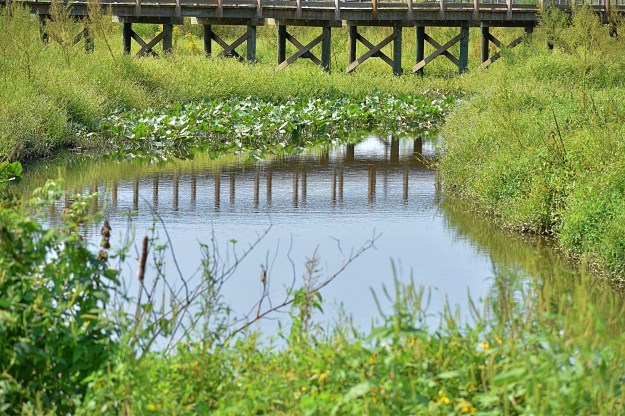
Our destination was Neabsco Regional Park in Woodbridge, VA, billed as “300 acres of natural, recreational, and historic amenities including the Rippon Lodge Historic Site, Rippon Landing, the Potomac Heritage National Scenic Trail Neabsco Creek Boardwalk, Julie J. Metz Neabsco Creek Wetlands Preserve, and portions of historic Kings Highway.” https://bit.ly/2VS0oYt We opted for the Boardwalk. You can see an aerial photo of the Boardwalk on the website.

The upside of the Boardwalk is that it’s a … boardwalk. You stay above the muck, mud and other “things” while having a broad view of the natural scene. The downside of the Boardwalk is that it enables bicyclists, strollers and large groups to move easily along and disrupt, in a minor way, your tranquility.

This is part of the Boardwalk that is surprisingly long:

The other outstanding feature of Neabsco is that the bog/swamp area is surprisingly uniform. For an area this large there appears to be relatively little biodiversity.

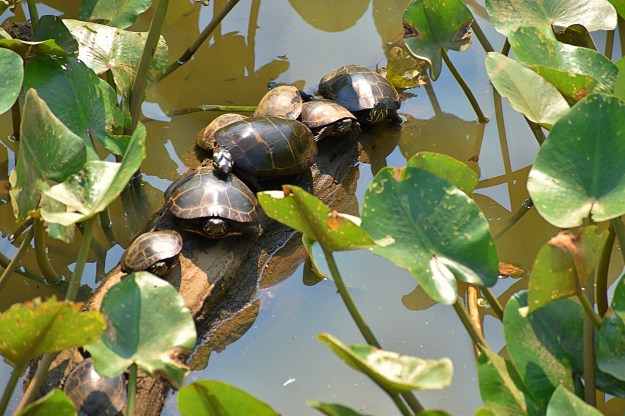
Nevertheless, the observant observer can see plenty of interesting activity in  and above the bush. In addition to the turtle “hotel”

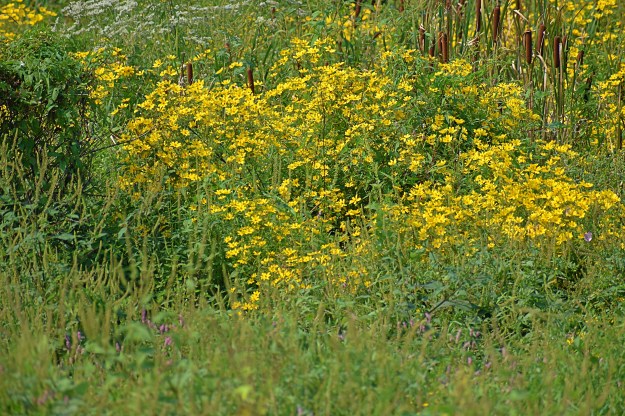
we saw some beautiful flowers, though, curiously, they mostly were single blossoms poking through the surrounding greenery:

though, as always, there were brilliant exceptions:

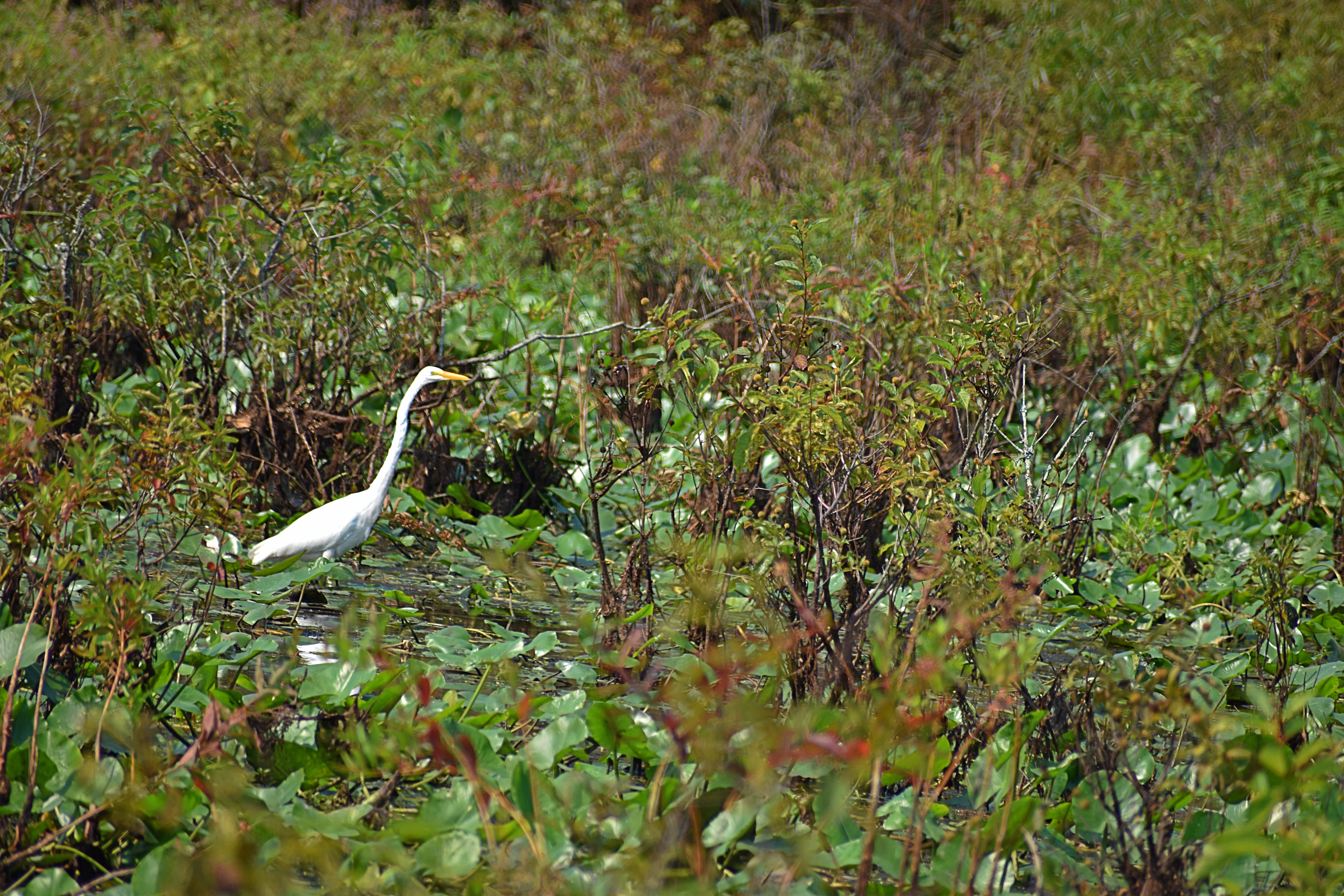
But, of course, the real “juice” at a place like this is the wildlife and we had several delightful surprises. At ground level, there was this amazing  heron whose neck contortions in his slow hunt for food were astonishing to see up close:

By the way, the crawfish (we think) in his bill in the last picture escaped at the least moment! The heron took it in stride and resumed his stalking through the bog.

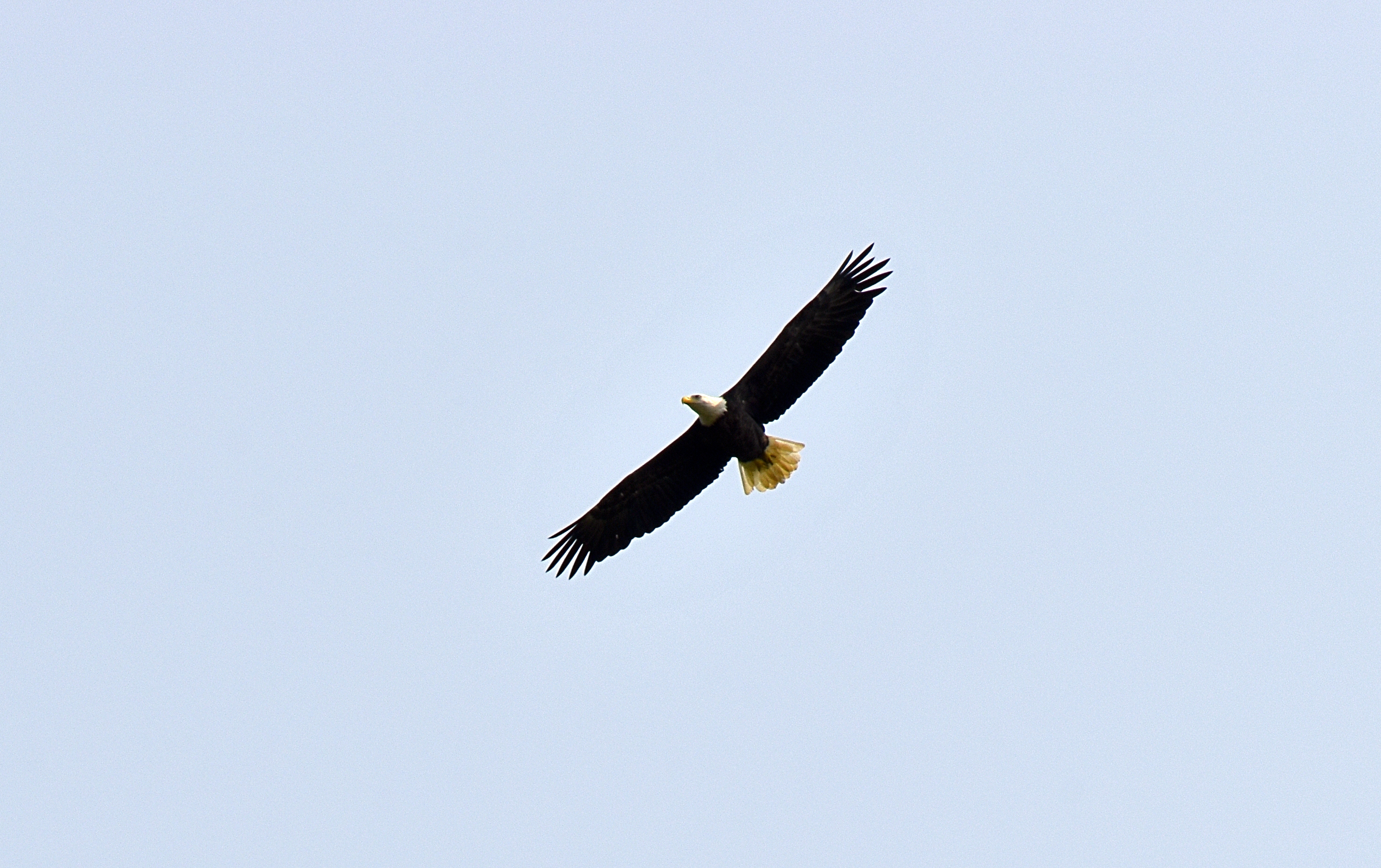
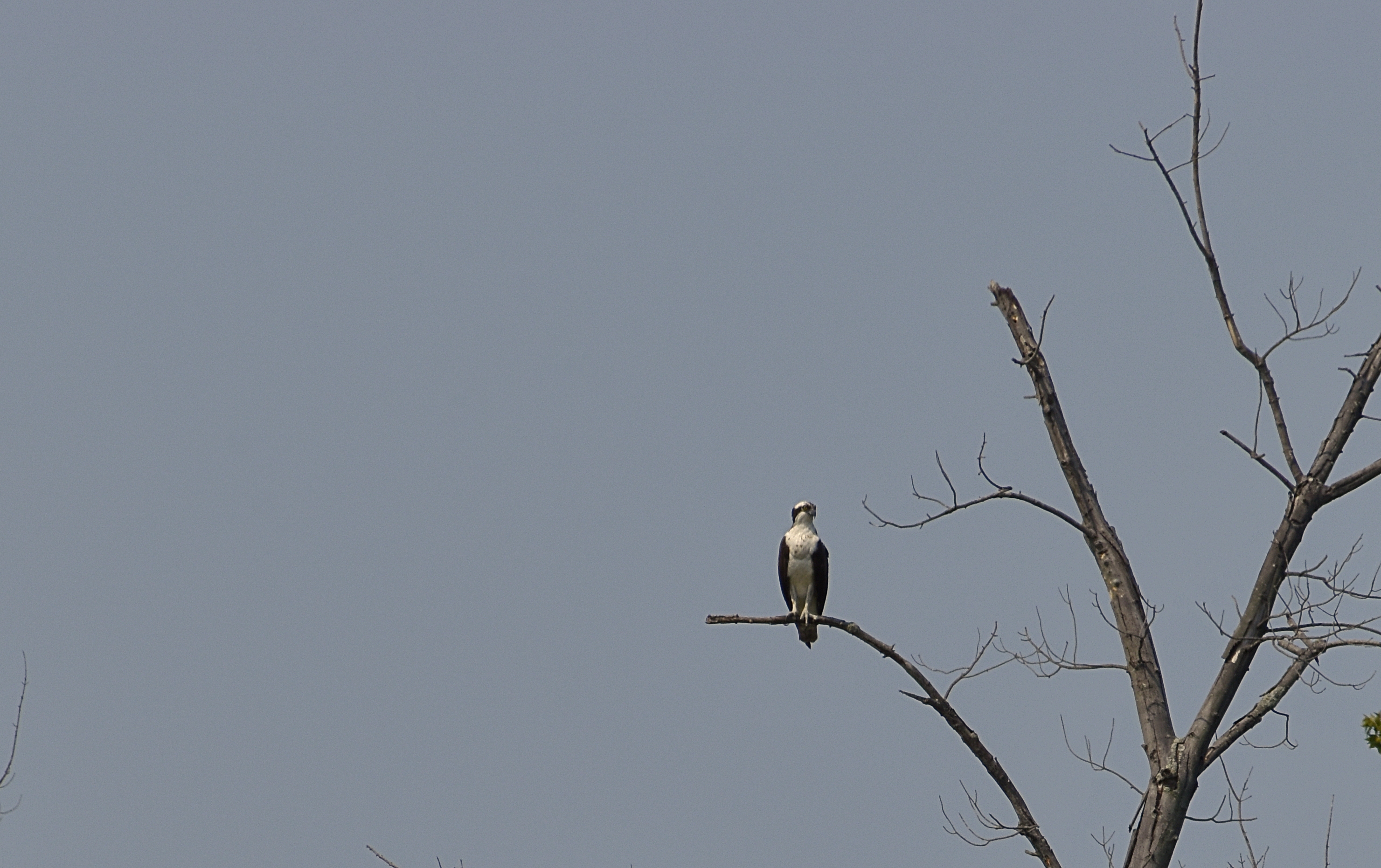
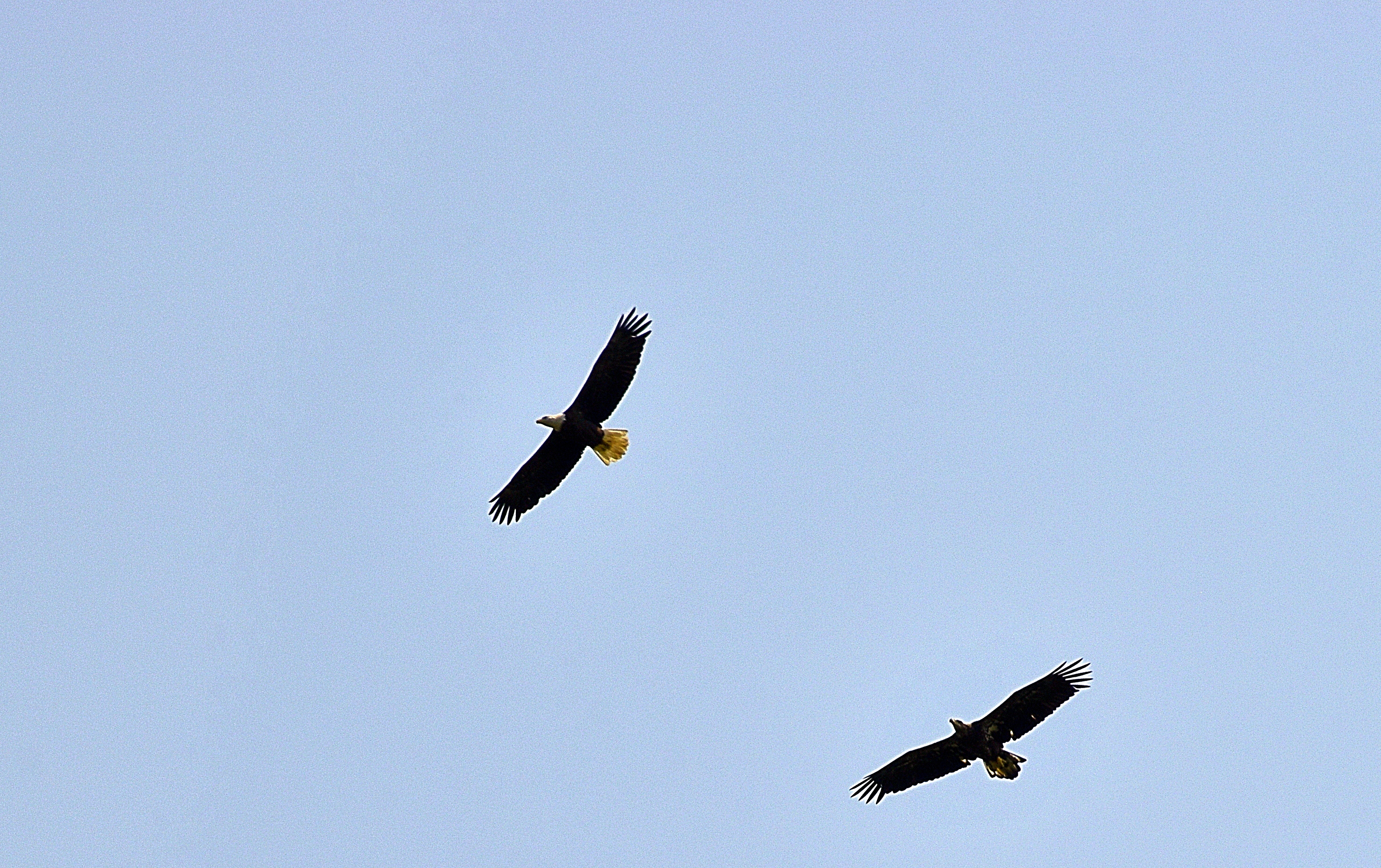
The thing is that in a place like this your attention is naturally drawn downward, but it’s important not to focus too much on what’s right in front of you. My wife’s vision for spotting animals in the wild is remarkable. and she detected these bald eagles quietly hunting and the osprey in a tree  probably a hundred yards away:

Largely sated by these experiences, we departed for Occoquan Bay National Wildlife Refuge, where we limited ourselves to what is billed as the Wildlife Drive. Mistake. If you want to see what this Refuge has to offer, you’ll have to do it on foot. The Wildlife Drive looks like a narrow gravel road running among bushes and trees for it’s entire distance. Nothing to see. There are foot trails; check the map carefully to find them. The oddest thing was that these signs appeared throughout the drive:

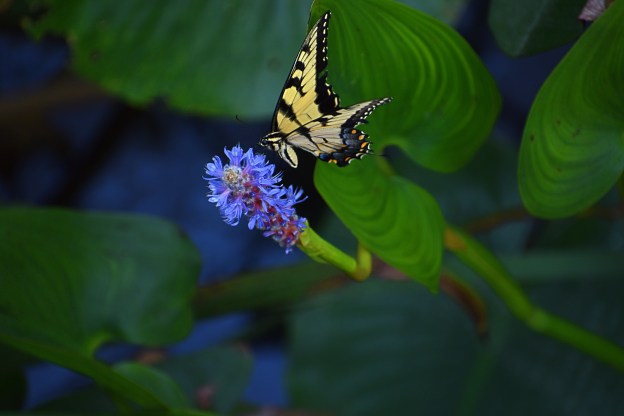
We still haven’t figured out what you would dig for but it must be a real problem because there were a lot of signs. We were pretty disappointed in this experience, but it did not detract from the cool stuff in Neabsco. And, yes, the featured image at the top of this post, butterfly on flower, was taken there.

The Road Not Taken

Kudos to President Biden for taking the hard but right path to restoring the physical and economic health of the country. Shame on those who continue to harp on the ignorant and irrationally resistant themes of “my rights” at the expense of the health and welfare of others. ENOUGH!

We’re at the fork in the road. Nothing short of a full-on frontal attack on the virus is going to get us out of this mess. The great American poet Robert Frost captured the idea in his famous poem, The Road Not Taken:

Two roads diverged in a yellow wood,
And sorry I could not travel both
And be one traveler, long I stood
And looked down one as far as I could
To where it bent in the undergrowth;

Then took the other, as just as fair,
And having perhaps the better claim,
Because it was grassy and wanted wear;
Though as for that the passing there
Had worn them really about the same,

And both that morning equally lay
In leaves no step had trodden black.
Oh, I kept the first for another day!
Yet knowing how way leads on to way,
I doubted if I should ever come back.

I shall be telling this with a sigh
Somewhere ages and ages hence:
Two roads diverged in a wood, and I –
I took the one less traveled by,
And that has made all the difference.

Biden has taken the road that many politicians would eschew – the one that will, and has, inevitably create another furor. Rather than the “safe path,” Biden has shown the courage of a leader by doing the right thing rather than the safe or easy route. You can hide from destiny only so long, as this great story reminds us:

A merchant in Baghdad sent his servant to the market.
The servant returned, trembling and frightened. The
servant told the merchant, “I was jostled in the market,
turned around, and saw Death.

“Death made a threatening gesture, and I fled in terror.
May I please borrow your horse? I can leave Baghdad
and ride to Samarra, where Death will not find me.”

The master lent his horse to the servant, who rode away,
to Samarra.

Later the merchant went to the market, and saw Death in
the crowd. “Why did you threaten my servant?” He asked.

Death replied, “I did not threaten your servant. It was
merely that I was surprised to see him here in Baghdad,
for I have an appointment with him tonight in Samarra. 

The choice we face now, that we must face, is between aggressively striking at the virus with all the tools at our disposal or continuing to beg the irrational and uninformed to do the right thing. The former has a chance to stop the pandemic, to take advantage of the astonishing opportunity that the rapid deployment of vaccines has provided. The latter approach has virtually certain terrible consequences: more illness, more death, more permanently damaged bodies.

The reality is that the vaccines are safe and effective. The reality is that the rapid spread of the Delta variant has again overwhelmed the nation’s medical capabilities. COVID infections that are mainly in unvaccinated individuals are denying needed medical services for people with other medical conditions.

I have read some of the insane rantings of primarily right-wing and libertarian “authorities” who claim to have inside knowledge that the virus was released deliberately by agents of the federal government who are cashing in on the vaccines. These people claim that the vaccines contain various poisons, microchips and who knows what else.

It seems that one can always find someone who claims to have the inside track on awful secrets and conspiracies that are constantly being plotted against the rest of humanity. These sometimes include people with “medical credentials,” but often they are former workers in the pharmaceutical industry who are certain that they have inside information to expose the crimes being perpetrated in the name of … whatever. They readily accept the plausibility of conspiracies involving many thousands of people around the globe, no one willing to spill the beans, all in the name of “follow the money” or some other cliché that substitutes for actual thought.

We see this same theme played out in science fiction movies and what I call “caper movies” in which bad guys pull off, at least temporarily, extraordinary schemes to steal, blow up, capture huge sums of money, power over the world, etc. Movies like Air Force One, Die Hard and so many others. I have struggled through a few episodes of a TV series called Eureka that is loaded with utterly implausible, preposterous concepts and science-like doublespeak and gibberish. Some people apparently take such stories to be true. It’s an easy shift from one phantasmagorical storyline to another. Harry Potter is real, flying broomsticks and all.

Reality is more mundane. Two kinds of sickness pervade the country. One is the COVID-19 virus. We’ve learned a lot about it and about how to prevent its worst manifestations. Vaccines, masks, social distancing – that’s pretty much the essence. Study after study confirms the validity of these measures, if, at least, they are applied broadly and consistently.

But it’s damned inconvenient and mighty annoying. COVID has shuttered many businesses, interfered with our fun and instilled a deep-seated fear in many people that they and their loved ones, including children for whom they are responsible, are being exposed to an invisible, highly transmissible and deadly disease. More than 648,000 dead from a disease that our former president assured us would “soon disappear like magic.” Damned annoying.

The other sickness is the resistance to the solution. We know what to do but for many Americans, the disease isn’t the real enemy. The real enemy is the government. Many people appear to believe the government unleashed the virus. Why would the government do that? Did the government want to destroy the economy? Weaken our national defenses? Reduce the population? End civilization? Apparently, many believe so.

Logic and reason have little to do with this mindset. It’s analogous to those who argue that the January 6 insurrection was actually the work of the winners of the election who wanted to stop the certification of their win so that the loser, whom they hate, would be installed as the winner. That make sense to you? If so, take two giant steps to the right.

Along comes the new president who starts an unprecedented and initially successful campaign to deliver life-saving and pandemic-ending medicine into tens of millions of citizens without any meaningful adverse consequences and at no cost. And yes, yes, I understand we can’t prove that ten years from now there won’t be some inexplicable adverse outcome for somebody. There is no scientific or medical reason to suspect that could or would happen, but we can’t predict the future with 100% certainty, so ….

But, you know, in the long run we’re all dead anyway. In the meantime, we can return to “normal life.” All we have to do is get vaccinated and comply with a few annoying but otherwise trivial practices a while longer with a few minimal restrictions on our behavior.

But, no, this is apparently asking too much for millions of Americans. They have their “rights” to protect, regardless of the consequences. “Freedom” is their watchword. Don’t tell me what to do even if it’s for my own good. Sounds like a teenager who thinks he knows everything already and is invulnerable. Or the guy with the boat who insists on going out in the hurricane because he can “handle anything.”

Many of these people end up in the ICU, begging for the vaccine, only to be told by doctors, “it’s too late for you. You should have taken the vaccine earlier. It can’t help you now. Nothing can help you now.”

The solution is in our hands, if only our minds will allow us to see it. I despair of it, after engaging yet another person who on first encounter seemed reasonable and thoughtful, but then insisted “we are being lied to” and that the vaccines contain deadly poisons that make them magnetic. She argued with me that the vaccination program was unnecessary because “natural immunity” was superior protection to the vaccines and lasted longer. How she knows this: read on the internet.

I end where I began. History will record that Joe Biden acted justly and rightly in ordering mandatory vaccination programs, with, in most cases, very generous opt-outs for people with true medical conflicts and genuine religious objections (I don’t know what religion that is, but the exemptions are available).

I find some inspiration in these closing words from Ulysses by Alfred, Lord Tennyson:

Though much is taken, much abides; and though
We are not now that strength which in old days
Moved earth and heaven; that which we are, we are;
One equal temper of heroic hearts,
Made weak by time and fate, but strong in will
To strive, to seek, to find, and not to yield.


An Uncensored View of Facebook “Censorship”

I have no problem with a social media platform that, having given the multitudes free rein to publish their views for others to see, has finally decided to address the use of the platform for promoting false information about, among other things, public health, politics, public policy issues (guns, for example). The attempt to prevent the use of these generally free platforms to spread disinformation is not subject to “free speech” principles under the First Amendment that only relates to government action. In fact, and in law, attempts to have the government interfere with the content-control policies of private platforms are themselves, in most cases, in conflict with the First Amendment.

The issues are complex, obviously. To some of us, there are some “opinions” that simply are based on false ideas and platforms do not have to serve as passive instruments for the spreading of such information. Examples abound but certainly include the QAnon conspiracy theory, the claim that the 2020 election was rife with fraud and the claim that the January 6 attack on the Capitol was not actually Trump supporters but was BLM and other left-wing groups pretending to be Trump supporters.

On that latter issue, I cannot fail to note the “reasoning” behind the Trumpers’ argument that the winners of the election, disguised as Trump supporters, tried to stop the certification of the Biden victory and install the person those left-wing groups despise the most as president and dictator. As one Twitter meme notes, to believe that takes a special kind of stupid.  Nevertheless, it appears that many Americans have convinced themselves that the claim is true. Facebook, in my view, has no obligation to allow the propagation of such nonsense by permitting postings containing that claim.

Now, considering what I’m about to tell you, you may chuckle to yourself and think, “well, wise guy, you got hoisted by your own petard,” because Facebook has “censored” one of your posts. Ha ha ha.

It is true that Facebook “unpublished” one of my posts. It was this one: Time for Strong Action Against Unruly Air Travelers, https://bit.ly/38m76Zb Facebook said the post violated its Community Standards because it was “spam.” Facebook defines “spam” this way:

We don’t allow people to get likes, follows, shares or video views in a way that’s misleading to others.

We define spam as things like:

·      Repeating the same comment

·      Getting fake likes, follows, shares or video views

·      Coordinating likes and shares to mislead others about the popularity of something

At that point in the Facebook process, you are given two choices: Back or Continue. Choose Continue and you get this gem:

You disagreed with the decision

We usually offer the chance to request a review, and follow up if we got decisions wrong

We have fewer reviewers available right now because of the coronavirus (COVID-19) outbreak. We’re trying hard to prioritize reviewing content with the most potential for harm.

This means we may not be able to follow up with you, though your feedback helps us do better in the future.

Thank you for understanding.

Here you have one “choice:” Close.

So, Facebook has blocked the post but has no process by which to question that action. But, hey, thanks for understanding.

There are many aspects to this. First, the post was placed on my blog on May 25 and was placed on Facebook manually by me that same day per my usual practice. The notice from Facebook announcing my “violation” arrived August 26. I have no idea when the public’s view of the post was blocked. Facebook doesn’t know, doesn’t care.

Second, there is no plausible way that Facebook’s “system” could rationally conclude that the post in question was a repeat comment (I post each blog post manually on Facebook in two distinct places – my timeline and, if and only if relevant to the purposes of the group, to a private group of which I am a member; I have done this dozens of times and never been challenged by Facebook for duplicate postings).

Third, the post in question was simply placed on Facebook by inserting the link to it. No rational inference could be drawn that doing so was for the purpose of “Getting fake likes, follows, shares or video views,” whatever that means.

Fourth, there is no evidence, because it did not happen, that I tried “coordinating likes and shares to mislead others about the popularity of something.” I would have no idea how to do that even if I wanted to. And I don’t. The item was posted to be read by those interested.

It is a fact, however, that the post about unruly air passengers is the third most-read post since I started the blog. The explanation for that is simple: air travel is a popular subject, many of my followers are in the travel industry and … never mind, it’s just too obvious.

So, what are we left with as the explanation for Facebook’s delayed “decision” to “unpublish” my post is one thing: INCOMPETENCE. The so-called artificial intelligence that manages the Facebook censorship process is simply unable to do its job properly.

Is this better or worse than the purposes attributed to Facebook by many on the political right and the political left who claim every day that Facebook is engaged in some pernicious politically motivated campaign to stifle the views of the [insert ‘right’ or ‘left’ here]? I don’t know.

It’s dangerous, of course, to generalize from a single experience, but the Facebook action to bury my post seems blatantly unreasonable and downright stupid. It would be silly to think that Facebook’s algorithms were written to promote dangerous behavior on airplanes. Not even the most dedicated QAnon believer would …. well, those people might believe it but no one else would.

The action could not be the product of conscious thought by a rational person or “reviewer” as Facebook calls them. The post related to a public policy problem – a growing number of air travelers refusing to comply with flight crew instructions and airline policies regarding, among other things, wearing of masks to combat the spread of COVID. The passengers in question have engaged in various acts of violence that have, among other things, threatened the safety of aircraft in flight. Serious stuff. Some of them are being visited by huge fines for their misconduct. My argument was that the government should crack down even harder on that behavior. I proposed several additional policy actions that could help.

For some inexplicable reason, Facebook rates that as “spam.”

The most disturbing aspect of this, beyond the plain stupidity of it, is that Facebook has essentially said, “we’re too short-handed here to review your objection to our action, so… get lost. Thanks for understanding.” Not a chance.

Facebook’s financial statements for 2020 show more than $85 billion in Gross Revenue, an increase of 22 percent over 2019; Income from Operations up 36%; Operating Margin of 38%; Net Income up 58% and Provision for Income Taxes -58%. That’s right. Taxes down 58% with income up 58%.

If it chose to do so, Facebook can afford to hire more reviewers so that it’s “decisions” to block content are not merely arbitrary and capricious, yet it chooses to say, “so sorry, we’re short-handed so drop dead.” This strategy may work in the short term – it is in fact working now – but I question whether it’s viable in the long-term. On the other hand, this approach to business has worked for many giant companies in the past for extended periods. See Climate Change. Until, usually, competition did them in or forced major changes in how they do business. See American Automobile Companies. Time will tell about Facebook.

Meanwhile, yes, I am posting this post on Facebook. We’ll see what happens.