Dear Mayor Bowser

I am inspired to publish this now because I received your News message of October 15 entitled Accelerating Roadway Safety Projects. You stated a planned “acceleration of roadway safety improvements across DC,” driven by a wave of “traffic violence.” One of the primary solutions was the reduction of the default speed limit to 20 mph, although you recognized that speed is not the only problem – it’s also “distracted driving or a refusal to share the road.” Indeed.

One of the major “solutions” proposed is your request to DDOT “to move forward with a campaign to accelerate the construction of roadway safety improvement projects that will better protect pedestrians. This includes the installation of speed humps, stop signs, and right turn hardening measures. Starting this week, and continuing annually, DDOT will target 100 intersections that are within the District’s high-crash, high-injury corridors.”

Before going further, I suggest that solving the “traffic violence” problem is not achievable by placing obstacles in the path of already frustrated drivers. Speed humps may slow a car temporarily but if they lead to rapid acceleration after driving over one, the purpose seems defeated. Similarly, stop signs work if drivers stop and look before proceeding. If not, they can create more of a hazard as people in a hurry run through them. This happens every day all over the city.

While it may appear otherwise initially, rest assured that I am on your side. You have a difficult job for reasons too well known to reiterate here. Take what I offer as a good faith effort to help. As background, I moved to the District in December 2020, following three years in New York City. Before that, I lived in Northern Virginia (Falls Church, Reston, Alexandria) beginning in 1967, so I am no stranger to this area.

It is useful to begin with consideration of some general principles. The government is essentially a joint effort, funded with community money, to establish some rules within which a civilized society can function safely and fairly. This includes rules designed to establish order in what would otherwise be a chaotic, every-person-for-himself madhouse with high risks for everyone. Without such rules, the situation would resemble the Tragedy of the Commons in which each person would act in a manner designed to benefit him alone even though the result is destruction of the common good and losses for everyone. Today, DC roads resemble the Tragedy of the Commons because gross and serious violations of the laws, rules-of-the-road and common sense are rampant.

To be clear, I am not referring to “law and order” in the Republican/Tea Party/right-wing sense of the term, nor do I want to live in a “police state.”  The goal is a regime that, with reasonable compliance, benefits everyone – drivers, bicyclists, pedestrians. Everyone enjoys the benefits of more order, smoother traffic flow, less stress and more safety. There is an irreducible minimum of order that must be maintained to prevent chaos and avoidable harms.  DC appears to be well beyond that threshold.

For context, most days I drive two roundtrips from the West End (Washington Circle area) to the east end of town (10th & K), using L Street and returning west on I Street. When the traffic is unusually slow on I Street, I often move up to K Street for the return leg. Total roundtrip distance is exactly 4.1 miles. What occurs around me almost every day borders on unbelievable but it’s all true. A very select example includes:

Just this morning, we were confronted by a car traveling the wrong way on a one-way street (11th Street NW). The driver just kept coming, veering away at the last minute and turning the corner behind us. He was either completely oblivious or determined to place himself and us at risk to avoid turning around and driving in the proper direction.

Later, as I sat waiting for the light to change at Pennsylvania and 25th Street NW, two people, at least in their 30s, walked across Pennsylvania in reliance on the “walk” sign that was clearly lit. A car headed east on Pennsylvania ran the red lights facing west, passing between the pedestrians. Apparently, neither of them was aware of the danger – each had his nose buried in a cell phone and never looked up as the car raced between them.

A white Range Rover on K Street going west abruptly moved into the right lane in front of me with no signal, then a few blocks later, drove through a red light, turned left in front of the cars in the left lane and continued down the cross street, thereby also illegally crossing the service road on the other side.

A red truck in Washington Circle stopped at a red light, then drove thru it.

A driver ran three red lights in rapid succession in Dupont Circle.

It is routine to encounter drivers on M Street in Georgetown going 40 mph and more with impunity.

Illegal parking during rush hours is rampant. By taking up what would be traffic lanes, these parkers restrict the driving space for cars, leading to congestion, anxiety and angry, reckless driving behavior. Many sections of L Street are down to one lane in many places due to rush hour parking on sections already narrowed by construction sites. Many days a week the van in the photo below is illegally parked during evening rush in front of 1100 L Street NW:

Speaking of narrowed streets, the decision to block the left lane of the L Street/20th Street corner with pylons while allowing parking along the right side has reduced L Street at that intersection to one lane.
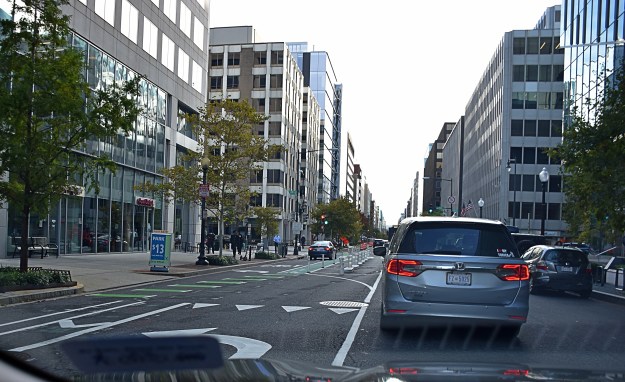
The result is that many drivers are surprised to find the left lane blocked and struggle at the last moment to enter the traffic flow in the one remaining lane of traffic. Conflict!

Worse yet, the complexity of the pylon arrangement misleads many drivers who then make a left turn from the remaining traffic lane, crossing the bike lane and the actual left turn lane, defeating the purpose of the pylon arrangement to provide additional protection to bicyclists.

The apparent absence of law enforcement in the city has led to other dangerous practices:

Pedestrians routinely slow-walking through intersections with nose buried in can’t-wait-to-be- read cell phone messages

Scooters/motorcyclists/bicyclists lane-splitting among cars in traffic lanes, zigzagging among the cars to get ahead

Scooters suddenly flying off the sidewalk at intersections to enter traffic

Red-light violations everywhere – by cars, trucks and bicyclists – often without even showing down

Left turns on K Street across multiple traffic lanes to enter the service road going the opposite way, in effect a risky U-turn, causing much sudden lane shifting

Turning from the wrong lane, usually with no signal – failure to use turn signals is rampant everywhere

The city’s installation of bus-only lanes, sometimes changing every block or two, has created additional parking space for trucks and cars alike. Buses for which the lanes were intended are forced to veer into car traffic lanes to get back. There is no apparent enforcement.

The most egregious and often-repeated violations of good driving practices are (1) failing to use the turn signal to indicate lane-changes/turns on the streets and in the roundabouts, and (2) turning from the center lane in either direction across the actual turning lane. These happen every day on my short roundtrip.

Then there is the matter of noise. As noted, I have lived in New York City and am no stranger to the realities of compacted urban living. There is, however, a difference between the unavoidable sounds of a city, cars and buses, aircraft overhead, etc. and the entirely preventable racket made by people who get some bizarre satisfaction from drawing attention to themselves by making unnecessary noise. These include motorcycles with punched-out mufflers, or no real mufflers at all, and cars with mufflers designed to make huge bursts of sound during acceleration and braking. These cars often display spoilers on the trunk and are in the style of “muscle cars.” The drivers who race the engines in traffic, do high-rpm “jack rabbit” starts and engine-assisted stops are trying to draw attention and they do, along with a large dose of irritation at the unnecessary noise they produce. Their behavior screams “look at me, look at me!” It is irritating and distracting.

The city has, apparently, determined to address these issues by trying to force traffic to slow down, as noted in the Mayor’s news message above. Reducing speed limits may seem an easy and appropriate defense, but speed limits that are too low likely cause more problems than they solve. Take a drive on the 40 mph GW Parkway, for example. Anyone trying to comply with that speed limit on the four-lane divided road will find other drivers speeding around them, frequently showing anger, impatience and dangerous driving. Average actual speeds in those areas are vastly higher whenever traffic volume permits and often even when it doesn’t.

It seems most drivers most of the time assess the risk of getting a ticket or being involved in or causing an accident as vastly lower than the costs of being a few minutes later at their destination. There is little question that this happens on DC streets every day all day everywhere. My casual but repeated observation of DC driving behavior suggests a widespread belief among drivers that there simply are no meaningful constraints on their behavior – no laws, no rules, no risk of being caught while endangering others.

Studies in the Netherlands support the idea that higher speeds, both generally and in relation to other cars, produce more crashes with greater damage to drivers and others affected. https://www.littlerock.gov/media/2484/the-relation-between-speed-and-crashes.pdf [the Institute for Road Safety Research] But US studies suggest that may not be the whole story and that “posted limits are not the cause of auto accidents – reckless driving is.” https://www.hg.org/legal-articles/the-effects-that-speed-limits-have-on-auto-accidents-30226

The last cited article states that

A method known as the “85th percentile” is used by traffic engineers to establish speed limits. This tactic operates under the assumption that most drivers will travel at a speed that is reasonable, sensible and comfortable to them on any given roadway, regardless of the posted limit. Speed limits are set at a number that separates the bottom 85% from the top 15%. For example, if the speeds of 100 vehicles are measured and 85 vehicles are traveling at 37 mph or less, the speed limit for the road could be set at 35 mph. [emphasis added]

A California study,

showed that higher speed limits set in 1995 and 1996 did not increase the rate of fatal or injury traffic crashes. In fact, actual travel speeds on roads with increased speed limits barely changed. People were already traveling faster than previous speed limits, and once speed limits were altered they generally did not speed faster than their comfort zone…. Although findings across the country are conflicting, they have shown that drivers are by-and-large practical and cautious. In essence, posted limits are not the cause of auto accidents – reckless driving is. [emphasis added]

At the risk of exposing my confirmation bias, those US observations are consistent with my day-to-day experience in DC. Lowering speed limits to levels that most drivers will find unreasonably constraining and putting speed bumps and stop signs in more places, will not change that. Such policies simply make more people into scofflaws, but they won’t likely change outcomes much if at all.

What then to do?

First, identify some of the main drivers of the problem and put resources against them. These would certainly include illegal parking in rush hour and in places where such parking materially increases congestion and conflict. The return on investment to DC from a well-managed team of “meter monitors would likely be very high.

Second, hire, train and deploy small teams to monitor driver behavior on problematic streets and intersections. Take videos of excessively dangerous practices and have another team member stop the car and issue tickets. This is not much more complicated than fielding teams of police to use radar and then flag down speeders. Observation of vehicles in the “circles” alone would likely more than pay for the costs of the teams.

Third, use the email addresses of DC-licensed drivers to remind them of certain rules-of-the-road. Explain in stark terms that certain behaviors will no longer be tolerated and that if stopped after being notified, the consequences will be serious.

I do not suggest these steps will solve all the problems. Even a 25 percent reduction in aberrant driving would be a worthy achievement and city revenues would increase significantly.

As for noise, the solutions are similar. There is no reason that the city should put up with people who deliberately make noise just to attract attention. Horn honking by automobiles (and frequently by impatient bus drivers) should be outlawed unless essential in an emergency. You get what you tolerate. DC has a Noise Ordinance.

Section 20-2700 of the DC Municipal Regulations states,

It is the declared public policy of the District that every person is entitled to ambient noise levels that are not detrimental to life to life, health, and enjoyment of his or her property. It is hereby declared that excessive or unnecessary noises within the District are a menace to the welfare and prosperity of the residents and businesses of the District. It is the declared public policy of the District to reduce the ambient noise level in the District to promote public health, safety, welfare, and the peace and quiet of the inhabitants of the District, and to facilitate the enjoyment of the natural attraction of the District.

This regulation reflects a serious quality-of-life problem in the city. Enforce it.

The cars in question usually are Mustangs or sports cars/muscle cars that look like them, often fitted with a rear spoiler. The noise they emit is usually coincident with moving at high speed through crowded streets in places like Georgetown’s M Street and less-crowded (at least now) thoroughfares like Pennsylvania Avenue. Even casual observation by enforcement would readily identify locations where deliberate noise violations, and often related dangerous driving, occur daily. This past Sunday I observed a motorcyclist riding twice through the same Georgetown neighborhood gunning his unmuffled engine for no purpose other than making noise.

In addition to the obvious benefits to safety and good order, active enforcement of traffic safety and noise control would also benefit the city’s finances. The cost of a reasonably trained force of meter monitors, traffic monitoring teams (all of whom do not have to be police officers) focused on serious violations and repeated noise ordinance violations would contribute significant revenue to fund the city’s other obligations. Everyone wins.



The Right to Vote

One necessary condition for the existence of a democratic republic is the ability of the people to control their government representatives. The control may be indirect and often untimely, but without the ultimate power in the hands of the governed, there is no democracy and no republic.

The essential manifestation of the power of the governed to control the governors is the vote. Without a watchful voting population, the baser instincts of politicians will eventually prevail, and the system will devolve toward uncontrollable authoritarian rule that benefits the governors at the expense of the governed.

To be effective, the right to vote must be available to everyone affected by the decisions of the governors. They must be able to exercise the vote with sufficient ease and frequency that the governors will remain cognizant of, and influenced by, the belief that if they fail to adequately and properly represent their electing constituents, they may be replaced. Since under normal conditions (e.g., no gerrymandered districts) the electing populace will be a mixture of viewpoints and interests, elected officials will often necessarily seek compromise and consensus to retain the consistent favor of at least a working majority of the electorate. When the interests of large electoral sectors are ignored consistently by political leaders, the normal conclusion is that gerrymandering is at work and politicians believe they only answer to a subset of the electorate. That in turn means that the interests and views of many voters are being ignored, that laws and policies will lag behind (often very far behind) the current views of the majority.

This is a complex and fraught business especially given the propensity of politicians to want to insulate themselves from the employment vulnerability that democracy necessarily imposes. Thus, professed fealty to the electorate and the “common good” often conflicts with the self-interest of employment security and the other fruits of power and influence. Hence the truth of the aphorism, eternal vigilance is the price of liberty.

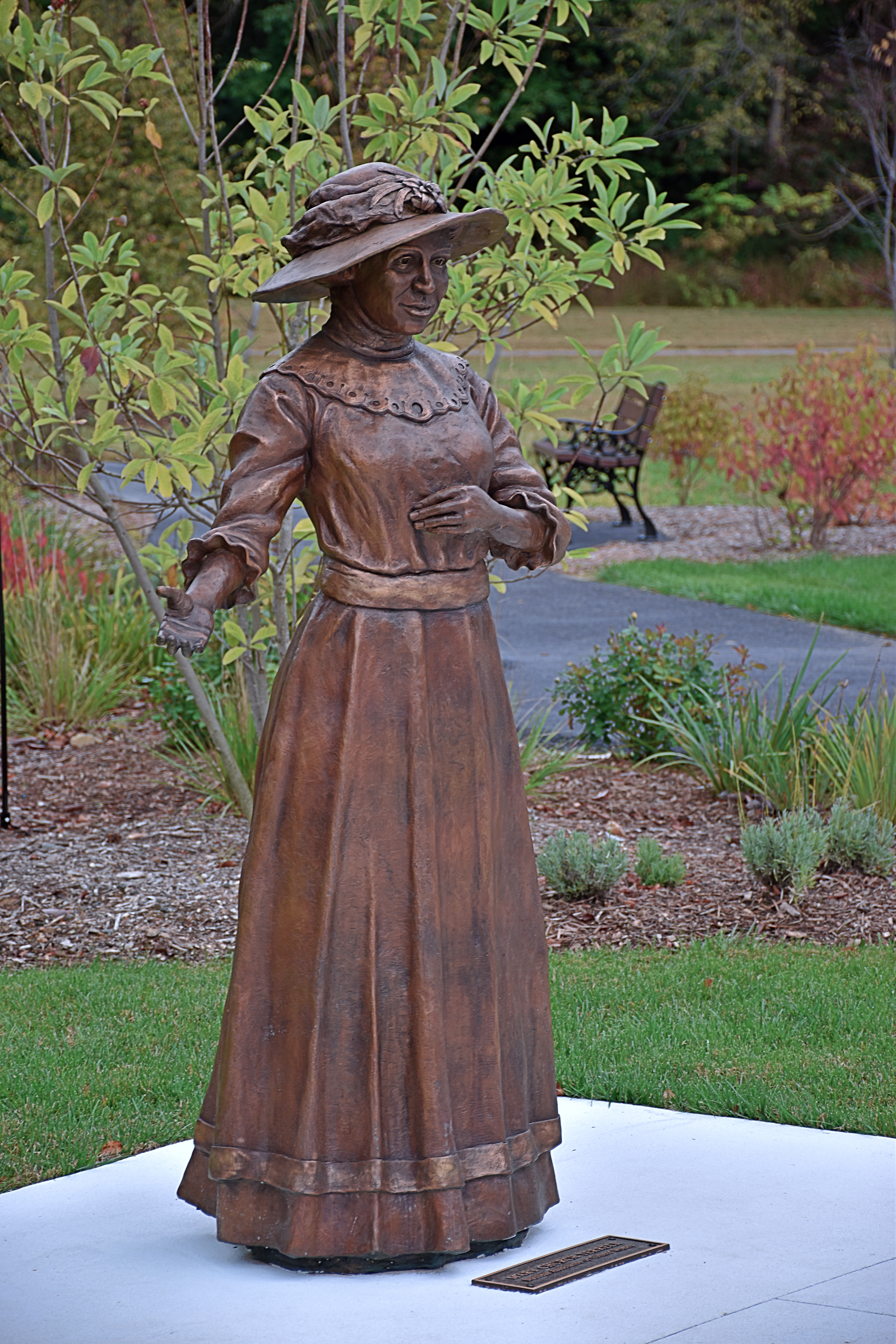
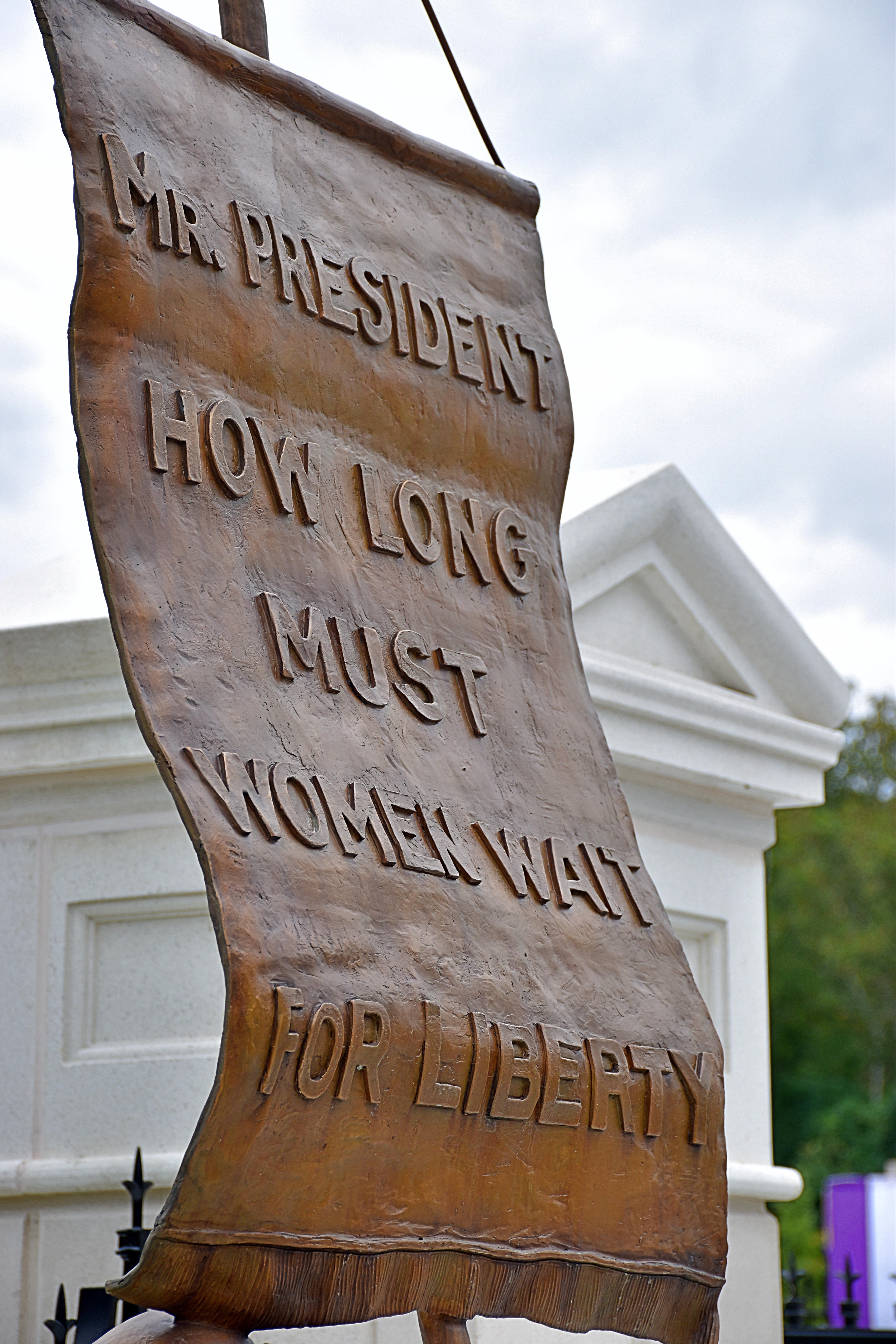
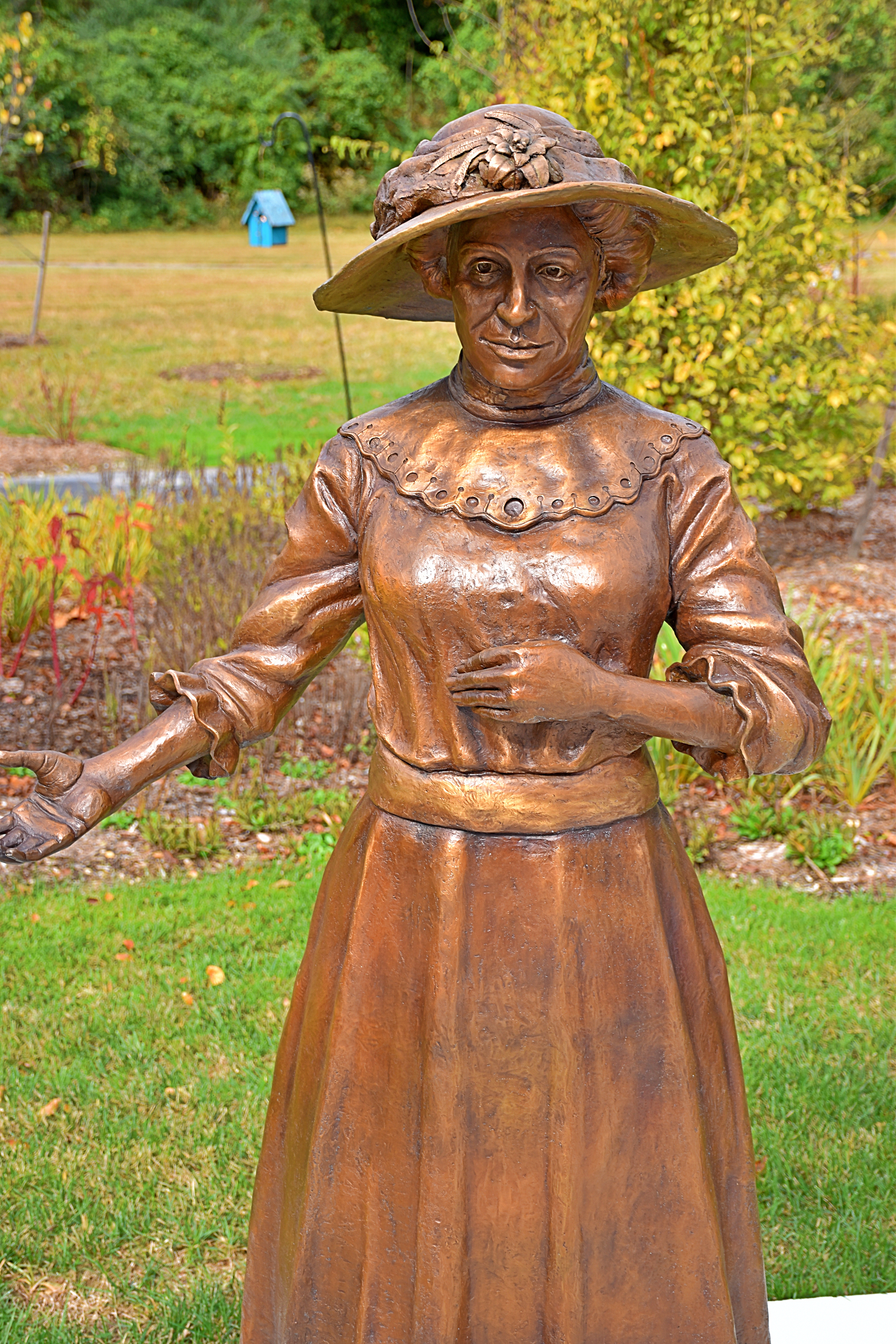
We were recently reminded of this, and more by the invitation of a good friend to attend a presentation of the Women’s Advisory Board of the Girl Scouts Nation’s Capital at the Turning Point Suffragist Memorial in Occoquan Regional Park. We learned some interesting history not covered in many American history curricula. Inconvenient truths, it seems, are everywhere.

In a nutshell, the right to vote for women was not included in the original Constitution. Men resisted the idea for a very long time, despite persistent efforts by women to secure equal standing at the ballot box. While there are varying explanations of what led to the eventual drastic measures, the common point in the narratives is that women suffragists took to picketing the White House during the Woodrow Wilson administration. Wilson’s support for female suffrage had been unenthusiastic at best.

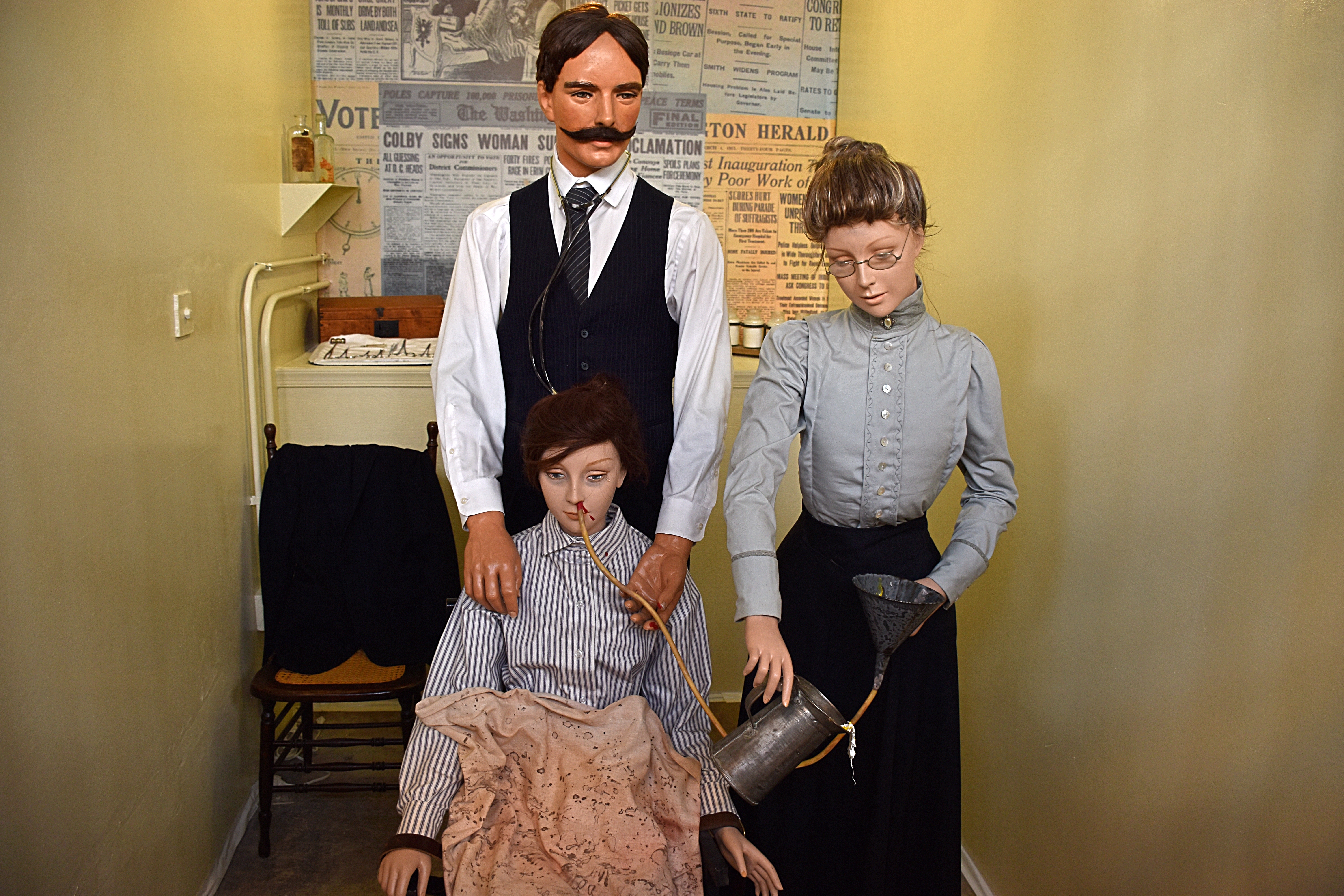
Eventually, the picketers, were arrested and jailed. They chose jail rather than pay fines they felt were unjust. In jail, fed rotten food with maggots, many of the women refused to eat and were force-fed with funnels and tubes. A diorama of this torture can be seen at the Lucy Burns Museum housed in the old Lorton Reformatory just up the road from the Suffragist Memorial. Lorton has now mostly been converted into an arts center, but the Burns Museum is must-see.

The Memorial is supported by the Girl Scouts National Capital. Lidia Soto-Harmon, the CEO of GSNC advised me that,

We are thrilled that in the design they created a bridge that will allow generations of Girl Scouts to “Bridge” to the next level in Girl Scouting.  We had two long time Girl Scout champions, that made a donation to the memorial on behalf of our council, and we are grateful to be listed along with the many contributors.

That bridge is pictured below with the attendees at the event.

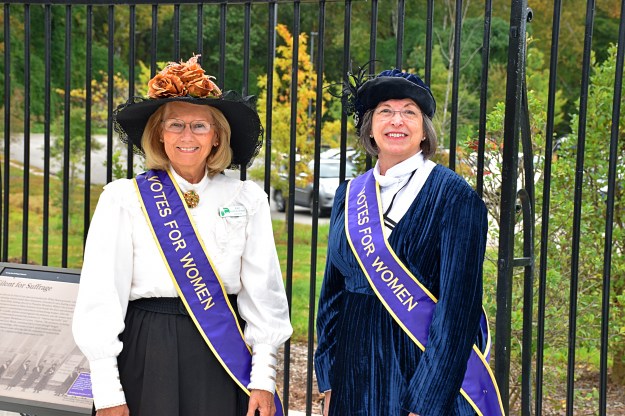
Patricia Wirth, Executive Director of the Turning Point Suffragists Memorial Association, presented an extemporaneous and compelling history lesson for the enthusiastic group that attended. Pat is pictured here on the left, with Nancy Lyons Sargeant, who following long involvement in the TPSMA, has served as the Chairman of the Board since 2015.

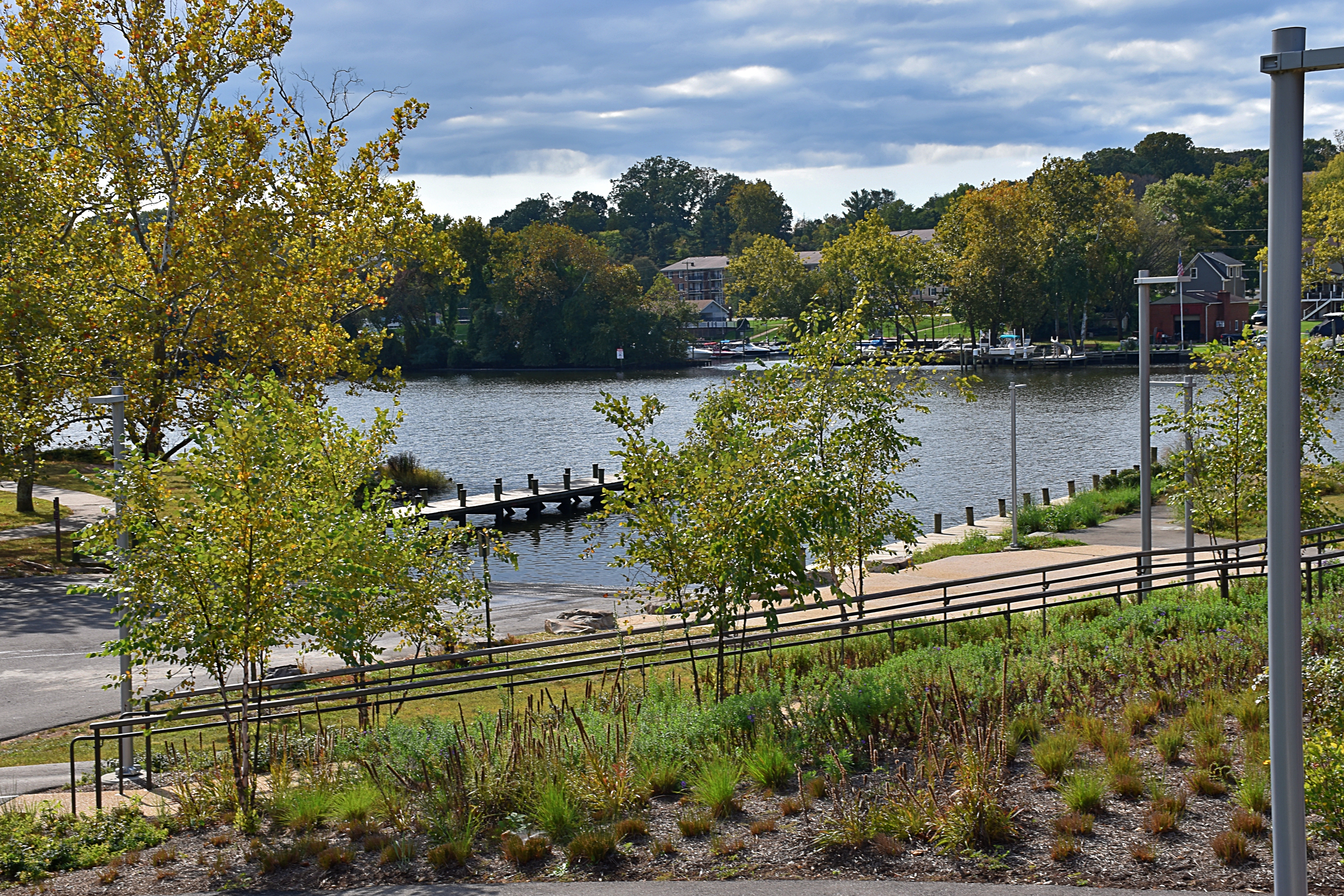
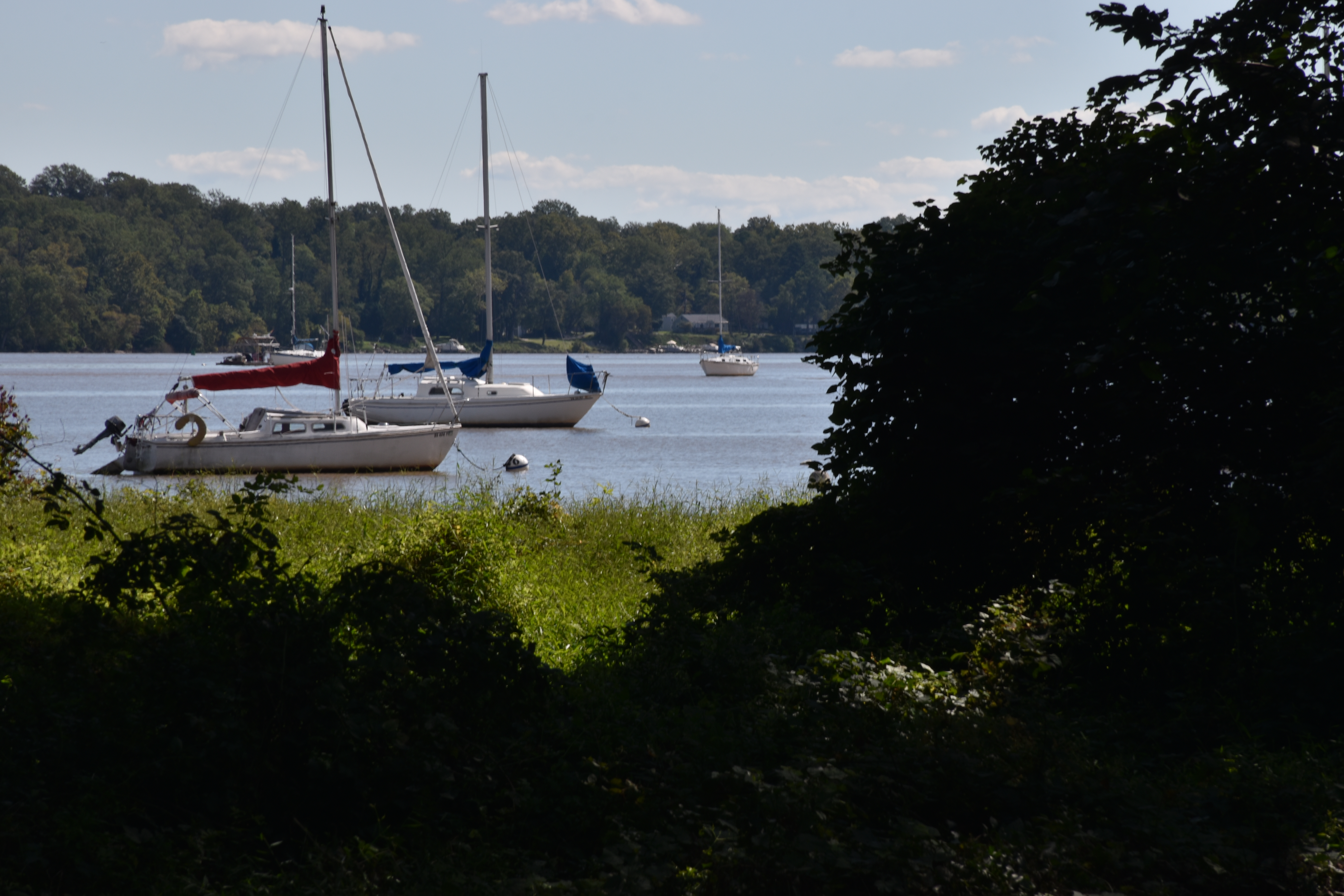
A trip to Occoquan Regional Park is worthwhile for other reasons. There are paved and unpaved paths of varying degrees of difficulty, a very nice café with outdoor seating, great views of the Occoquan River

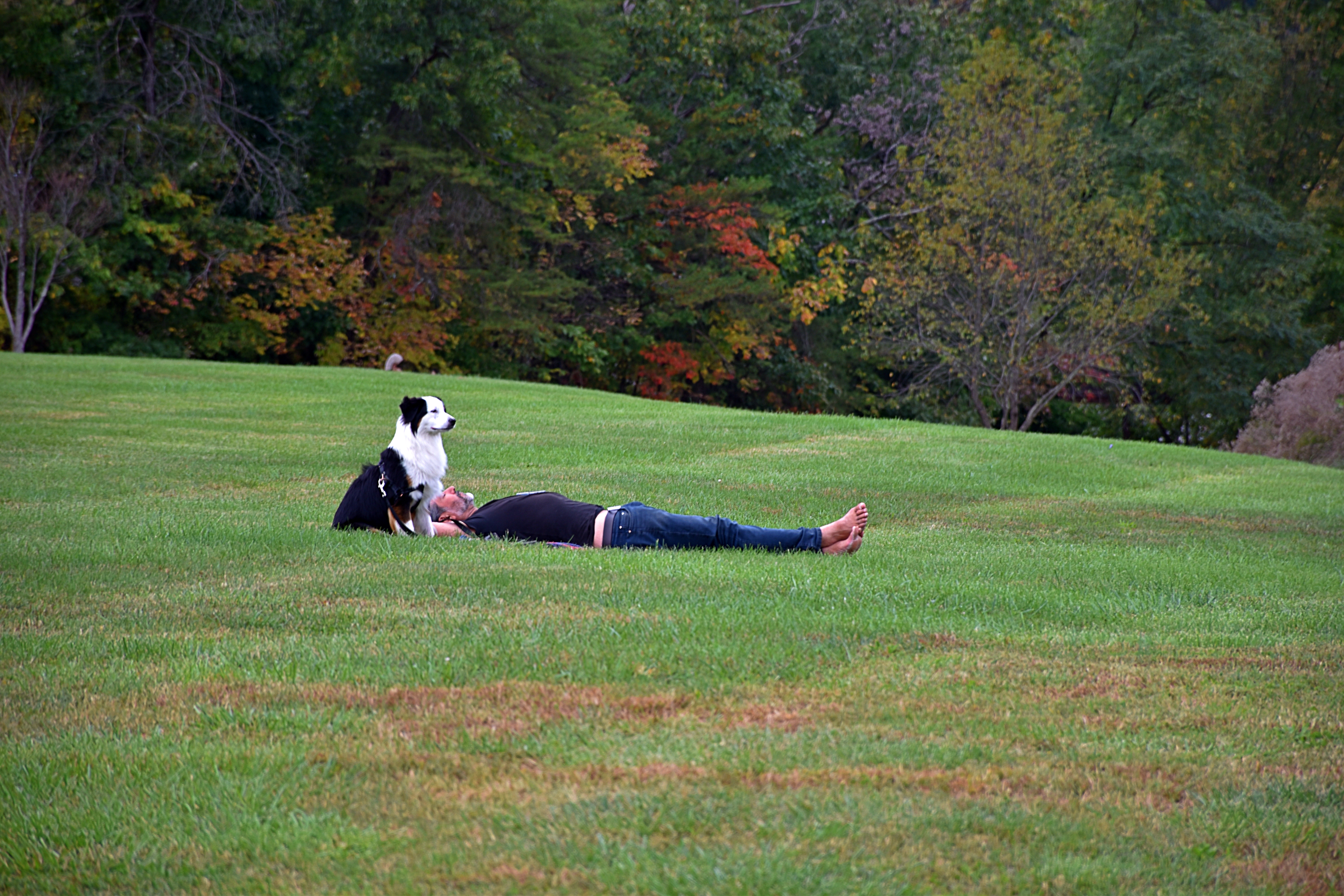
and plenty of space to picnic and play. But you don’t want to overlook the Suffragist Memorial. It’s an excellent learning opportunity for some history often overlooked, and especially for young people who need to understand all aspects of America’s history so, hopefully, they can improve on it in the future.


Artists Speak in Tongues

I often don’t understand. I recently had this experience again at DC’s Hirshhorn Museum https://hirshhorn.si.edu/about-us/ when we visited the huge Laurie Anderson exhibit, https://hirshhorn.si.edu/exhibitions/laurie-anderson-the-weather/ that will be displayed until July 31, 2022.

The museum describes Anderson as a “groundbreaking multimedia artist, performer, musician, and writer.” While I’m not qualified to judge, the description seems accurate. She’s going to be performing live at the museum next year, at times yet to be published, and, to my surprise, I think I want to see her. This woman has designed new musical instruments! Hirshhorn describes her thus:

As a Grammy Award-winning musician, performer, writer, and artist, Anderson has an international reputation as an artist who combines the traditions of the avant-garde with popular culture. Anderson’s theatrical works combine a variety of media, including performance, music, poetry, sculpture, opera, anthropological investigations, and linguistic games, to elicit emotional reactions. As a visual artist, Anderson has been shown at the Guggenheim Museum, SoHo, and extensively in Europe, including the Centre Georges Pompidou in Paris. She has also released seven albums for Warner Brothers, including Big Science, featuring the song “O Superman,” which rose to No. 2 on the British pop charts. She is currently Charles Eliot Norton Professor of Poetry at Harvard University.

Her particular style/mode of artistic expression is not one to which I have been drawn in the past, but the two expressions below got my attention and I am something of a convert:

These photos are but a tiny portion of the full exhibit that includes many forms of multi-media, including video of Anderson dancing with electronic devices strapped to her body that make drum sounds when slapped.

You probably should read this before visiting the exhibit, https://www.nytimes.com/2021/10/06/magazine/laurie-anderson.html, but visit you should. I am still thinking about what I saw. Such stimulation of a distracted mind (you know, the destruction of our democracy) must mean something important is going on. Note that when the Hirshhorn first proposed a retrospective on Anderson’s long career (74 now), she refused and proposed an all-new show.

What Freedom Really Looks like

Many people are refusing to be vaccinated against COVID-19. Some of them have adopted a mantra that they will not be vaccinated because complying with government directives or even guidelines somehow compromises their “freedom.” It’s sometimes expressed as “I’m an American and no one tells me what to do.” Even if it’s for their own good and the good of their fellow Americans. Freedom first, they say.

These people are becoming increasingly marginalized because American businesses are recognizing, slowly but surely, that the best hope we as a whole people have to return to normalcy rests with achieving a high percentage of vaccinated citizens. The federal government recognizes this as well and is requiring vaccination for federal employees.

I’m not here to argue about that. You know where I stand on vaccination. No, I’m here to talk about what true “freedom” looks and feels like.

True freedom was the ability this past Saturday night to attend the Paul Taylor Dance Company performances at the Kennedy Center. Everyone entering had to show a vaccination record, ID and then received a wrist band (see the photo above). Everyone had to remain masked in the theater. What did this mean?

First and foremost, it meant the freedom, for the first time since early 2020, to watch remarkable talented performers live on stage right in front of us. We can’t do what they do but we soared with them in another way. I wanted to jump up and shout but I restrained myself.

It meant that my wife had the freedom to chat with the man seated next to her about his having seen the first set of dances ten years ago. He clearly felt the freedom too, that deep sense of relief that we can live again. Live dancers – no Zoom! The real thing.

The audience was a good mixture of older people and many younger ones as well. Some of the latter group looked like dancers and I have no doubt they were as excited to see the Paul Taylor company as we were.

The performances were amazing. The first set was devoted to music from the late 1930’s and 1940’s sung by the Andrews Sisters, tunes like Pennsylvania Polka, Boogie Woogie Bugle Boy and Rum & Coca Cola. The boogie woogie vibe of that era was fully realized in the choreography and high energy of the dancers. The dancers were clearly having a good time, and the audience was extremely responsive to the skills and enthusiasm of those remarkable people.

The second set was quite different: danced to Bach’s Violin Concerto in E Major and Double Concerto for Two Violins in D Minor (Largo & Allegro). If you aren’t familiar with those somewhat obscure titles, treat yourself here: https://yhoo.it/3lwXQc1 and here https://yhoo.it/3Bzy0tJ

While the set began with what seemed, to me at least, some pointless running around, it didn’t take too long for the choreographer’s vision to take hold with spectacular acrobatic leaps, rolls and more. Amazing athleticism. Amazing grace. Freedom!

Two days later we were still talking about the performance and the feelings it inspired.

Obviously, there are other more profound and, in a broader sense, more important aspects of freedom, but I’ll take this for now. We could breathe again, stop being afraid and just rejoice in the passion of the moment. Because everyone in the theater was vaccinated and wearing a mask. Everyone was respecting everyone else. The truth is I hate the mask. But it’s a small thing to do for my own and everyone else’s safety. And, not surprisingly, during the performances I forgot entirely that I was wearing a mask.

I read now that the Delta variant of COVID is in “remission” and that cases and deaths are once again declining. That’s good news, but we’ve been here before. Instead of declaring victory, do the smart thing: get vaccinated immediately. Demand that friends, family and co-workers do the same. That’s the only way we’re going to emerge from this nightmare. If you live in states where leadership is resisting vaccination mandates, replace those people. They don’t care about you.

If you want true freedom again, the fastest, best and only road there runs through the vaccination program. Do it now.

Places to Go, Things to See

The weekend looms. A good opportunity to review some of the places we’ve visited recently for relief from the continuing gloom of a city not yet recovered from COVID’s shutdown of the economy.

Over a span of a few months we have been on the road quite a bit. A very brief sample of some of the available delights follows, starting with the most distant from Washington:

Savage River Lodge

This place is located at the end of a 1.5 mile gravel road in upper northwest Maryland, best attempted only if you have at least a front-wheel drive vehicle and (in winter) 4-wheel drive. The lodge has a restaurant with outdoor seating and a collection of cabins and yurts for rent. The site is remote and hilly but abounds in natural beauty. It is an easy drive to Grantsville, MD and close to Frostburg.

In one day we saw about a dozen deer, a personal record. The Casselman Bridge in the last photo is in Grantsville whose principal attraction is the Hill Top Fruit Market which is mainly a candy store, lined with bins of all manner of sweet stuff, including many you haven’t seen since childhood. You can also buy fresh fruits and vegetables there. The Fernwood Soap shop and the flowers are in the Spruce Forest Artisan Village, adjacent to the Penn Alps Restaurant & Craft Shop.

Be advised that for a more accessible but still interesting “remote” experience, the cabins in New Germany State Park are very hospitable and inexpensive. They are a fun place to use as a base for exploring the area, maybe doing a little fishing, rafting and such.

Skyline Drive

This, of course, is the 105-mile mountain-top ride in Shenandoah National Park in the magnificent Blue Ridge Mountains of Virginia, Don’t  think about driving the full length of the Drive unless you plan to stay overnight at some of the few on-site lodges. The speed limit is low and the road curves, rises and falls incessantly so fast driving is not in the cards. Besides, you’ll miss the scenery.

Great Falls Park After Hurricane Ida

One of the interesting aspects of Great Falls Park is that it is radically affected by upstream rainfall, which is evident in this small sample of photos showing the impact of Hurricane Ida having dropped massive water upstream. The water is high and brown. Impressive but you wouldn’t want to fall in.

Dyke Marsh

This little gem, about two miles roundtrip, flat as a pancake, can surprise you with unexpected visual delights. In the right season, red-wing blackbirds make the adjoining vegetation their nesting grounds. The Potomac River runs alongside. There are usually a few walkers along the way but even on weekends, we have found Dyke Marsh trail uncrowded and pleasant for a short easy walk. My wife’s uncanny ability to spot creatures in the wild accounts for the grasshoppers and Blue-tailed Skinks that I would have missed entirely.

Sadly, there is always evidence that humans have been here before us, seemingly the unavoidable consequence of so much nature so close to so many people who just don’t understand:

Tregaron

Finally, even closer to [our] home is Tregaron Conservancy, entered most conveniently from either Macomb Street NW or Klingle Road NW. It is situated between the Cleveland Park and Woodley Park neighborhoods just west of Rock Creek Park. The park is small but considering it’s in the middle of a city neighborhood, it has some interesting features, the best of which, for us, was the Lily Pond, small but full of life.

There were, of course, many more frogs and dragon flies, as well as a small armada of goldfish. The frogs are quite bold, as these photos attest.

Frogs have featured in Japanese haiku for centuries and somehow capture the essence:

The old pond

A frog leaps in.

Sound of the water.

What else is there to say?

Conclusion

We continue to be pleasantly surprised at the natural resources available around the Washington area and are often surprised by the wildlife that thrives in our midst. Walking slowly and observing quietly usually pays off.


More Than the Heart Can Bear

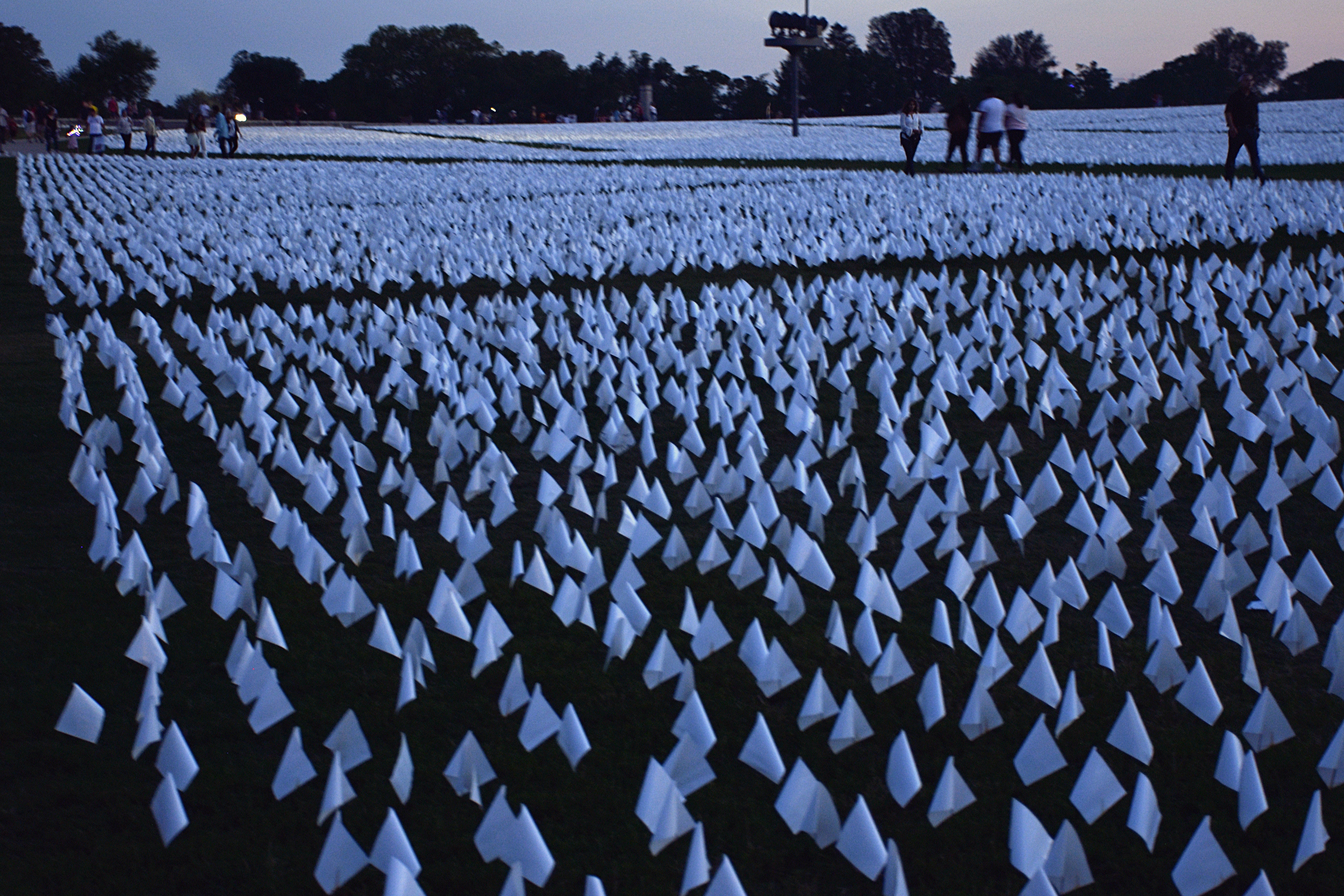
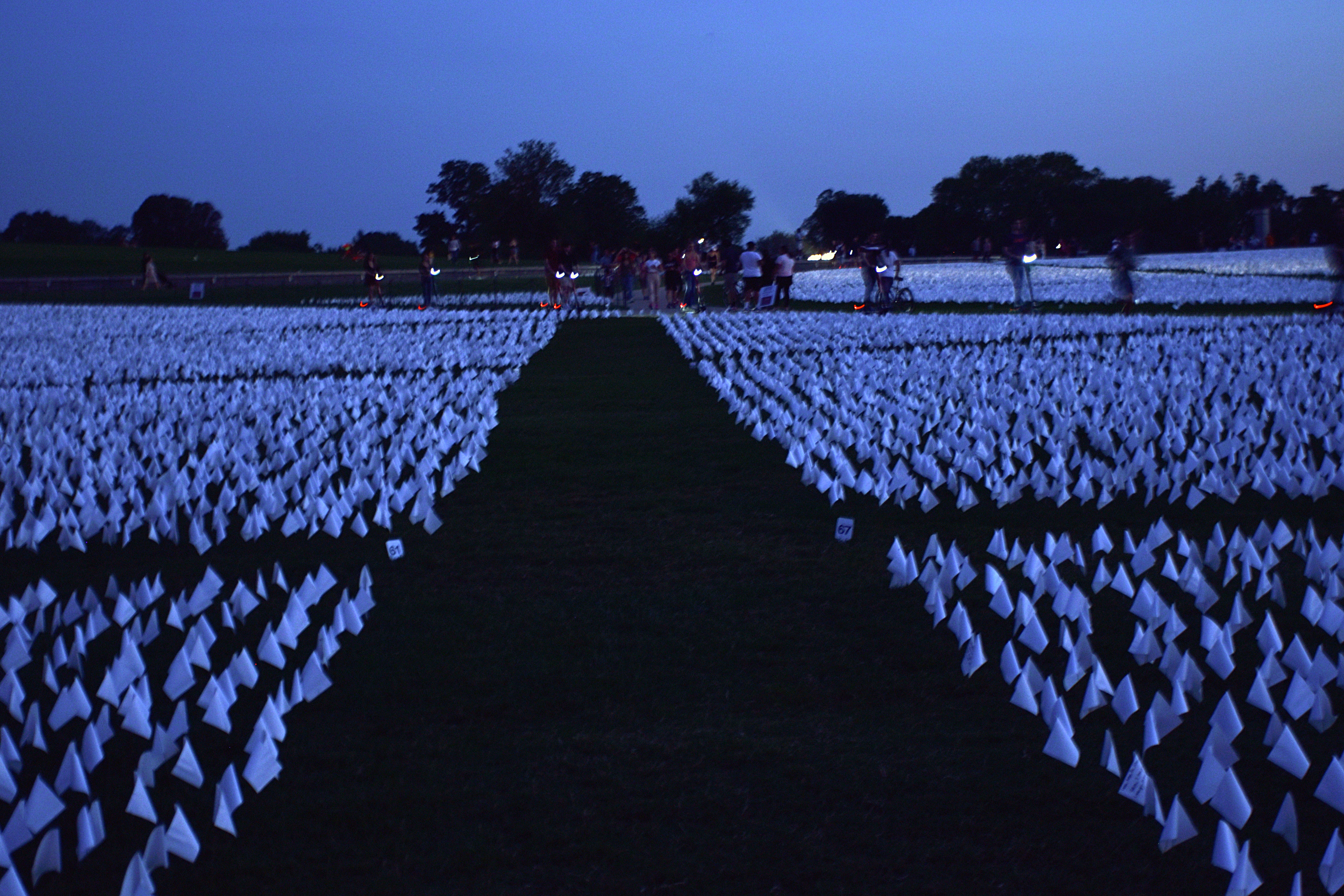
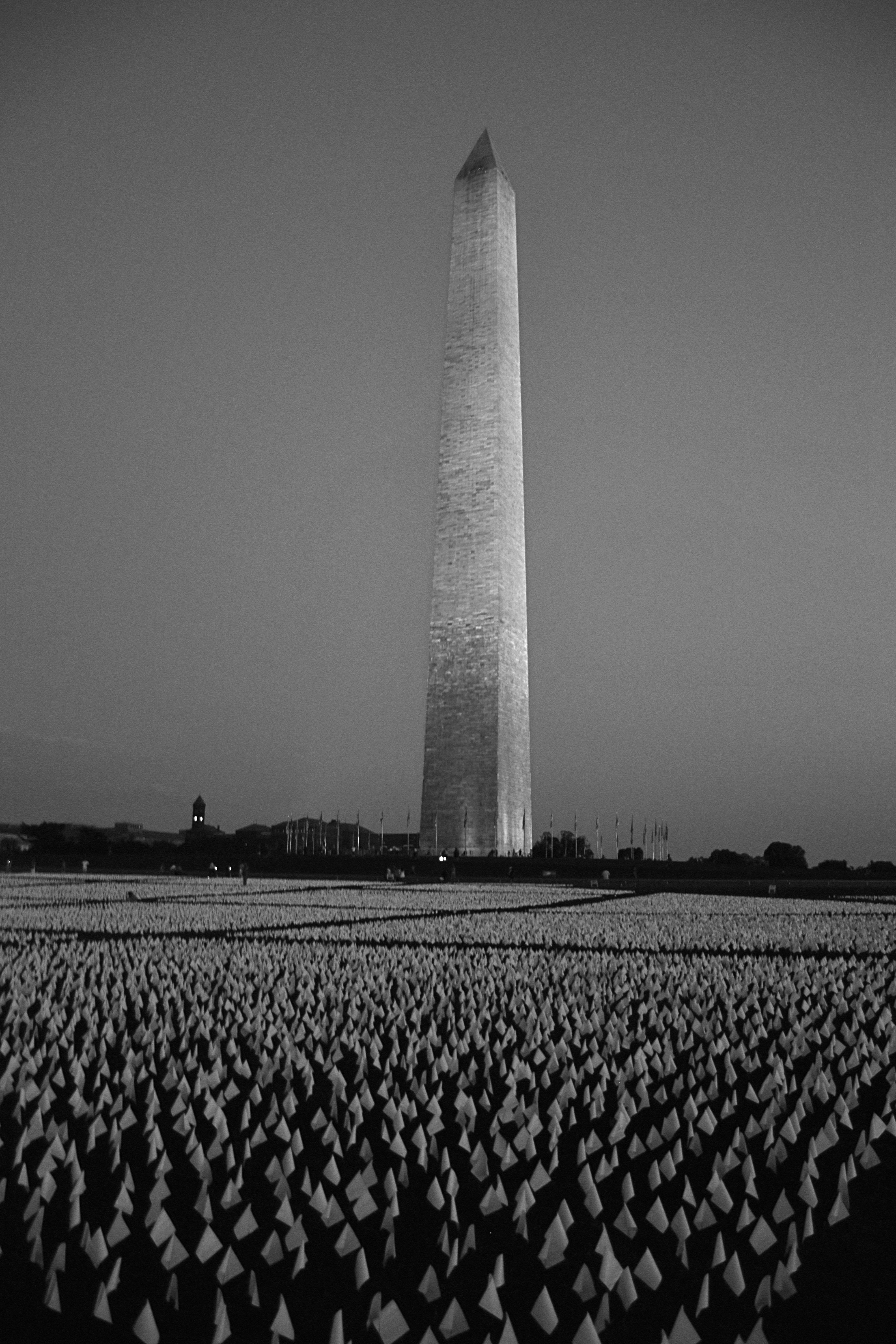
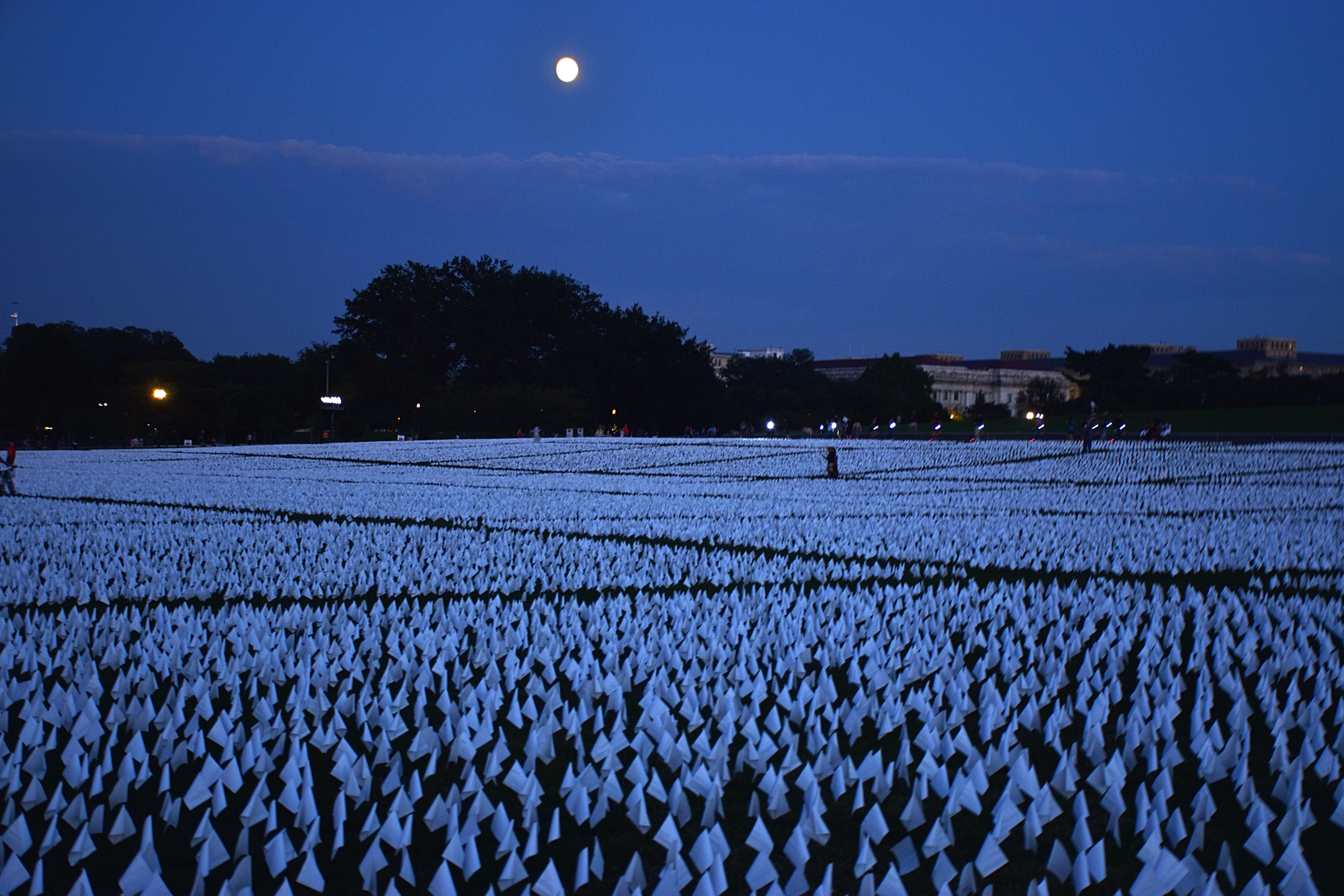
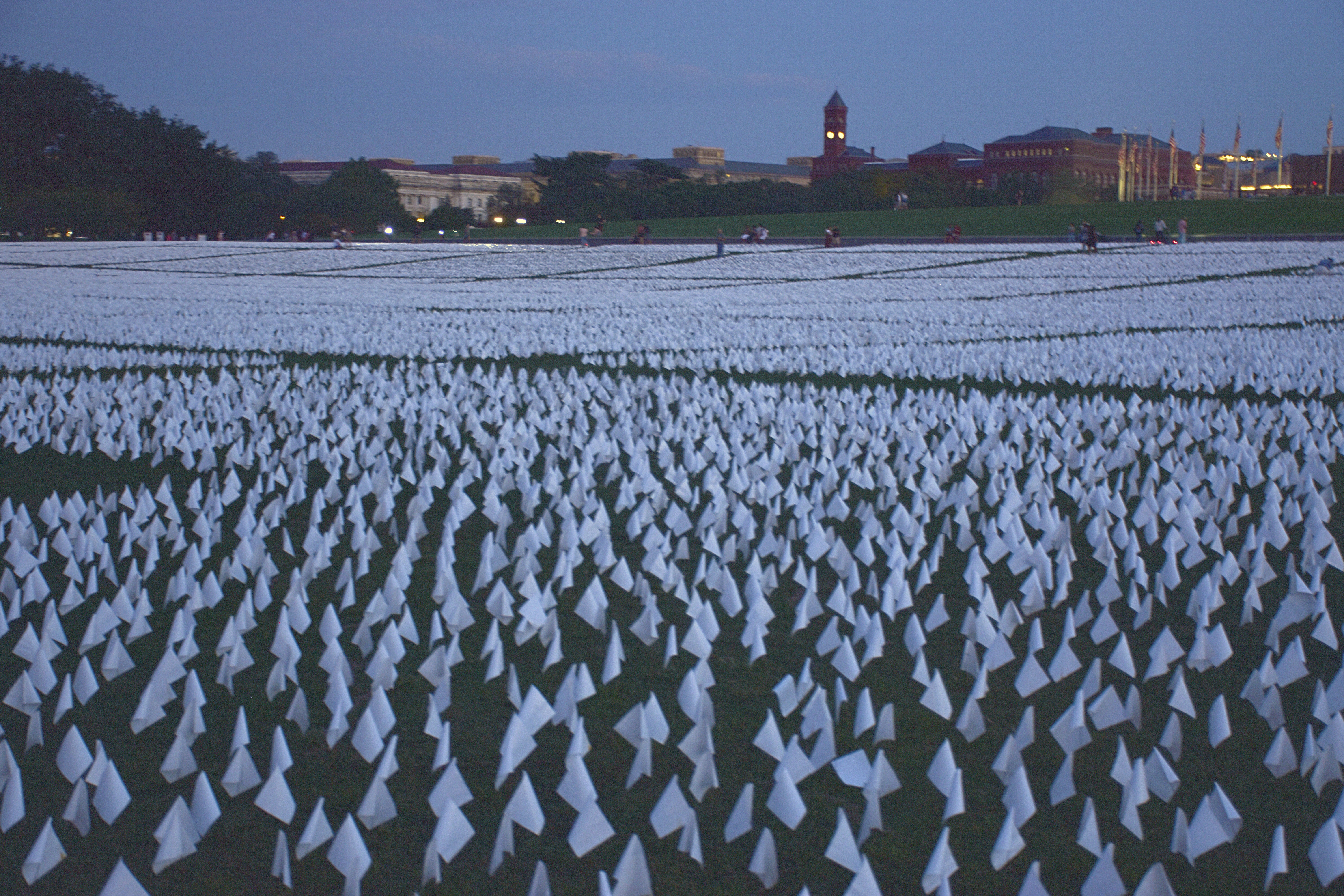
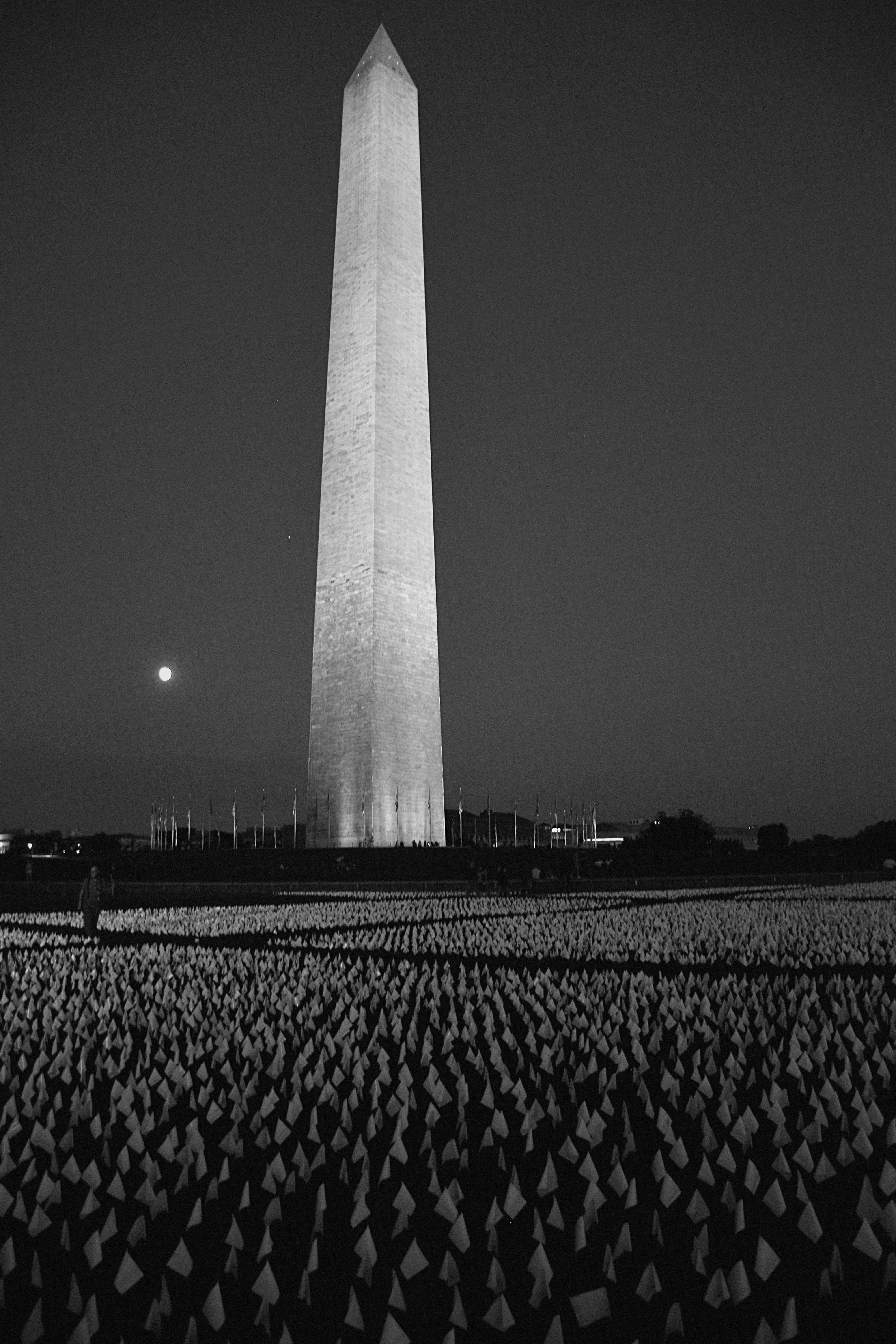
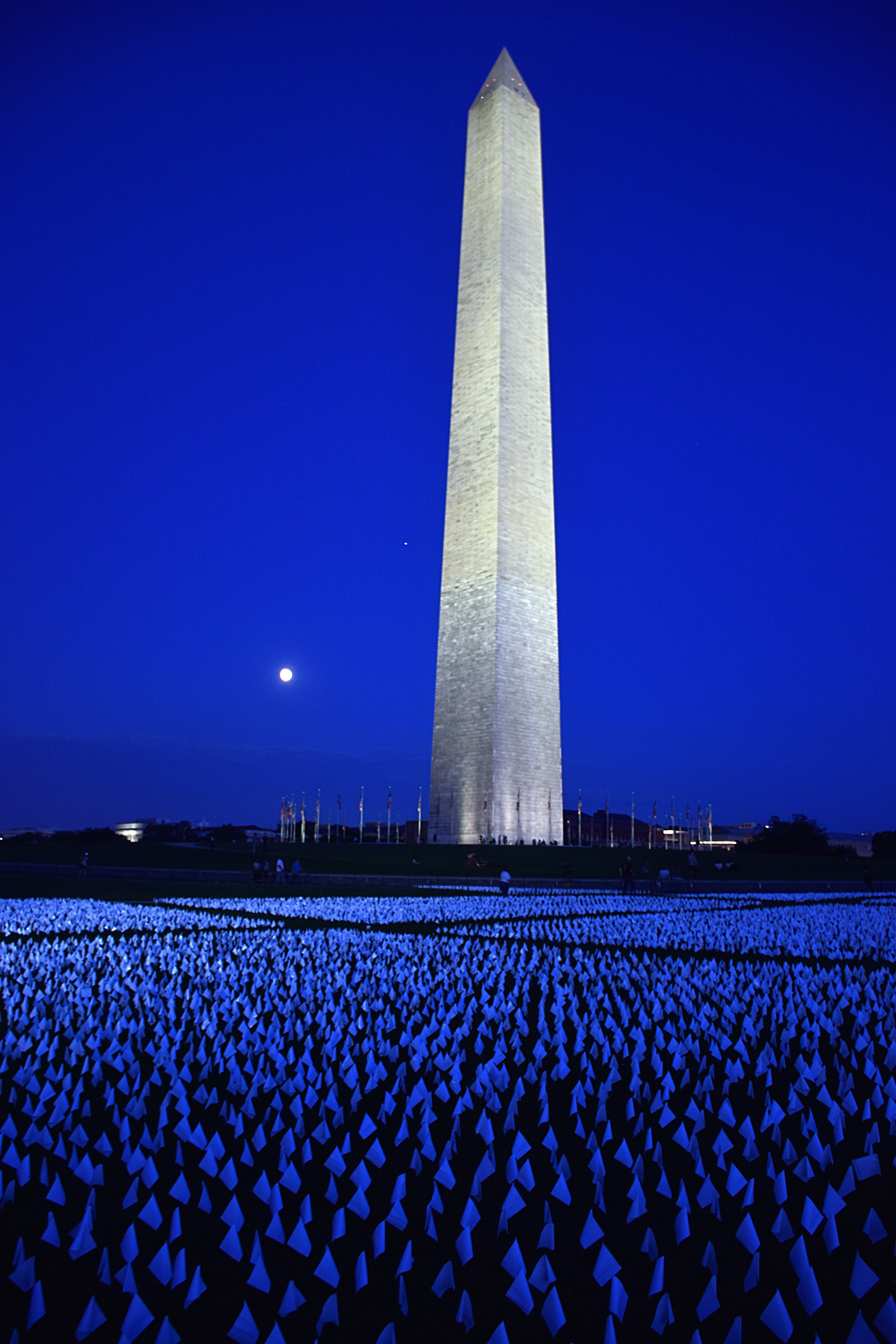
Early last evening we visited the Washington Monument grounds to see the acres and acres of white flags that have been placed there by artist Suzanne Brennan Firstenberg to memorialize the more than 670,000 Americans who have died from COVID-19. The display of flags is called America Remember. It has received little attention from media.

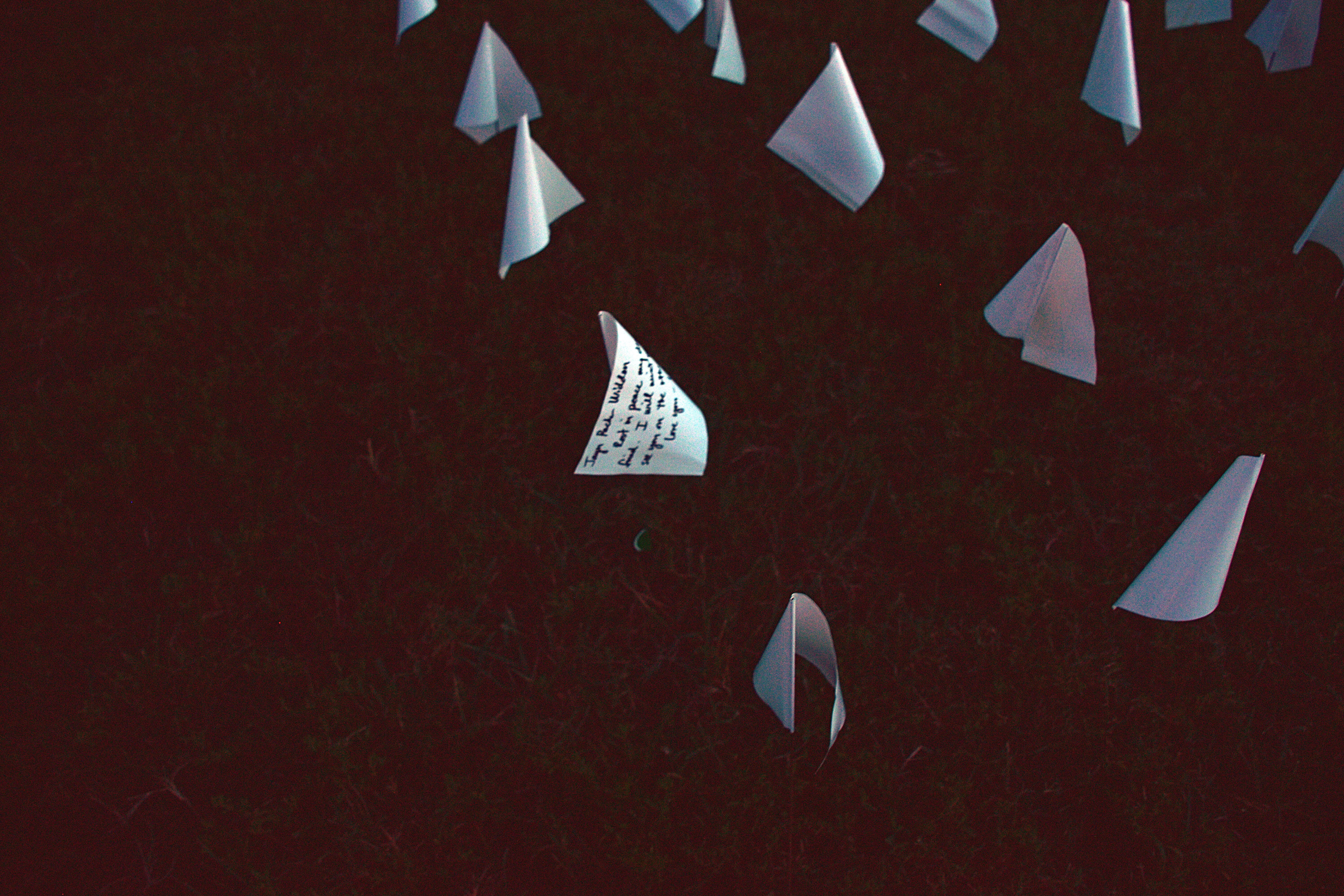
Stunning in scale, the flags cut into you, especially, I suspect if, like us, you have lost a loved one to the virus. Some who visited have penned notes on the flags, expressing their grief.

The setting is surreal, watched over by the Washington Monument. It can be seen from the White House. It is overwhelming. You have to see it, to walk among the endless row upon row of white symbols of death, of loss, of pointless tragedy. For those who can’t do so in person, I hope these photographs will suffice at least for now. There are no words.


Another Day, Another Park

Since a certain group of people continue to prevent the country from escaping the pandemic, we remain in partial shutdown and, if you regard your health seriously, limited to where we can eat and otherwise do “normally.” The road ahead seems long and unpleasant.

Thus, desperate for escape, needy of stimulation and just to get some air, we visited yet another “local” park last weekend. Two actually, though one barely counts, as you will see.

Our destination was Neabsco Regional Park in Woodbridge, VA, billed as “300 acres of natural, recreational, and historic amenities including the Rippon Lodge Historic Site, Rippon Landing, the Potomac Heritage National Scenic Trail Neabsco Creek Boardwalk, Julie J. Metz Neabsco Creek Wetlands Preserve, and portions of historic Kings Highway.” https://bit.ly/2VS0oYt We opted for the Boardwalk. You can see an aerial photo of the Boardwalk on the website.

The upside of the Boardwalk is that it’s a … boardwalk. You stay above the muck, mud and other “things” while having a broad view of the natural scene. The downside of the Boardwalk is that it enables bicyclists, strollers and large groups to move easily along and disrupt, in a minor way, your tranquility.

This is part of the Boardwalk that is surprisingly long:

The other outstanding feature of Neabsco is that the bog/swamp area is surprisingly uniform. For an area this large there appears to be relatively little biodiversity.

Nevertheless, the observant observer can see plenty of interesting activity in  and above the bush. In addition to the turtle “hotel”

we saw some beautiful flowers, though, curiously, they mostly were single blossoms poking through the surrounding greenery:

though, as always, there were brilliant exceptions:

But, of course, the real “juice” at a place like this is the wildlife and we had several delightful surprises. At ground level, there was this amazing  heron whose neck contortions in his slow hunt for food were astonishing to see up close:

By the way, the crawfish (we think) in his bill in the last picture escaped at the least moment! The heron took it in stride and resumed his stalking through the bog.

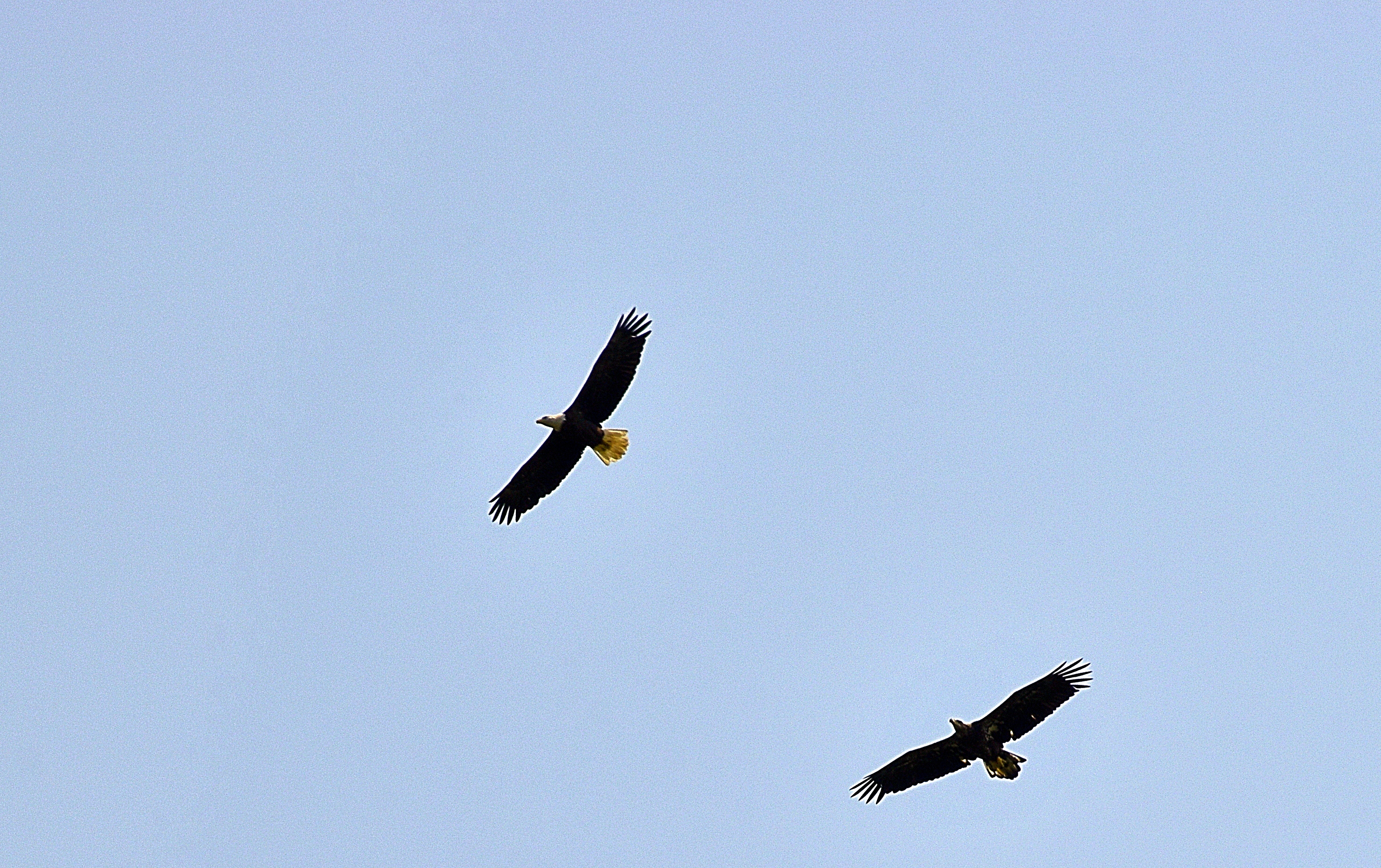
The thing is that in a place like this your attention is naturally drawn downward, but it’s important not to focus too much on what’s right in front of you. My wife’s vision for spotting animals in the wild is remarkable. and she detected these bald eagles quietly hunting and the osprey in a tree  probably a hundred yards away:

Largely sated by these experiences, we departed for Occoquan Bay National Wildlife Refuge, where we limited ourselves to what is billed as the Wildlife Drive. Mistake. If you want to see what this Refuge has to offer, you’ll have to do it on foot. The Wildlife Drive looks like a narrow gravel road running among bushes and trees for it’s entire distance. Nothing to see. There are foot trails; check the map carefully to find them. The oddest thing was that these signs appeared throughout the drive:

We still haven’t figured out what you would dig for but it must be a real problem because there were a lot of signs. We were pretty disappointed in this experience, but it did not detract from the cool stuff in Neabsco. And, yes, the featured image at the top of this post, butterfly on flower, was taken there.

The Doomsday Scenario – Strangelove as President

You’ve seen one of the movies, most likely. One masterpiece that comes to mind is Dr. Strangelove, subtitled, “How I Learned to Stop Worrying and Love the Bomb.” If you are one of the five living people who hasn’t seen it, Wikipedia summarizes the story like this:

The story concerns an unhinged United States Air Force general who orders a first strike nuclear attack on the Soviet Union. It separately follows the President of the United States, his advisors, the Joint Chiefs of Staff and a Royal Air Force (RAF) exchange officer as they attempt to prevent the crew of a B-52 plane (who were following orders from the general) from bombing the Soviets and starting a nuclear war. [https://bit.ly/39fqU0M]

There are other such stories, including the similar Seven Days in May, about a “military-political cabal’s planned takeover of the United States government in reaction to the president’s negotiation of a disarmament treaty with the Soviet Union.” [https://bit.ly/2Xip8cF]

At the root of each drama is the conflict between the civilian and Constitutional leader of the military (the President) and the military leadership. Usually, it’s the military people that go off the reservation. In the real world, we had the opposite, terrifying scenario of the President of the United States becoming unhinged from reality and unrestrained by Constitutional or any other restraints (including his Cabinet). Trump was behaving so irrationally that the senior military authority, General Mark Milley, Chair of the Joint Chiefs of Staff, undertook steps to be sure that Trump’s lunacy did not destroy the world.

Republicans, and even a few Democrats, are losing their minds over this. Ignore the Republicans, who, as with COVID-19, Ukraine and many other situations, can be counted upon to suspend all rational thinking in favor of obeisance to Donald Trump. Especially people like the morally compromised Senator Marco Rubio. Their reaction is predictable and meaningless.

Our attention is captured, however, as it should be, when someone like Ret. Lt. Col. Alexander Vindman, driven out of the service by Donald Trump, complains that Gen. Milley should be removed because he “usurped civilian authority, broke Chain of Command, and violated the sacrosanct principle of civilian control over the military.” https://wapo.st/3zbu9Ry

Despite my great respect for Lt. Col. Vindman for his courageous stand against Trump’s lies about the Ukraine extortion, I disagree with his judgment on Gen. Milley.

In time of crisis, there are two essential options: (1) look to an authority source for direction and mechanically do what it says, or (2) use judgment to assess whether the authority source works in the situation at hand and, if not, choose another course of action. People face these choices every day in one way or another, thankfully almost always in situations trivial by comparison to the problem Gen. Milley faced. They make such choices on the spur of the moment, often without much thought. Sometimes they are right and sometimes not.

For example, in a different realm, the standard instruction is: don’t run from a bear; running will trigger its predatory instincts to attack. Also, don’t get between a mother bear and her cubs.

Fine, but what if you’ve wandered between the mother and cubs before you are even aware of their presence. The rules then are more complicated: if it’s a brown bear and it charges you, fall into a fetal position, trying your best to protect head, neck and stomach. If it’s a black bear, fight back. Throw things, get “big,” shout. Brown bears are more aggressive typically but may lose interest when you cease to be a threat. Black bears are ferocious but may yield and run from a fight.

If it’s a polar bear, well, hope your estate plan is in order.

The point is that these “rule book” principles are fine until they don’t work. If a grizzly attacks, you go fetal and he starts eating you, it may be that the stick lying beside you is your only remaining hope of survival. So, you grab the stick and poke him in the eye or other sensitive place, make a lot of noise and fight like hell for your life. You’re going to die otherwise, so you do what you have to do. Your options are few so you do what you can to change the odds.

Imperfect as analogies may be, the ultimate question is crisis is: will following the authority solve the problem or do I have to improvise and do the unthinkable?

Gen. Milley was faced with precisely this situation. [Disclosure: I haven’t yet read the Woodward/Costa book that revealed this story and even then might not have all the information.]

Gen. Milley had the real-life Dr. Strangelove in the role of President of the United States. His choice was to follow the rule book, let events take their course. He realized he could possibly be witness to, and complicit in, the destruction of the world as we know it if Donald Trump, desperate to cling to power, were to issue orders for a nuclear strike against China. Evidence was abundant that Trump was having serious mental disfunction. This was nothing new, but the loss of the 2020 election unhinged him from reality to a degree not previously seen. He claimed without evidence that the election had been stolen; he refused to cooperate in the peaceful transition of power; on January 6 he had urged his followers to use force to stop the final step in certifying the election result; he openly sought to reverse election counts in multiple states by pressuring state officials.

Donald Trump spit in the face of the constitutional order, giving every indication that he might be prepared to do something even more unprecedented in human history to retain power.

In those circumstances, perhaps one person alone stood as the final bulwark against insanity on the loose. That was General Milley. He chose to act rather than be another passive instrument of Trump’s delusion. I think I understand the tendency of people like Lt. Col. Vindman to turn to the “book” in cases like this, but history should vindicate the judgment of Gen. Milley that the evidence of irrational behavior was too strong, and the weakness of the inner Trump circle was too compromised, to simply hope for the best. The nation, indeed the world, should be grateful.

Note: Jennifer Rubin’s Washington Post opinion piece on this issue raises questions regarding the lessons to be taken from this episode and how we shore up the constitutional order against a future Trump. https://wapo.st/3hEyKpm Those are very important questions that require the most serious consideration.


Religious Exemption – What Religious Exemption?

I keep hearing about people claiming they have a religious objection to (1) wearing a mask and/or (2) getting a COVID vaccination. I have asked the Twitterverse to identify the religion that contains such prohibitions in its doctrine, so far without response.

To be clear, I am not writing this to belittle anyone’s religious faith. I write to raise the highly relevant question in the pandemic of what exactly qualifies as a valid “religious exemption” to masking and/or vaccination.

My thesis is that (1) the sudden discovery during the pandemic of one’s “religious doctrine” is just too convenient and is not a valid claim; (2) to make a valid religious exemption claim, at least two things must be demonstrated: (a) an established discoverable documented statement of clear doctrine opposing the use of masks/vaccinations to prevent/limit disease on the basis of an identified moral/ethical code, and (2) evidence that the claimant has in actual fact practiced the doctrines of the asserted religious for an extended period prior to the pandemic.

Point (1) should not be that hard. Established religions that have such doctrines can be expected to have produced writings/speeches/published practice directives that make these assertions and tie them to some “higher power” ethical controlling principles. I am not aware that such religions exist. Christian Science may be one, though I am not clear that it actually rejects vaccination conceptually. But I am not an expert on religions and there may be others. Waiting.

Point (2) may be much harder for many people. I do not accept that a person may make a valid religious exemption claim if they suddenly discover that their “religion” has some doctrine that may be used as an exemption support, and they then decide to assert it when the reality is that they never followed the doctrine before.

I am astonished and perplexed to learn that the Equal Opportunity Employment Commission has adopted as policy in its Compliance Manual on Religious Discrimination the “principle” that in practice means a religious exemption is in most cases whatever the person says it is, regardless of past practice of adherence or any other considerations. I am not going to elaborate on my judgment of that – if you’re interested, you can find the details here: https://bit.ly/3yUWlIh I do believe it is conceptually and otherwise preposterous.

But that such muddled thinking is part of government policy, at least in one domain, it is small wonder that people are using religious exemption claims to cover their political or merely ignorant resistance to public health measures that have been shown to limit COVID infection spread. The resisters – the anti-makers and anti-vaxxers – are not only dying at much higher rates than the vaccinated, but they are facilitating the “evolution” of the virus into more virulent strains, such as the Delta Variant that is ravaging the country now. Breakthrough infections, with sometimes deadly outcomes, are increasing also. This is virtually certain to result from vast numbers of unvaccinated people walking among us.

My limited understanding of religion is that any legitimate one has an ethical/moral foundation of principles to live by. Whether it’s one deity or many, a set of principles to live by is the central idea. If so, I can’t help wondering what foundation of ethical/moral principles the people who suddenly found religion think they are asserting. Their new “religion” has the effect of exposing themselves and, worse, others to a deadly disease. What principle of ethics/morality justifies that? How do they square their supposed adherence to a set of ethical/moral principles while basically lying about their “sincerely held religious beliefs?”

The Road Not Taken

Kudos to President Biden for taking the hard but right path to restoring the physical and economic health of the country. Shame on those who continue to harp on the ignorant and irrationally resistant themes of “my rights” at the expense of the health and welfare of others. ENOUGH!

We’re at the fork in the road. Nothing short of a full-on frontal attack on the virus is going to get us out of this mess. The great American poet Robert Frost captured the idea in his famous poem, The Road Not Taken:

Two roads diverged in a yellow wood,
And sorry I could not travel both
And be one traveler, long I stood
And looked down one as far as I could
To where it bent in the undergrowth;

Then took the other, as just as fair,
And having perhaps the better claim,
Because it was grassy and wanted wear;
Though as for that the passing there
Had worn them really about the same,

And both that morning equally lay
In leaves no step had trodden black.
Oh, I kept the first for another day!
Yet knowing how way leads on to way,
I doubted if I should ever come back.

I shall be telling this with a sigh
Somewhere ages and ages hence:
Two roads diverged in a wood, and I –
I took the one less traveled by,
And that has made all the difference.

Biden has taken the road that many politicians would eschew – the one that will, and has, inevitably create another furor. Rather than the “safe path,” Biden has shown the courage of a leader by doing the right thing rather than the safe or easy route. You can hide from destiny only so long, as this great story reminds us:

A merchant in Baghdad sent his servant to the market.
The servant returned, trembling and frightened. The
servant told the merchant, “I was jostled in the market,
turned around, and saw Death.

“Death made a threatening gesture, and I fled in terror.
May I please borrow your horse? I can leave Baghdad
and ride to Samarra, where Death will not find me.”

The master lent his horse to the servant, who rode away,
to Samarra.

Later the merchant went to the market, and saw Death in
the crowd. “Why did you threaten my servant?” He asked.

Death replied, “I did not threaten your servant. It was
merely that I was surprised to see him here in Baghdad,
for I have an appointment with him tonight in Samarra. 

The choice we face now, that we must face, is between aggressively striking at the virus with all the tools at our disposal or continuing to beg the irrational and uninformed to do the right thing. The former has a chance to stop the pandemic, to take advantage of the astonishing opportunity that the rapid deployment of vaccines has provided. The latter approach has virtually certain terrible consequences: more illness, more death, more permanently damaged bodies.

The reality is that the vaccines are safe and effective. The reality is that the rapid spread of the Delta variant has again overwhelmed the nation’s medical capabilities. COVID infections that are mainly in unvaccinated individuals are denying needed medical services for people with other medical conditions.

I have read some of the insane rantings of primarily right-wing and libertarian “authorities” who claim to have inside knowledge that the virus was released deliberately by agents of the federal government who are cashing in on the vaccines. These people claim that the vaccines contain various poisons, microchips and who knows what else.

It seems that one can always find someone who claims to have the inside track on awful secrets and conspiracies that are constantly being plotted against the rest of humanity. These sometimes include people with “medical credentials,” but often they are former workers in the pharmaceutical industry who are certain that they have inside information to expose the crimes being perpetrated in the name of … whatever. They readily accept the plausibility of conspiracies involving many thousands of people around the globe, no one willing to spill the beans, all in the name of “follow the money” or some other cliché that substitutes for actual thought.

We see this same theme played out in science fiction movies and what I call “caper movies” in which bad guys pull off, at least temporarily, extraordinary schemes to steal, blow up, capture huge sums of money, power over the world, etc. Movies like Air Force One, Die Hard and so many others. I have struggled through a few episodes of a TV series called Eureka that is loaded with utterly implausible, preposterous concepts and science-like doublespeak and gibberish. Some people apparently take such stories to be true. It’s an easy shift from one phantasmagorical storyline to another. Harry Potter is real, flying broomsticks and all.

Reality is more mundane. Two kinds of sickness pervade the country. One is the COVID-19 virus. We’ve learned a lot about it and about how to prevent its worst manifestations. Vaccines, masks, social distancing – that’s pretty much the essence. Study after study confirms the validity of these measures, if, at least, they are applied broadly and consistently.

But it’s damned inconvenient and mighty annoying. COVID has shuttered many businesses, interfered with our fun and instilled a deep-seated fear in many people that they and their loved ones, including children for whom they are responsible, are being exposed to an invisible, highly transmissible and deadly disease. More than 648,000 dead from a disease that our former president assured us would “soon disappear like magic.” Damned annoying.

The other sickness is the resistance to the solution. We know what to do but for many Americans, the disease isn’t the real enemy. The real enemy is the government. Many people appear to believe the government unleashed the virus. Why would the government do that? Did the government want to destroy the economy? Weaken our national defenses? Reduce the population? End civilization? Apparently, many believe so.

Logic and reason have little to do with this mindset. It’s analogous to those who argue that the January 6 insurrection was actually the work of the winners of the election who wanted to stop the certification of their win so that the loser, whom they hate, would be installed as the winner. That make sense to you? If so, take two giant steps to the right.

Along comes the new president who starts an unprecedented and initially successful campaign to deliver life-saving and pandemic-ending medicine into tens of millions of citizens without any meaningful adverse consequences and at no cost. And yes, yes, I understand we can’t prove that ten years from now there won’t be some inexplicable adverse outcome for somebody. There is no scientific or medical reason to suspect that could or would happen, but we can’t predict the future with 100% certainty, so ….

But, you know, in the long run we’re all dead anyway. In the meantime, we can return to “normal life.” All we have to do is get vaccinated and comply with a few annoying but otherwise trivial practices a while longer with a few minimal restrictions on our behavior.

But, no, this is apparently asking too much for millions of Americans. They have their “rights” to protect, regardless of the consequences. “Freedom” is their watchword. Don’t tell me what to do even if it’s for my own good. Sounds like a teenager who thinks he knows everything already and is invulnerable. Or the guy with the boat who insists on going out in the hurricane because he can “handle anything.”

Many of these people end up in the ICU, begging for the vaccine, only to be told by doctors, “it’s too late for you. You should have taken the vaccine earlier. It can’t help you now. Nothing can help you now.”

The solution is in our hands, if only our minds will allow us to see it. I despair of it, after engaging yet another person who on first encounter seemed reasonable and thoughtful, but then insisted “we are being lied to” and that the vaccines contain deadly poisons that make them magnetic. She argued with me that the vaccination program was unnecessary because “natural immunity” was superior protection to the vaccines and lasted longer. How she knows this: read on the internet.

I end where I began. History will record that Joe Biden acted justly and rightly in ordering mandatory vaccination programs, with, in most cases, very generous opt-outs for people with true medical conflicts and genuine religious objections (I don’t know what religion that is, but the exemptions are available).

I find some inspiration in these closing words from Ulysses by Alfred, Lord Tennyson:

Though much is taken, much abides; and though
We are not now that strength which in old days
Moved earth and heaven; that which we are, we are;
One equal temper of heroic hearts,
Made weak by time and fate, but strong in will
To strive, to seek, to find, and not to yield.