Tag Archives: Russia

Worst Case Scenarios & Warning to MAGAs

Think of this as a kind of law school exam.

  • Assume Donald Trump is still alive as the 2028 presidential election process begins in 2027;
  • Assume further that Trump during his second presidency has subverted the military, civilian law enforcement and the courts. In short, he and Elon Musk are in complete charge of the federal government without meaningful legal restraint.

Assume further that either:

  • civil war broke out but was brutally and quickly suppressed by the combined forces mentioned in Assumption (2) above, OR
  •  the people of the United States succumbed without a meaningful fight to the fascist regime established by the Trump/Musk/Vance administration.

Assume further that either:

  •  Russia has decided to work through Trump & team rather than physically occupying the United States, OR
  • Russia has defeated the NATO alliance (or what remained of it after the US withdrew), and has occupied the US without meaningful resistance,

AND in any case, assume that

  • The United States, or whatever it is called by then, has no meaningful international relationships or allies.

Before addressing the questions below, state any additional assumptions necessary to explain the probable relationships between the federal government, state governments and other countries after the presidency of Donald Trump is substantially completed in 2027. Include in those additional assumptions any relevant information about the degree of freedom exercised by the people of the United States (referencing, in particular, women (females), Black people, non-citizen residents (if any), the condition of the economy, employment and any other facts you consider significant to what the United States will look like in late 2027.

Exam Questions:

  • Is it plausible to believe that Trump will simply step down voluntarily and allow someone else (Vance? Someone not Vance?) to seek the presidency — explain; OR
  • Is it more likely that Trump will declare the term limits in the Constitution invalid and seek a third term? — explain, AND
  • If Trump seeks a third term, is it plausible to believe that he will allow a free and fair election to occur or is it more plausible to believe that he will simply declare himself the popular choice and remain in office for a third term? Explain

Open your red books and discuss. Take your time but bear in mind that time is rapidly running out.

For extra credit for MAGAs only, Google this question: “how many jews were killed in the holocaust?” You will see estimates of 6 million plus another 5 million non-Jews, including prisoners of war) in the various reports there.

Then Google: “how many Russians were murdered by Stalin’s regime?” Mussolini?

Then, answer the question: WHO were the people killed by the Germans and by Stalin and by Mussolini?

Finally, for double extra credit, MAGAs only: how likely is it that a dictator Donald Trump will behave differently than Hitler, Stalin, Mussolini and all the other dictators through the vastness of time that have wantonly and randomly slaughtered “enemies” and “friends” and “supporters” who were merely suspected of becoming possible enemies or resisters even as they professed their undying loyalty to the regime? How many were murdered after being reported by neighbors? By friends? By family members?

Do you understand that a major part of the dictator’s view of the world is that everyone is a potential enemy, that spreading distrust throughout the population is essential to protecting the dictator, and that random killing ensures fear and compliance in advance from those still alive? How sure are you that an American dictator will not follow in the footsteps of all the other dictators through history?

You may leave when you turn in your red book. We assure you that your answers will be kept confidential ….

We assure you.

Is Trump Setting the United States Up for Surrender?

A report in the New York Times today indicates that Trump is threatening to force Canada out of the Five Eyes intelligence sharing agreement that also includes Britain, Australia and New Zealand AND that he is reviewing military cooperation between the two countries, particularly the North American Aerospace Defense Command.

For anyone not familiar with NORAD:

North American Aerospace Defense Command

The North American Aerospace Defense Command (NORAD) is a United States and Canada bi-national organization charged with the missions of aerospace warning, aerospace control and maritime warning for North America. Aerospace warning includes the detection, validation, and warning of attack against North America whether by aircraft, missiles, or space vehicles, through mutual support arrangements with other commands.

Aerospace control includes ensuring air sovereignty and air defense of the airspace of Canada and the United States. The renewal of the NORAD Agreement in May 2006 added a maritime warning mission, which entails a shared awareness and understanding of the activities conducted in U.S. and Canadian maritime approaches, maritime areas and internal waterways. [https://www.norad.mil/About-NORAD/]

NORAD has been an essential element of joint US-Canadian defense against Russian (and other) aggression for decades.

Trump has no strategic military experience or expertise. Steadfastly refusing to read or be briefed about complex intelligence developments, normally a daily function of the presidency, Trump’s ignorance threatens the safety of both countries. While he claims to think that Canada should be merged into the United States as the 51st state, he just as likely has other motives in relation to his lunatic claims about the U.S.-Canada relationship.

My suspicion is that Trump wants to weaken the northern defense perimeter that has existed with Canada’s involvement for decades to help prepare the United States for surrender to Russia without a fight.

I know that may sound crazy but in the context of Trump’s cozy relationship with Vladimir Putin and his appointment of Tulsi Gabbard as Director of National Intelligence, it seems not beyond the pale that Trump’s long-term goal is to so weaken U.S. defenses that we can no longer stand up to Russian domination.

I leave it to others more versed in this to evaluate the risks, but Trump’s smash-the-dishes approach to international relations should give every loyal American pause to consider what is really going on here. Trump clearly wants to abandon Ukraine to Russian aggression and possibly withdraw from NATO as well. America First then becomes America Alone, a position of weakness we have not experienced in many decades.

Treason in Plain Sight

“…. and soon the school feels to Werner like a grenade with its pin pulled.”

As I reread this morning Anthony Doerr’s Pulitzer Prize-winning novel, All the Light We Cannot See (2014), I reached the chapter entitled Everything Poisoned where that partial sentence appears. How astonishing that I would arrive at those remarkable words and the idea they capture as I was struggling to finish the post that follows below. Doerr’s observation about the young German Werner, one of the major characters in the story, captured perfectly how I, and millions of others here and around the world, felt watching the President of the United States, working in synchrony with his Vice President and his Secretary of State, ambush the popular, war-battered President of Ukraine at a press event called for that very purpose.

And make no mistake, while there may be no written script for the event we’ll ever see, I and many others are certain beyond any doubt that the attack was planned. The phony umbrage of JD Vance was calculated to unleash Trump’s angry denunciation of President Zelensky while Marco Rubio sat, hands folded, seemingly hoping no one would notice him. Everyone played their part to perfection at a public event that had no apparent purpose except to sabotage the mineral rights deal that Trump purported to want but only, it turns out, if Ukraine essentially surrendered to Putin’s Russia.

Zelensky wasn’t having it. Trump knew or should have known would be true and thus played out the end-game for the day: kill the deal while acting outraged that a visiting head of state engaged in an existential fight for the very survival of his country would have the temerity to disagree with the great and powerful Donald Trump making multiple demonstrably false claims about the war.

Why do this? Because Trump knew that Putin, the aggressor in the Russia-Ukraine war, did not want the United States to support Ukraine. Putin does not want peace. He wants conquest. Nothing could be clearer.

But, as he did during his first term with the COVID pandemic and the attempt to blackmail Zelensky into undermining Joe Biden’s presidential candidacy, Trump miscalculated both Zelensky’s character and the worldwide support for the survival of Ukraine as an independent democracy. The Republican sycophants who support Trump will proclaim their usual wonderment at how Trump “stood up” for the United States, but the reality is that he stood up for Putin’s Russia and sold out the United States once again.

Professor Timothy Snyder, author of On Tyranny among others, promptly posted a video on Substack entitled Five Failures in the Oval Office in which he outlines how Trump failed the country at the Zelensky lynching. https://open.substack.com/pub/snyder/p/five-failures-in-the-oval-office?utm_campaign=post&utm_medium=email The video takes less than six minutes and should be watched.

I am going to go a step beyond Professor Snyder. This post was originally intended to address only Trump’s directive that the United States vote twice with Russia against Ukraine on United Nations resolutions condemning Russia’s invasion of Ukraine. I will return to that but first ….

I make no claim to expertise in the subject of how the Constitution defines “treason.” But I have the Supreme Court to help, along with other credible sources.

Important background:

As the Library of Congress’s Constitution Annotated notes, the Framers were wary of vesting the power to declare and punish treason in Congress. Having just won their independence from Great Britain, the Framers had seen how the English kings and British Parliament had escalated “ordinary partisan disputes into capital charges of treason.” In other words, the ruling class used the crime of treason to eliminate their political dissidents.https://constitution.findlaw.com/article3/annotation24.html

Perhaps because of the limiting history of the constitutional definitions, there is almost no precedent in case law. There is a statute on the books, however:

Whoever, owing allegiance to the United States, war against them or adheres to their enemies, giving them aid and comfort within the United States or elsewhere, is guilty of treason and shall suffer death, or shall be imprisoned not less than five years and fined under this title but not less than $10,000; and shall be incapable of holding any office under the United States. [18 US Code § 2381 (1948)]

And there is Haupt v. United States, 330 U.S. 631 (1947) wherein the Supreme Court went to some lengths to spell out what is required to establish “treason” and which remains, as far as I can tell, as the last word on the subject.

The charges against Mr. Haupt related to aid and comfort he provided to his son with knowledge of the son’s mission to aid Germany in its war with the United States. After his arrest, Haupt volunteered information to FBI agents including that he had been present when the son told the complete story of his travel outside the U.S., his return by German submarine with large sums of money and plans to be a saboteur. During his confinement in the Cook County jail, Haupt also talked with two fellow prisoners concerning his case; they testified as to damaging admissions made to them.

Ultimately twelve overt acts in three categories asserted to be treasonous were submitted to the jury: (1) Haupt accompanied his son to assist him in obtaining employment in a plant engaged in manufacturing a bomb sight; (2) he harbored and sheltered his son; and (3) he accompanied his son to an automobile sales agency, arranging, making payment for, and purchasing an automobile for the son. Each of these was alleged to be in aid of the son’s known purpose of sabotage. The Supreme Court was faced with Haupt’s argument that his motives were merely those of a loving father supporting a son.

Key findings:

  • … the minimum function of the overt act in a treason prosecution is that it show action by the accused which really was aid and comfort to the enemy. Cramer v. United States,325 U.S. 1 (1945); This is a separate inquiry from that as to whether the acts were done because of adherence to the enemy, for acts helpful to the enemy may nevertheless be innocent of treasonable character;
  • Cramer’s caseheld that what must be proved by the testimony of two witnesses is a “sufficient” overt act.
  • … there can be no question that sheltering, or helping to buy a car, or helping to get employment is helpful to an enemy agent, that they were of aid and comfort to Herbert Haupt in his mission of sabotage. They have the unmistakable quality which was found lacking in the Cramercase of forwarding the saboteur in his mission.
  • We hold, therefore, that the overt acts laid in the indictment and submitted to the jury do perform the functions assigned to overt acts in treason cases, and are sufficient to support the indictment and to sustain the convictions if they were proved with the exactitude required by the Constitution.
  •  The Constitution requires that “No person shall be convicted of treason unless on the testimony of two witnesses to the same overt act . . . .” Art. III, § 3.
  • And while two witnesses must testify to the same act, it is not required that their testimony be identical. Most overt acts are not single, separable acts, but are combinations of acts or courses of conduct made up of several elements. It is not easy to set by metes and bounds the permissible latitude between the testimony of the two required witnesses. It is perhaps easier to say on which side of the line a given case belongs than to draw a line that will separate all permissible disparities from forbidden ones….and it is not required that testimony be so minute as to exclude every fantastic hypothesis that can be suggested.
  • The law of treason makes, and properly makes, conviction difficult, but not impossible…. [Haupt’s] mission was frustrated, but defendant did his best to make it succeed. His overt acts were proved in compliance with the hard test of the Constitution, are hardly denied, and the proof leaves no reasonable doubt of the guilt.

The judgment is Affirmed.

The Court thus found that, given the incriminating testimony of the required two witnesses, it was for the jury to decide between “treason” and “just a father helping his son get along.”

Mr. Justice Douglas wrote a concurring opinion, noting “…. As the Cramer case makes plain, the overt act and the intent with which it is done are separate and distinct elements of the crime. Intent need not be proved by two witnesses, but may be inferred from all the circumstances surrounding the overt act …. The requirement of an overt act is to make certain a treasonable project has moved from the realm of thought into the realm of action.”

Mr. Justice Murphy dissented in an opinion that suggested it was for the courts rather than the jury to decide whether “reasonable doubt” existed as to the true nature of the acts in dispute. Happily, that was not and is not the law.

The foregoing, I believe, fairly summarizes the law governing sustainable findings of treason.

Before turning to why I believe Donald Trump, among others, is plainly guilty of treason, you should also be aware of some facts set out in Autocracy, Inc., The Dictators Who Want to Run the World (2024) by Anne Applebaum, winner of the Pulitzer Prize for Gulag, A History of the Soviet Camps (2004) and author of Twilight of Democracy, among others:

On February 24, 2022, Russia launched a full-scale war against Ukraine, the first full-scale kinetic battle in the struggle between Autocracy, Inc. and what might loosely be described as the democratic world. Russia plays a special role in the autocratic network, both as the inventor of the modern marriage of kleptocracy and dictatorship and as the country now most aggressively seeking to upend the status quo. The invasion was planned in that spirit. Putin hoped not only to acquire territory, but also to show the world that the old rules of international behavior no longer hold.

From the very first days of the war, Putin and the Russian security elite ostentatiously demonstrated their disdain for the language of human rights, their disregard for the laws of war, their scorn for international law and for treaties they themselves had signed. They arrested public officials and civic leaders: mayors, police officers, civil servant, school directors, journalists, artists, museum curators. They built torture chambers for civilians …. They kidnapped thousands of children, ripping some away from their families, removing others from orphanages, gave them new “Russian” identities and prevented them from return home to Ukraine. [Autocracy, Inc. at 13]

And more. And more. Those facts are not disputable by anyone with a functioning mind and the ability to disassociate from the penumbra of subordination cast by Donald Trump on his followers.

The conclusion from that and much other evidence, all well-known, is that Russia under Putin is the enemy of the United States. To anyone observing Putin and his statements and behavior, he has made it clear beyond any doubt that he regards American democracy and our constitutional freedoms as anathema. Multiple investigations here have shown beyond doubt extensive Russian interference in our elections and more.

It is also clear beyond doubt that there are more than two witnesses to Trump’s issuing of instructions to the interim U.S. representative to the U.N to vote with Russia and against Ukraine. There is no possibility she would have just done this on her own without instructions from the highest level. Speaking in Trumpish, “America’s acting envoy to the UN, Dorothy Camille Shea, described the US resolution as a “simple historic statement… that looks forward, not backwards. A resolution focused on one simple idea: ending the war”. https://www.bbc.com/news/articles/c7435pnle0go

Now add the sickening spectacle of Trump and Vance aligning with Putin’s Russia against Zelensky’s Ukraine and you have the perfect description of multiple acts of giving “aid and comfort” to an avowed enemy of the United States.

Trump has abandoned the western alliance formed after WWII and aligned himself and now the U.S. government with Russian aggression against a free and independent democracy on its border. Given the bizarre collection of appointments Trump has made to positions high in our defense, security and intelligence apparatus, it is not farfetched to believe that he is preparing to gift Ukraine to Russia and likely a lot more.

Recall that Trump is the same person who removed highly confidential documents from the White House when he left in 2021 and that he refused to return them, lied about what he had and engaged in overt acts to hide what he had from authorities seeking their protection and return. The FBI under Trump’s new appointed leadership has just returned those documents to Trump!

So now, etched in our memories forever, is the pathetic spectacle of Trump and his henchman JD Vance, with the silent acquiescence of Marco Rubio, attacking and berating Volodymyr Zelensky in an almost certainly staged event for that very purpose. Trump, self-satisfied that he had accomplished his mission, freely noted at the end that it would “make great television.” In this pathetic demonstration of anti-American animus, Trump gave further aid and comfort to a declared enemy of the United States he took an oath to defend. You can read a reasonably accurate account of the episode here: https://www.nytimes.com/2025/02/28/us/politics/trump-zelensky-us-ukraine-russia.html

This was a first in American diplomatic history and, I believe, an obvious effort to sabotage Zelensky and Ukraine in front of the American people. Trump set up the press event and, with VP Vance chiming in with a personal attack near the end, erupted when Zelensky tried to explain the true situation Ukraine faces with Russian aggression. Vance and Trump acted like Zelensky had forced his way into the White House, called the press event himself and then outrageously used it to stand up for the freedom of his country that is under existential attack designed to eliminate the very existence of the country.

Trump, as usual had spent the first two-thirds of the press event talking about himself, what a great negotiator he is, how he only wants the best for the United States, how he was persecuted, how terrible Presidents Obama and Biden were, on and on and on, the same old mindless lies and blather.

In my opinion, the entire nightmarish scene was planned to undermine Ukraine and Zelensky. Trump knows Putin does not want peace; he wants conquest. And it won’t stop with Ukraine if he’s successful. Trump had no intention of making a deal with Zelensky unless it involved the total surrender of Ukraine to Russia.

I have no idea what leverage Putin has on Trump – you have no doubt read many of the same stories and speculations as I have – but whatever it is, it must be very strong to produce such overt appeasement that rivals or exceeds anything ever seen in world relations. Russian media ate it up, of course, just as one would expect. Peter Baker, White House reporter, wrote that

Never has an American president lectured the leader of an ally in public like this, much less the leader of a country that is fighting off invaders.

I have covered the White House since 1996. There has never been an Oval Office meeting in front of cameras like this in all that time.

The damage Trump/Vance did to United States standing in the world is immeasurable and unforgivable. It was, I believe, pure and simple treason.

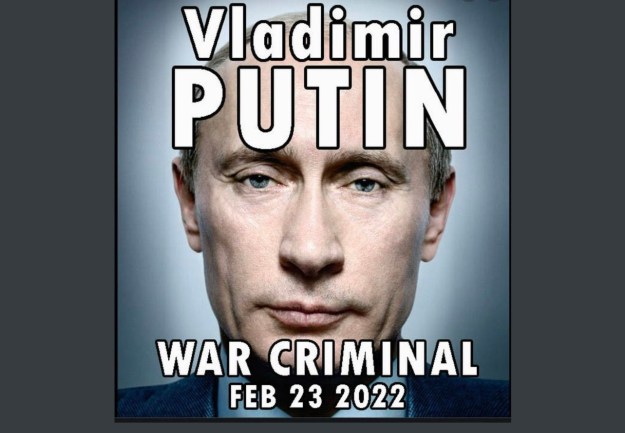
Oh No! Another Biden Gaffe! Or….

The media and, of course, the Republican Party and even some Democrats are having conniption fits over President Biden’s statement about Vladimir Putin at the end of his speech in Poland: ““For God’s sake, this man cannot remain in power.”

Media reports indicate that this was an ad lib, not uncommon for this, or any other, president. Secretary of State Blinken, for example, “clarified” that,

We do not have a strategy of regime change in Russia or anywhere else, for that matter…. In this case, as in any case, it’s up to the people of the country in question. It’s up to the Russian people. [https://nyti.ms/37UHZjc]

To clarify Blinken’s clarification, the United States strategy today is not to take overt actions to push Putin out of power or other terminate his leadership position in Russia. Fine. It has been clear to anyone watching closely that this was the case all along. Neither the United States nor NATO is going to attack Russia to force Putin out. Biden didn’t necessarily say otherwise.

There are several “non-conniption fit” interpretations of Biden’s remark that are worth consideration. One example,

Julianne Smith, the U.S. ambassador to NATO, told CNN’s “State of the Union” that Mr. Biden’s remarks were “a principled human reaction” to the Ukrainian refugees he had met in Warsaw. [https://nyti.ms/37UHZjc]

There are others. One is that it wasn’t an ad lib at all, that it was planned just the way it played out. A signal, you might say, to the Russian oligarchy that their removing Putin by whatever means was fine with the United States. In other words, it was a “Who will rid me of this turbulent priest?” moment. [for those unfamiliar, see https://bit.ly/3DiFBi8] Then, of course, it was “walked back,” as planned. Keep ‘em guessing.

Maybe it was just a kind of prayer for divine intervention. Biden is quite religious so that’s a plausible expression of human angst from him.

Maybe it was just a profoundly humane response to the grief he felt in being with the refugees and so close to unprovoked death and destruction being wrought by the Russian invasion of Ukraine.

I, of course, have no inside knowledge of this situation. Maybe it was just a gaffe. If so, let he who has not gaffed throw the first stone. Then let’s move on.

The Republicans probably won’t. They’ll harp on this as long as the media gives them the play they so desperately want to make the president look bad even as we try to navigate the treacherous path between helping Ukraine stand up to a dictator hell-bent on imprisoning another independent nation while avoiding a nuclear provocation that could end up destroying all life worth living on the planet.

But the media should calm down. Even if Biden were expressing his personal desire that Putin be taken down, the attention to this is overblown and self-defeating. Better to just keep ‘em guessing.


Mind the Words You Read – Part Two

A compelling third example of this issue may be found in the OZY Presidential Brief of October 17. https://bit.ly/2MV1HgE This email newsletter also reports on the Trump-Pelosi encounter:

Trump Has ‘Meltdown Over Syria Criticism

President Donald Trump and House Speaker Nancy Pelosi accused one another of having a “meltdown” during a tense meeting yesterday about the U.S. troop pullout in Syria. Trump, at least, had reason to fume: Amid growing bipartisan anger, two-thirds of House Republicans voted for a resolution condemning his decision, which left the formerly U.S.-backed Kurds open to attack from Turkish forces. Democratic leaders ditched the meeting after Trump reportedly called Pelosi a “third-rate politician.”

The key words, that I bolded in the quote, are “at least,” a usage that in this context clearly implies that Pelosi had no reason to be upset. The deck is subtly stacked in favor of Trump, by suggesting that Trump’s unhappiness about the House impeachment is warranted in some undefined way. The unstated further implication is that Pelosi, the woman in the room, was being unreasonable. The language reinforces the title of the article, further supporting the message that Trump, and only Trump, was justified in having a ‘meltdown,’ removing the implicitly negative implication of the title as regards Trump.

The OZY piece was not labeled “Opinion.” It was presented as a news story. There is no particular reason to think that OZY supports Trump. The writer of this piece may not even be aware of the effect of the language choice.

Finally, another example from the New York Times. https://nyti.ms/32CAV3h Its title is: What, Exactly, Is Tulsi Gabbard Up To? The subtitle is “As she injects chaos into the 2020 Democratic primary by accusing her own party of “rigging” the election, an array of alt-right internet stars, white nationalists and Russians have praised her.” [bolding added]

Clearly there is a lot to unpack here. For present purposes, however, let’s just focus on what is being conveyed. The implication is that Gabbard is “up to” something big — accusing the Democratic Party of “rigging” the primary election. If true, that’s pretty important. Having been thus primed for it, you would expect the presentation of compelling evidence to support those claims.

The “chaos” supposedly being injected by Gabbard consists only of her threatening to boycott the next Democratic debate [she ultimately participated though her poll numbers barely scraped by the threshold]. Other than her apparent attraction for white supremacy groups, detailed in the article, there is no apparent reason to credit her with injecting anything into the debate process. Indeed, “Both Ms. Gabbard and her campaign refused requests for comment about her support in right-wing circles or threat to boycott the debate.” If she won’t talk about it, why is the press making a “thing” of it?

The article speculates that “There is potential upside for Ms. Gabbard: Drawing more attention could energize her donors and perhaps attract more supporters, extending her candidacy’s life span.” But the “attention” seems to be from the media, not from the Democratic Party. In attacking the media and suggesting election rigging, we are seeing a familiar refrain used repeatedly by none other than Donald Trump himself. In a masterful deployment of self-contradictory double-speak and exaggeration, the article says “In a moment marked by fractured politics, Ms. Gabbard’s nontraditional positions are a major part of her appeal for voters seeking to break out of polarized partisan divisions…. she is representing viewpoints that draw support from an array of people in the United States as well as abroad.” How one sees supporting someone claiming election rigging as way out of polarization remains a mystery. And, I remind you, she is polling barely above 2 percent, just enough to squeeze into the debates she is decrying.

But most disturbing is that the article describes the embrace of Ms. Gabbard by the Russian media that were involved in the documented and indisputable 2016 election interference, then, in language reminiscent of the Mueller Report, takes her off the hook with “but there is no evidence of coordination between these networks and the campaign itself.”

Here I remind readers of the truism that “the absence of evidence is not evidence of the absence.” And, whether or not Gabbard’s campaign is in cahoots with Russia, it’s more than a little curious that, using some of the same tropes as Trump in 2016, she has attracted the same support from an adverse foreign power and has not rejected it. Then, the article cites Franklin Graham, described as an “influential evangelist” saying, “This whole thing the Democratic Party has done by putting forward this false idea that there was collusion between Russia and Trump has hurt our relations in a huge way with the Russians.”

That’s the Donald Trump party line. Isn’t it strange that Gabbard’s ardent supporters are repeating the Trump mantra in defending her political position? Is she a Democrat or a Republican? It’s hard to tell from articles like this and her political platform. The article recites her attraction to Middle Eastern dictators, another trait she shares with Trump.

So, you may be asking, where is the evidence of election rigging that was the chaos Gabbard supposedly was injecting into the Democratic debates? There is none, at least not in this article. I remain puzzled as to the true purpose of this article. I understand that it has a byline but that, by itself, does not disqualify it as an attempt at providing news. If we accept it as an opinion piece anyway, what is the opinion? Gabbard is in cahoots with Russians to influence the 2020 election? There is evidence, though not conclusive proof, of that. There is also much “equivalency,” albeit in the form of endorsements from Republican enablers of Donald Trump, like Franklin Graham. It’s a mighty curious thing, all this circling of Republican and Russian wagons around the marginal, barely-alive candidacy of a woman with few actual credentials warranting a nomination for the top executive leadership job in our government. Am I being too hard on her? I don’t think so. It was easy for her to reject the support of David Duke of KKK fame but she still sounds like a Republican and a Trump Republican at that.

********

As consumers of political reporting and commentary, we must remain constantly on guard against priming, framing and other psychological biases that work their way into the language of journalism. Taken to extremes, these techniques amount to ‘gaslighting’ which is defined as,

a tactic in which a person or entity, in order to gain more power, makes a victim question their reality.… Anyone is susceptible to gaslighting, and it is a common technique of abusers, dictators, narcissists, and cult leaders. [https://bit.ly/2Ep8mJV]

Over time, gaslighting erodes the public sense of what is trustworthy and leads to false equivalencies being accepted for blatantly untrue claims such as Trump’s claim that there were good people on both sides of the conflict in Charlottesville between pro-Nazi and anti-Nazi groups. Gaslighting eventually wears down people’s resistance to lying. Google “effect of indifference in politics” and you’ll begin to get an idea of how serious this is.

Mueller Report Part II – Trump Guilty of Obstruction of Justice-E

E. Mueller’s Inexplicably Generous Treatment of Trump’s Knowledge of Events

Another of the remarkable and unexplained conclusions reached by Mueller was that the evidence of Trump’s knowledge about Flynn’s lies about Kislyak was inconclusive. II MR-46. This conclusion seems flatly inconsistent with Trump’s statement to Christie that firing Flynn ended the Russia collusion issue.  II MR-38. We are asked to believe that Flynn told McFarland that his contacts with Kislyak had averted a major policy conflict with Russia but she did not pass that on to Trump! And that neither she nor Bannon could remember this major development! This is yet another example of Mueller’s lack of aggressive approach to Trump. WHY didn’t the SCO interview Trump to get at answers to these critical questions instead of saying they had enough evidence and it was late in the investigation? It is also unclear why it mattered so much whether Trump knew about Flynn’s deception close to the time the Kislyak talks occurred.

Even more puzzling is Mueller’s conclusion that Trump’s effort to get K.T. McFarland to write an internal email saying that Trump did not direct Flynn to talk to Kislyak was not an attempt to have McFarland lie. II MR-48. What then was Trump trying to get McFarland to do?  What is the alternative explanation for Trump’s request of her? This is another example where evidence of corrupt intent is simply written off as “insufficient” without explanation. IF SCO had interviewed Trump, questions like this could have been resolved instead of being left open and then construed as exonerating Trump.

A similar problem arises regarding Trump’s campaign to have Attorney General Jeff Sessions un-recuse himself regarding the Russia investigation. In a footnote Mueller says it was unclear that Trump was aware of White House counsel’s admonition not to contact Sessions. II MR-50, n. 289. Why isn’t Trump chargeable with constructive knowledge of WH counsel’s directive? Trump declined to read documents — does that relieve him of responsibility for knowing what was official White House policy that had been put in writing?  Moreover, if the SCO had interviewed Trump, it could have gotten answers to these questions left open and ultimately construed in Trump’s favor on grounds that the evidence did not show he knew something that, on a common sense view, he almost certainly did know.

Mueller’s generous treatment of Trump continued in the discussion of Comey’s briefing of the Gang of Eight legislators in March, 2017, about the Russia investigation. Mueller said it’s “unclear” whether Trump knew about the briefing at the time, but notes taken by McGahn’s chief of staff say that “POTUS in panic/chaos.” II MR-52. How/why would Trump be in a panic if he didn’t know about Comey’s briefing of Congressional leaders? How could the president be ignorant of such developments that might have such huge impacts on his presidency and to which he had devoted so much attention in the past few months?

 The Comey briefing led to one of the clearest cases of obstruction of justice, in that Trump demanded, and McGahn complied, that McGahn contact Dana Boente, then acting assistant attorney general at Justice, to publicly correct the “misperception” that Trump was under investigation. II MR-54,55. Once again, Trump insiders had failed memories of demands Trump made for intervention with the Department of Justice. II MR-5. And, there is no attempt to explain inconsistencies in other testimony from some of the same insiders, claiming Trump never ordered them to do anything wrong. These statements from NSA Director Rogers are inconsistent with the contemporaneous memo of the President’s call and of NSA Deputy Director Ledgett’s characterization of the extraordinary nature of the call. II MR-56. Why is there no consideration of these inconsistencies?

When Trump then reached out directly to Comey to ask him to relieve the impression Trump was under investigation, the Report, unbelievably, turns to McGahn’s asserted recall of what Dana Boente told him Comey had told Boente about Trump’s contacts with him. II MR-59.  As usual, Boente claimed not to recall this discussion. II MR-60.

Then, in one of the most remarkable moments in the Report, Mueller drops into a footnote (II MR-59, n. 376) the reminder that White House counsel had advised Trump not to contact DOJ about the investigation. Mueller seemingly attached no significance to the extraordinary & undisputed fact that Trump on multiple occasions ignored the advice of his White House attorneys by reaching out directly to Comey to discuss relieving the pressure of the Russia investigation. WHY? This was not the conduct of an innocent man.

Mueller seemed to be impressed with the fact that the people involved claimed that they did not interpret Trump’s repeated importunings as “directives” to interfere in the investigation. II MR-60. These people were all Trump appointees and true believers in his politics, who would naturally seek to maintain favor with him by declining to interpret his repeated requests as “directives.” In any case, the real question is not what they thought, but what Trump intended and the only way to get to the bottom of that ultimately was to interrogate him, which SCO, curiously, declined to demand. Trump’s attempts to secure a champion at DOJ included personal contacts with Coates, Pompeo, Rogers and Comey. Despite that, Mueller, with his usual reticence to accept the obvious, concludes that “the evidence does not establish that the President asked or directed intelligence agency leaders to stop or interfere with the FBI’s Russia investigation.” II MR-60.

The same question arises in connection with Trump’s multiple attempts to prevent AG Sessions from recusing himself from oversight of the Russia investigation. A couple of things are clear. Trump thought the AG worked for him personally and therefore that Sessions should remain in place to do Trump’s bidding regarding the investigation. And, White House counsel tried to cut off communications with Sessions about recusal to avoid the appearance of attempted interference with the investigation. Yet, once again, Mueller states it was “not clear” that the “no contact” directive was conveyed to Trump. II MR-61. HOW is it remotely plausible that White House counsel, in a matter of seminal importance, would not have conveyed this information to the one person whose knowledge of it and compliance was the most important? Why didn’t the SCO demand Trump answer this question? He refused to do so even in writing and the SCO let him get away with it!

Mueller repeatedly and uncritically refers to Trump’s asserted belief that the Russia investigation was somehow interfering with, Miller his ability to conduct foreign policy but never discussed how that interference worked or what real impact it had on a president who, by all accounts, spent most of his time watching television and playing golf. II MR-61.

Another point of clarity in the Report is the finding that Trump lied about the basis for firing Comey. II MR-62. Why would he do that except to cover up his corrupt motive to which he shortly confessed? Trump’s lies about his conduct, in the context of his other actions, were a clear case of cover-up that could have been treated as a separate offense by Mueller if he had the aggressive instincts of a prosecutor rather than the timidity of an equivocator.

A related question – why was Stephen Miller not indicted for his role in preparing a phony letter to cover Trump’s tracks regarding the firing of Comey? II MR-64. Another related question: the final stated reason for firing Comey was pretextual. All Trump cared about was establishing that he was not under FBI investigation and that he was firing Comey because Comey refused to say that publicly. The Rosenstein/Sessions memo was constructed as an alternate explanation that Trump then adopted while still insisting, against advice, that the point about his not being under investigation be prominently included in the firing letter. II MR-67. Yet, again, no indictments were brought against any of the president’s men for conspiring and lying to cover the tracks of a discharge action plainly intended to obstruct the FBI investigation. See, e.g., II MR-70 regarding lies told by Sean Spicer, then Press Secretary about the motivation for the Comey firing.

Mueller basically gave a pass to all Trump’s enablers who accepted and acted on his directions. Michael Cohen, in later testimony before Congress, spoke specifically about how Trump rarely gave specific directions for anything. He spoke in “code,” that Cohen claimed he understood. It is beyond credibility that, by the time of Comey’s firing, the president’s men did not also understand how he “directed” what he wanted done, what he insisted upon, without ever explicitly saying so. Mueller appears to have completely overlooked this aspect of Trump’s directorial style, crediting him with innocence because there was no overt statement by him that amounted to a confession. In the future, then, Trump’s enablers have no reason to fear repercussions when they willingly follow his non-order orders.

Further evidence of Mueller’s timidity may be found in his ultimate conclusion that “the anticipated effect of removing the FBI director … would not necessarily be to prevent or impede the FBI from continuing its investigation.” II MR-74. That astonishing statement shows Mueller going out of his way to avoid the overt implications of evidence regarding Trump’s actions that were, by Trump’s own admission, intended to interfere with the Russia investigation. Why else would he have fired Comey and handled the firing as he did, including conspiring to give the impression that Rosenstein/Sessions were responsible for the firing? A seasoned prosecutor like Mueller surely knew better, but falls all over himself in avoiding the plain implications of Trump’s conduct. Moreover, even if the investigation would have been unfazed by Comey’s firing (and thus completely ignored by the surviving DOJ attorneys), the clear intent of the discharge was proven and, as Mueller’s own statement of the governing legal tests showed, an attempt to obstruct does not have to be successful to violate the criminal law.

Curiously, the Report takes a somewhat different approach to assessing evidence of Trump’s intentions when it addresses Trump’s attempts to have the Special Counsel removed. II MR-84 thru MR-90. This may be the result of superior clarity of the evidence but this is not apparent from the Report language. One explanation may be that the “committee” of lawyers that drafted the Report were assigned different sections and that each one had a different approach. The analysis highlights the fact that Trump lied publicly about whether he had tried to have Mueller removed, an approach Trump had taken to other issues but which led to Mueller equivocating about the strength of the evidence. II MR-90.

It is a fair question as to why Mueller did not indict Cory Lewandowski whom Trump chose as the go-between to direct AG Jeff Sessions to publicly speak about the unfairness of the SCO investigation and to limit its authority to future elections only. The recited evidence clearly shows that both Chief of Staff Kelly and Lewandowski himself were well aware of the impropriety of Trump’s demands and took actions to conceal his conduct from exposure. II MR 91-93 & n. 604.

Regarding the infamous Trump Tower meeting, the evidence is clear that Trump took overt actions to cover up the situation. II MR-98 to MR-107. Yes, Mueller concludes that Trump’s actions were merely part of a press strategy and not an effort to affect the SCO investigation or the related work of Congressional investigations. This is an astonishing judgment when the SCO allowed Trump to avoid testifying and be examined about this subject. It is therefore impossible to conclude that these obstructive acts did not occur. Moreover, Trump clearly acted dishonestly regarding disclosure of the information and created a misleading paper trail that could have affected decisions at SCO about what to do regarding the Trump Tower meeting. Mueller resolved all doubts in favor of Trump even in face of evidence of his lies and duplicity regarding the issue at hand.

Other instances of Mueller’s resolving doubts in favor of Trump or his people involved Trump’s effort, using his personal counsel, to have McGahn publish a statement denying that Trump had asked him to fire Mueller. Mueller resigns to a footnote and fails to explain the conflict between Hope Hicks & Gen. Kelly regarding whether the McGahn resistance story was correct. II MR-114, n. 788. Kelly, Sarah Sanders and Rob Porter all experienced memory failure regarding aspects of Trump’s demands and denials about trying to get McGahn to fire Mueller. Trump, of course, remorselessly lied to his own staff about what he had said. II MR-115. He continued to press McGahn to “correct” stories that ” McGahn repeatedly told Trump, and others, was accurate as written. II MR 116-117. Mueller resorts to the gentlest possible language when describing these activities, using phrases such as “runs counter to the evidence” as opposed to the more precise “he lied.” II MR-118.

Rob Porter played a direct role in delivering Trump’s demands to McGahn (II MR-116) but, without explanation, was not indicted for conspiracy to obstruct justice.

Mueller Report Part II – Trump Guilty of Obstruction of Justice-A

In many ways, the obstruction of justice issue is the easiest to understand. But, among other factors, because the Attorney General, a Trump appointee, took it upon himself to assert publicly conclusions that the Mueller Report plainly did not reach, the question has been clouded in the public mind. Republican lackies for the president, and the President himself, continue to repeat the AG’s lies about the Report.

The following analysis will endeavor to tell the truth about the Mueller Report and to ask fair questions that remain in the Report’s wake and as a result of Mueller’s refusal to speak about the substance of the Report.

A. Declining to Decide – Why Was This Not Disclosed at the Outset?

The Report opens with a summary statement of five major-impact concepts that shaped the investigation and the Report as its outcome (the Report says there are only four, but a careful reading indicates five).

  1. The Office of Special Counsel (OSC) accepted the 2000 Justice Department legal conclusion that a sitting president could not be indicted – the Report refers to this as a limitation on “prosecutorial jurisdiction;” II MR 1.
  2. The OSC believed, independent of the Justice Department’s opinion about constitutional constraints, indictment of the sitting president would “place burdens on the President’s capacity to govern and potentially preempt constitutional processes for addressing presidential misconduct.” II MR 1.
  3. Investigation is nonetheless permitted during the presidential term, immunity does not follow the person after presidential service is over and, very importantly: “if individuals other than the President committed an obstruction offense, they may be prosecuted at this time.” II MR 1.
  4. The OSC decided not to apply an “approach that could potentially result in a judgment that the President committed crimes” because it would be unfair to make such findings when the opportunity for a speedy trial on the charges would not be possible. II MR 2
  5. Notwithstanding (4) above, if the OSC concluded that the president did not commit crimes, it would have so stated, but it could not so state based on the evidence developed; therefore, the Report neither accuses nor exonerates the president. II MR 2

These introductory words in the Report raise many questions, among them:

  1. If the SCO knew at the outset that it would not issue indictments, why was this not disclosed at the beginning?
  2. I will go into this in much more detail later, but given the overwhelming evidence that Trump engaged in multiple acts of obstruction, why was not a single person indicted from his staff, his cabinet and in the Republican Party that supported his every falsehood and deflection?
  3. How was the investigative approach altered to assure that a “judgment that the President committed crimes” was not the result?
  4. Why was the Special Counsel prepared, if the evidence supported it, to publish a conclusion that the president was innocent of obstruction while being unwilling/unable to publish a conclusion that crimes were committed even if the evidence overwhelmingly supported that judgment? In light of this, the worst that the president could have faced was a finding that the evidence did not exonerate him. Considering that the alternative, an indictment, was never a possibility, Trump easily could see the outcome as a victory. And he did. And it appears that, at least in that sense, this was inevitable. The deck was stacked in Trump’s favor from the beginning.
  5. Was Mueller’s “no finding of innocence” a kind of double wink, saying, in effect, “my hands were tied, but here’s the evidence for Congress to make the obvious conclusion of guilt and impeach? Maybe, but that seems pretty naïve considering that, until the 2018 mid-term elections, Republicans controlled both houses of Congress and still control the Senate.

I’m not going to go into the details here, but I studied the entire 2000 Justice Department opinion finding that indictment of a sitting president is unconstitutional and it is remarkable in its presumption of undemonstrated facts. It employs extreme language when discussing the presumed burden on the president of having to defend an indictment while in office and seems to be written more to justify a pre-determined result than to analyze the situation neutrally. Like the Mueller investigation itself, the 2000 OLC opinion, like the 1973 opinion that it confirms, seems to have a pre-ordained outcome. Considering that the current occupant of the White House spends little time actually doing presidential work, the overblown language of the OLC opinions rings hollow, turning, as it does, entirely on the presumed interference with presidential responsibilities of the obligation to defend criminal charges.

Turning to the matter at hand, the Mueller Report begins with a summary of the “issues and events” that were examined for obstruction evidence. It includes:

(1) Trump’s lies about his business interests in Russia;

(2) Michael Flynn’s lies about his contacts with Russian Ambassador Kislyak;

(3) Trump’s attempt to extract loyalty commitments and a pledge to leave Flynn alone from then FBI Director Comey;

(4) Trump’s attempt to direct his Deputy National Security Advisor (K.T. McFarland) to produce a letter falsely stating the president had not directed Flynn to discuss U.S. sanctions with Kislyak (why would Trump try to manufacture evidence that he was innocent of soliciting help from Russia if he were innocent?);

(5) Trump’s attempt to prevent Attorney General Jeff Sessions from recusing himself regarding the Russia investigation;

(6) Trump’s attempt to use U.S. intelligence officials and again the FBI Director to make public statements exonerating him from involvement in Russian election interference;

(7) Trump’s firing of FBI Director Comey for the expressed purpose of relieving himself of the Russia investigation;

(8) Trump’s manipulation of the Comey firing letter to make it appear the firing was based on DOJ recommendations when in fact Trump had decided to fire Comey before hearing from DO;

(9) Trump’s attempt to have White House counsel tell the Acting Attorney General that the Special Counsel had conflicts of interest and must be fired;

(10) Trump’s attempt to limit Special Counsel to investigating future election meddling;

(11) Trump’s false narrative about the origins of the Trump Tower meeting, including repeated false denials by his personal attorney that Trump had any role in Trump Jr’s statement about the meeting;

(12) Trump’s attempts to pressure Sessions into un-recusing regarding the Russia investigation;

(13) Trump’s attempts to have White House counsel McGahn falsely state that Trump had not ordered him to have the Special Counsel removed; and

(14) Trump’s attempt to influence testimony from Flynn, Manafort and Cohen, including involvement by Trump’s personal attorney.

The Report then went through a most curious “on the one hand, on the other hand,” regarding Trump’s possible motives for interfering in the SCO investigation, defined by the point at which Trump became aware that he was personally under investigation. Mueller referred to these as “overarching factual issues.” II MR-7. Mueller expressed concern that some of Trump’s actions were within his Article II authority and that his motives should be judged in light of the fact that the investigation found no underlying crime in the Russia investigation, even though such a finding was unnecessary and despite the fact that Trump acted, throughout the entire period, as if he were guilty. II MR-7. Here, Mueller seems to have forgotten his own admonition that the absence of discovered evidence of participation in Russian interference was not proof that no such participation occurred. Finally, Mueller cites the fact that some of Trump’s allegedly obstructive conduct took place in public, although, again, the harm done would be the same for public as for secretive obstructive acts. II MR-7.

My sense of this odd insertion into the Report is that Mueller is revealing a disinclination to hold the president to account when he can’t indict. He is, in effect, gilding the lily in favor of Trump. However, in next analyzing various defenses asserted by Trump’s attorneys, Mueller concludes, correctly I think, that the corrupt use of Article II powers is not immune conduct. Mueller notes that the requirement of corrupt intent is a high standard and “requires a concrete showing that a person acted with an intent to obtain an improper advantage for himself or someone else, inconsistent with official duty and the rights of others.” II MR-8.

In the end, Mueller reaffirms the “principle that no person is above the law.” II MR-8. The Report then also concludes that based on the evidence adduced, the SCO could not find that the president committed no obstruction of justice crime. Therefore, although forbidden by policy from stating the prosecutorial conclusion that crimes were committed, the Report “does not exonerate him.” II MR-8.

Despite the clarity of that conclusion, the sitting Attorney General and then Trump himself concluded that the Report did exonerate him. Those statements by the AG and the President were false. The AG also said that he had independently evaluated all the evidence underlying Mueller’s Report and that he, the AG, had concluded that there was no evidence to support a finding of criminal conduct by the president. All that need to said about that is it is extremely unlikely that the AG personally was able to review the entirety of the evidence gathered by Mueller’s team in the time the AG had with the draft report. In making these claims, the AG stepped out of his role as Attorney General of the United States and acted as if he were Trump’s personal attorney defending him against Mueller. Barr’s conclusions should be discounted completely since they conflict with the evidence disclosed in the Report that clearly and strongly demonstrates that Trump did commit obstruction of justice on multiple occasions.

MUELLER REPORT PART I – TRUMP CANOODLING WITH RUSSIA – A

A. Collusion vs. Conspiracy – Setting a High and Unnecessary Threshold of Proof

The investigation focused on conspiracy law because “collusion” is not in a term used in the governing criminal law. That fact may explain why Trump constantly refers to collusion in defending his conduct. While it’s technically true that the Report did not find “collusion” between the Trump Campaign and the Russian Government, the Report did not make a lot of other findings because they were equally as irrelevant as “collusion.”  For example, the Report did not find that Donald Trump is a generous person who readily contributes substantial amounts of his claimed fortune to charitable causes. Such a finding would have been (a)  untrue and (b) utterly irrelevant to the matters under investigation.

On the relevant issue of conspiracy, the Report focused on “coordination” as a factual question — limited to whether an “agreement — tacit or express — between the Trump Campaign and the Russian government” existed during the Campaign or the transition. Why Mueller thought this limitation was essential to the investigation and to any charging decisions is never explained.

It was entirely possible for the Trump Campaign to “coordinate” without an “agreement” to do so. Given Mueller’s expressed conclusion that the Campaign expected to benefit from information stolen by the Russians and the clearly established fact that high-ranking members of the Trump Campaign and family actively sought “dirt” possessed by Russia on the Clinton candidacy, “coordination” within the meaning of the conspiracy laws should not turn on the existence of an “agreement,” tacit or otherwise.

Framing the problem as Mueller did sets a bar so high that a successful investigation was likely impossible. As bad as Russia’s demonstrated electoral interference was, it was entirely feasible that “coordination” by the Trump Campaign with the Russian activities could have been accomplished without anything resembling an “agreement” between the Campaign and the Russian government. Mueller owes an explanation of why the existence of an agreement was essential to a finding of conspiracy. Would mere knowledge of what the other side was doing suffice to establish such an “agreement?” Mueller apparently thought not, but the underlying reasoning for such a counter-intuitive judgment is missing. Conspiracies are typically very hard to prove, but there was no apparent or compelling reason to get the bar so high.

Although Russians masked their operation while conducting political rallies and in doing so “made contact with…Trump campaign officials,” Mueller says the investigation uncovered no evidence of “coordination.” I-MR 4 This cries out for elaboration. Which rallies and which campaign officials? When? Are we to believe that the Trump campaign worked with unknown parties to stage political rallies and never bothered to find out with whom they were working?

A related curiosity is the question of timing the decision to end the investigation. The Report notes (I-MR 14) that the Russians masked their identity in communications with the Trump Campaign but some of those contacts are still under investigation. Per Appendix D at I-MR D-1 thru D-6, there may be as many as 14 additional investigations pending but no details or clues are provided regarding their targets or subject matter. The massive redactions from I-MR 14 to I-MR 37 suggest that the primary subject matter may be Russian interference in the election unrelated specifically to possible coordination with the Trump Campaign, but, if so, this should be clarified.

The Report says Russians released hacked materials about Clinton through Wikileaks (I-MR 4), thus implicitly indicating that Julian Assange conspired with the Russians. Mueller concedes the SCO was unable to resolve the connection between the release of the Trump “grab ‘em” tape and the same-day release of WikiLeaks documents harmful to Clinton. I-MR 36. But what was Assange’s relationship to the Trump Campaign? This is not elaborated in the Report.

 Trump personally welcomed help from WikiLeaks and the Russians. He later claimed he was speaking sarcastically, but when, in relation to investigation steps, did he make the sarcasm claim?  This is a common Trump tactic – make a dog whistle statement followed by “I was just joking” when blowback ensues.

In June 2016 a Redacted Party predicted to the Trump Campaign that WikiLeaks would release info damaging to Clinton. I-MR 5. There is more here that needs explanation to sustain the conclusion that there was no evidence of coordination.

The Report portrays the involvement of Russia and Trump Campaign’s response as having same goals – each would benefit from the other’s success – but Mueller nonetheless concludes that throughout the entire campaign, the parties somehow operated independently, though in parallel, to each other’s activities without any coordination. I-MR 5. He also concluded that Trump Campaign people did not understand they were dealing with Russians, I-MR 35, an idea that conflicts directly with the documentary prelude to the infamous Trump Tower meeting at which high Campaign officials attended in explicit expectation of receiving stolen negative information about Hillary Clinton.

During 2016, George Papadopoulos, while working for the Campaign, tried to arrange meetings to follow up information from Joseph Mifsud (identified by Mueller as a Russian agent) that Russia had dirt on Clinton. While no meetings may have resulted, why weren’t Papadopoulos’s activities at a minimum “attempts to coordinate” Is it plausible that he acted entirely on his own without communicating with other Campaign officials? What specific efforts were made to track down this crucial information? Why isn’t this covered in detail in the Report?

Indeed, why was the Trump Tower meeting not, by itself, a clear attempt to coordinate with Russia?  The information offering may have been a ruse but Campaign leaders didn’t know that and attended in expressed hopes of getting dirt on Clinton. They walked out only when the hoped-for dirt was not proffered. It’s pretty clear from the email history that if the dirt had been produced, it would have been accepted and not reported to the FBI.

Similarly, Carter Page was ousted from Campaign only after media attention drawn to his Russian connections. I-MR 6 If there had been no media attention, is there evidence the Campaign would have removed Page? Nothing in the Report suggests this would have occurred. Was there not more evidence of Page’s connections to Russia and, therefore, likely attempts to coordinate with it in support of Trump’s campaign?

Paul Manafort, then Trump Campaign Chairman, was also meeting with Konstantin Kilimnik, who had Russian intelligence contacts.  They discussed campaign strategy, including swaying Democratic voters in Midwest. Manafort shared polling data. I-MR 7 WHY is this not coordination even by Mueller’s limited definition? At the time Manafort was the trusted head of the Campaign. Why would his conduct not have been attributed to the Campaign? Why was this not addressed in the Report?

Next: Involvement of WikiLeaks –Gaping Holes & Unresolved Issues

Semi-Final Thoughts on Mueller Report

Donald Trump and his enablers are jumping around like a bucking bronco that has just thrown its rider. This is to be expected. Supporters of the president are calling for revenge against those who questioned the president’s patriotism. Also to be expected from that crowd.The Trump gang does not, of course, care a whit about propriety as long as they win. Whether they have won remains to be seen, however.

I say that for several reasons, not least of which is the stunning revelation that Mueller’s team met with the Attorney General three weeks ago and disclosed that Mueller would make no finding on the obstruction of justice issue. Small wonder, then, that Barr/Rosenstein were able to absorb the entire Mueller report and provide their own crucial conclusion on obstruction (i.e., no obstruction) that Mueller had, on the evidence, declined to make.

Speaking of wonder, one must wonder now what else transpired during that meeting. Did Mueller’s people provide the AG with some or all of the evidence accumulated during the investigation? Apparently they did, because it would otherwise be impossible for Barr/Rosenstein to arrive at the conclusion of “no obstruction” as quickly as they did after Mueller’s report was “officially delivered” on Friday. This would also explain how an as yet unnamed “high official” at DOJ knew immediately after the report was delivered that there were no further indictments forthcoming.

If this is true, why was it done? I had originally thought it most likely that the Mueller report itself was just a summary, making the Barr/Rosenstein letter to Congress a summary of a summary, in which case Barr/Rosenstein wouldn’t have cared what the evidence was. Likely they don’t care anyway, but it is difficult to understand why Mueller would have provided a briefing to Barr/Rosenstein three weeks before releasing the report. Are we to believe as well that Barr/Rosenstein did not communicate the revelation to Trump before the DOJ letter was sent to Congress? It’s possible but if it were communicated in advance, we would have a hint as to why Trump was so suddenly down with the idea of pubic disclosure of the report.

All this is somewhat speculative, of course, but Mueller did the country no favors with these maneuvers. New questions arise at every turn. I confess that I decided early on not to watch the media circus of speculation and instant analysis that the Barr/Rosenstein letter inevitably created.

The ultimate question here – what role did Trump and his associates (family as well as hired hands) play in the documented Russian attempts to influence the 2016 election – will only be settled if and when the evidence on which Mueller relied is laid out for the public to digest. How much credence did Mueller give to Trump’s own statements and conduct in light of his refusal to be interviewed? It seems that Mueller discounted Trump’s own statements (Holt interview) about why he fired James Comey. If so, why did Mueller discount that evidence on both the collusion issue and the obstruction issue? Very importantly, how did Mueller square the Trump Tower meeting and Trump’s role in lying about its purpose with the conclusion that there was no collusion?

Was the no-collusion finding based on a lack of hard evidence such that Mueller, applying a strict beyond-a-reasonable doubt standard as a jury would do, felt no crime could be charged? To what extent did Mueller use the standard of probable cause in evaluating the evidence against Trump on collusion?

I could go on with this but it is pointless unless and until the full Mueller report and the evidence on which it was based are disclosed. Given the revelation of an undisclosed meeting between Mueller and DOJ leadership weeks ago at which Mueller’s findings were disclosed, such disclosure is essential if this sordid chapter of American history is to be put to rest.